

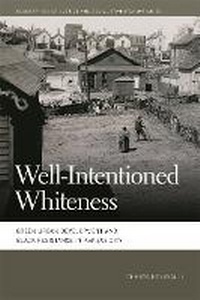
Well-Intentioned Whiteness
Green Urban Development and Black Resistance in Kansas City
Published on 15. April 2023
Book
Hardback
242 pages
978-0-8203-6408-7 (ISBN)
Description
This book documents how whiteness can take up space in U.S. cities and policies through well-intentioned progressive policy agendas that support green urbanism. Through in-depth ethnographic research in Kansas City, Chhaya Kolavalli explores how urban food projects-central to the city's approach to green urbanism-are conceived and implemented and how they are perceived by residents of "food deserts," those intended to benefit from these projects.
Through her analysis, Kolavalli examines the narratives and histories that mostly white local food advocates are guided by and offers an alternative urban history of Kansas City-one that centers the contributions of Black and brown residents to urban prosperity. She also highlights how displacement of communities of color, through green development, has historically been a key urban development strategy in the city.
Well-Intentioned Whiteness shows how a myopic focus on green urbanism, as a solution to myriad urban "problems," ends up reinforcing racial inequity and uplifting structural whiteness. In this context, fine-grained analysis of how whiteness takes up space in our cities-even through progressive policy agendas-is more
important. Kolavalli examines this process intimately and, in so doing, fleshes out our understanding of how racial inequities can be (re)created by everyday urban actors.
Through her analysis, Kolavalli examines the narratives and histories that mostly white local food advocates are guided by and offers an alternative urban history of Kansas City-one that centers the contributions of Black and brown residents to urban prosperity. She also highlights how displacement of communities of color, through green development, has historically been a key urban development strategy in the city.
Well-Intentioned Whiteness shows how a myopic focus on green urbanism, as a solution to myriad urban "problems," ends up reinforcing racial inequity and uplifting structural whiteness. In this context, fine-grained analysis of how whiteness takes up space in our cities-even through progressive policy agendas-is more
important. Kolavalli examines this process intimately and, in so doing, fleshes out our understanding of how racial inequities can be (re)created by everyday urban actors.
Reviews / Votes
Chhaya Kolavalli's new book is a richly evocative 'insider ethnography' tracing local food policy from its ideological roots in white supremacy and the logics of settler colonialism to its critical role in shaping Kansas City's contemporary racialized landscapes. Her chapters carefully document the role of upper-middle class, white foodie culture in shaping food policy for a city seemingly obsessed with green urban development, including hundreds of farmers markets, urban orchards, school and community gardens, and a thriving farm-to-table culinary scene. How green urban development policy targeting historically 'blighted' (read: Black) urban neighborhoods is pitted against individual and community agency grounded in longstanding historical geographies of food practice and agricultural experience. The Kansas City case is impeccable and a methodological model. The lessons transcend Kansas City and will fascinate anyone interested in green urban development, green gentrification, urbicide, food policy, Black agency, and the insidious consequences of and challenges to white hegemony and white supremacy in the American urban landscape. -- Richard Schein, professor of geography at the University of Kentucky Well-Intentioned Whiteness presents an interesting and needed analysis of racial dynamics in the dominant alternative food movement situated in a U.S. city beyond than the coastal cities that have been the focus of much urban food systems scholarship. . . . This type of analysis is important in broadening awareness of the problematics of white dominance in the food system and moving toward more equitable realities. -- Kristin Reynolds * coauthor of Beyond the Kale: Urban Agriculture and Social Justice Activism in New York City * As Kolavalli warns, even when our intentions are good-whether to ensure no one is food insecure or to grow more local food in the city-(attempts at) colorblindness and race avoidance simply uphold and allow race- and class-based inequities to expand and worsen. -- Lesli Hoey, Alex Bissell, Sukhmony Brar, Frankie Douglass, Coco Rios Escobar, Nia Dubon-Robinson, Shwetha Govindan, Jon Kent, Kenneth Mathews, Taylor Kaili McKenzie, and Lunia Oriol * Journal of the American Planning Association *More details
Series
Language
English
Place of publication
Georgia
United States
Target group
Professional and scholarly
Product notice
Paper over boards
Illustrations
4 Maps; 4 Maps; 4 Maps; 4 Maps; 4 Maps; 4 Maps; 4 Maps; 4 Maps
Dimensions
Height: 229 mm
Width: 152 mm
ISBN-13
978-0-8203-6408-7 (9780820364087)
Copyright in bibliographic data and cover images is held by Nielsen Book Services Limited or by the publishers or by their respective licensors: all rights reserved.
Schweitzer Classification
Other editions
Additional editions
Chhaya Kolavalli
Well-Intentioned Whiteness
Green Urban Development and Black Resistance in Kansas City
E-Book
04/2023
University of Georgia Press
€34.49
Available for download
Person
CHHAYA KOLAVALLI is a senior program officer for knowledge creation and research in entrepreneurship at the Ewing Marion Kauffman Foundation (though the views in this book do not necessarily reflect the views of the foundation). Her articles can be found in Gastronomica, Human Organization, and the Journal of Agriculture, Food Systems, and Community Development.