

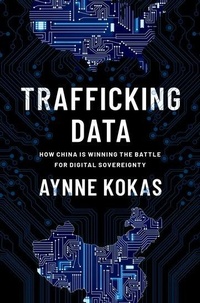
Trafficking Data
How China Is Winning the Battle for Digital Sovereignty
Published on 1. November 2022
Book
Hardback
360 pages
978-0-19-762050-2 (ISBN)
Description
From TikTok and Fortnite to Grindr and Facebook, Aynne Kokas delivers an urgent look into the technology firms that gather our data, and how the Chinese government is capitalizing on this data flow for political gain.
On August 6, 2020, the Trump Administration issued a ban on TikTok in the United States, requiring that the owner, Beijing-based Bytedance, sell the company to American investors or shut it down. Legions of TikTokers were devastated at the possible loss of their beloved platform, and for what: a political grudge with China? American suitors like Walmart and Oracle tried to make a deal with Bytedance to keep the platform operating in the US. But then something curious happened. The Chinese government refused to let Bytedance sell TikTok on national security grounds. As it turns out, the pandemic era platform for dance challenges is a Chinese government asset.
As digital technologies and social media have evolved into organizing forces for the way in which we conduct our work and social lives, the business logic that undergirds these digital platforms has become clear: we are their product. We give these businesses information about everything--from where we live and work to what we like to do for entertainment, what we consume, where we travel, what we think politically, and with whom we are friends and acquaintances. We do this willingly, but often without a full understanding of how this information is stored or used, or what happens to it when it crosses international boundaries. As Aynne Kokas argues, both corporations and governments "traffic" much of this data without our consent--and sometimes illegally--for political and financial gain.
In Trafficking Data, Aynne Kokas looks at how technology firms in the two largest economies in the world, the United States and China, have exploited government policy (and the lack thereof) to gather information on citizens, putting US national security at risk. Kokas argues that US government leadership failures, Silicon Valley's disruption fetish, and Wall Street's addiction to growth have fuelled China's technological goldrush. In turn, American complacency yields an unprecedented opportunity for Chinese firms to gather data in the United States and quietly send it back to China, and by extension, to the Chinese government. Drawing on years of fieldwork in the US and China and a large trove of corporate and policy documents, Trafficking Data explains how China is fast becoming the global leader in internet governance and policy, and thus of the data that defines our public and private lives.
On August 6, 2020, the Trump Administration issued a ban on TikTok in the United States, requiring that the owner, Beijing-based Bytedance, sell the company to American investors or shut it down. Legions of TikTokers were devastated at the possible loss of their beloved platform, and for what: a political grudge with China? American suitors like Walmart and Oracle tried to make a deal with Bytedance to keep the platform operating in the US. But then something curious happened. The Chinese government refused to let Bytedance sell TikTok on national security grounds. As it turns out, the pandemic era platform for dance challenges is a Chinese government asset.
As digital technologies and social media have evolved into organizing forces for the way in which we conduct our work and social lives, the business logic that undergirds these digital platforms has become clear: we are their product. We give these businesses information about everything--from where we live and work to what we like to do for entertainment, what we consume, where we travel, what we think politically, and with whom we are friends and acquaintances. We do this willingly, but often without a full understanding of how this information is stored or used, or what happens to it when it crosses international boundaries. As Aynne Kokas argues, both corporations and governments "traffic" much of this data without our consent--and sometimes illegally--for political and financial gain.
In Trafficking Data, Aynne Kokas looks at how technology firms in the two largest economies in the world, the United States and China, have exploited government policy (and the lack thereof) to gather information on citizens, putting US national security at risk. Kokas argues that US government leadership failures, Silicon Valley's disruption fetish, and Wall Street's addiction to growth have fuelled China's technological goldrush. In turn, American complacency yields an unprecedented opportunity for Chinese firms to gather data in the United States and quietly send it back to China, and by extension, to the Chinese government. Drawing on years of fieldwork in the US and China and a large trove of corporate and policy documents, Trafficking Data explains how China is fast becoming the global leader in internet governance and policy, and thus of the data that defines our public and private lives.
Reviews / Votes
A timely engagement with debates on the extraction, commodification and protection of data amidst sharpening US -- China tech relations. This volume, given its accessible writing style, might be of interest to students of data governance, communication industries and international relations. * Chenhao Ye, The China Quarterly * In Trafficking Data, Kokas walks us through the most recent trade-offs, Faustian bargains, and back door dealings that Silicon Valley firms use to do business in the People's Republic of China. Only by empowering consumers and holding technology affirms accountable, Kokas argues, can we stifle the international trafficking of our data. * Philip N. Howard, Director, University of Oxford's Programme on Democracy and Technology * China's digital platforms are well known, but Aynne Kokas is the first to study systematically the interactions between the digital products of US techno-liberalism and China's state-directed social order. Trafficking Data breaks new ground in the study of geopolitics and national sovereignty. Given our dependence on platforms and systems fuelled by Chinese AI, Kokas' account of China's expanding networked sovereignty in sectors from agriculture to urban design is essential reading for anyone concerned to bring the digital world back under democratic influence. * Nick Couldry, co-author of The Costs of Connection * Aynne Kokas masterfully guides readers through the complex intersection between widespread data gathering, government policy, and corporate practice, illuminating the deeply troubling consequences for both national security and everyday consumers. This book is a necessary and timely resource for researchers, activists, governments, and anyone who cares about the future of democracy and a rules-based order. * Shanthi Kalathil, co-author of Open Networks, Closed Regimes, and former Coordinator for Democracy and Human Rights, U.S. National Security Council * Aynne Kokas' Trafficking Data is a powerful warning of the risks of the enmeshment of the American and Chinese consumer data systems. It is a clear reminder that addressing the rising digital threats from China first requires getting the U.S house in order. * Adam Segal, Director of the Digital and Cyberspace Policy Program, Council on Foreign Relations *More details
Language
English
Place of publication
New York
United States
Target group
Professional and scholarly
Product notice
sewn/stitched
Cloth over boards
Dimensions
Height: 235 mm
Width: 163 mm
Thickness: 37 mm
Weight
576 gr
ISBN-13
978-0-19-762050-2 (9780197620502)
Copyright in bibliographic data and cover images is held by Nielsen Book Services Limited or by the publishers or by their respective licensors: all rights reserved.
Schweitzer Classification
Other editions
Additional editions
E-Book
10/2022
OUP eBook
€9.99
Available for download
E-Book
10/2022
OUP eBook
€9.99
Available for download
Person
Aynne Kokas is an Associate Professor of Media Studies at the University of Virginia and the C.K. Yen Chair at the University of Virginia's Miller Center. For over twenty years she has researched trade between the US and Chinese markets as a management consultant, professor, Fulbright scholar, and employee of Fortune 500 companies. She is the author of the award-winning book Hollywood Made in China. Her research has been featured in The New York Times, NPR, BBC World News, the Financial Times, Slate, and Bloomberg, and in over fifty countries around the world.
Content
Acronyms
Acknowledgments
Preface
1. The Data Trafficking Dilemma
2. What Happens in Vegas Stays in China: The Limits of US Tech Oversight
3. Becoming a Cyber Sovereign: Chinaas Politics of Data Governance
4. From Farms to Outer Space: How China Networks Sovereignty in the United States
5. Social Media: The Algorithm as National Security Asset
6. Gaming: The Porous Boundaries of Virtual Worlds
7. Money: The Risks of Data Trafficking for China
8. Health: Surveilling Borderless Biodata
9. Home: Data Through the Back Door
10. Toward Data Stabilization
Epilogue
English- Pinyin- Chinese Glossary
Notes
References
Index
Acknowledgments
Preface
1. The Data Trafficking Dilemma
2. What Happens in Vegas Stays in China: The Limits of US Tech Oversight
3. Becoming a Cyber Sovereign: Chinaas Politics of Data Governance
4. From Farms to Outer Space: How China Networks Sovereignty in the United States
5. Social Media: The Algorithm as National Security Asset
6. Gaming: The Porous Boundaries of Virtual Worlds
7. Money: The Risks of Data Trafficking for China
8. Health: Surveilling Borderless Biodata
9. Home: Data Through the Back Door
10. Toward Data Stabilization
Epilogue
English- Pinyin- Chinese Glossary
Notes
References
Index