

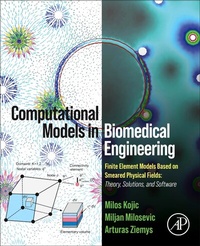
Computational Models in Biomedical Engineering
Finite Element Models Based on Smeared Physical Fields: Theory, Solutions, and Software
Published on 15. September 2022
Book
Paperback/Softback
400 pages
978-0-323-88472-3 (ISBN)
Description
Computational Models in Biomedical Engineering: Finite Element Models Based on Smeared Physical Fields: Theory, Solutions, and Software discusses novel computational methodologies developed by the authors that address a variety of topics in biomedicine, with concepts that rely on the so-called smeared physical field built into the finite element method. A new and straightforward methodology is represented by their Kojic Transport Model (KTM), where a composite smeared finite element (CSFE) as a FE formulation contains different fields (e.g., drug concentration, electrical potential) in a composite medium, such as tissue, which includes the capillary and lymphatic system, different cell groups and organelles.
The continuum domains participate in the overall model according to their volumetric fractions. The governing laws and material parameters are assigned to each of the domains. Furthermore, the continuum fields are coupled at each FE node by connectivity elements which take into account biological barriers such as vessel walls and cells.
The continuum domains participate in the overall model according to their volumetric fractions. The governing laws and material parameters are assigned to each of the domains. Furthermore, the continuum fields are coupled at each FE node by connectivity elements which take into account biological barriers such as vessel walls and cells.
More details
Language
English
Place of publication
Oxford
United Kingdom
Publishing group
Elsevier Science & Technology
Target group
Professional and scholarly
Illustrations
Approx. 100 illustrations; Illustrations
Dimensions
Height: 235 mm
Width: 191 mm
Weight
790 gr
ISBN-13
978-0-323-88472-3 (9780323884723)
Copyright in bibliographic data and cover images is held by Nielsen Book Services Limited or by the publishers or by their respective licensors: all rights reserved.
Schweitzer Classification
Other editions
Additional editions
Milos Kojic | Miljan Milosevic | Arturas Ziemys
Computational Models in Biomedical Engineering
Finite Element Models Based on Smeared Physical Fields: Theory, Solutions, and Software
E-Book
09/2022
Academic Press
€160.00
Available for download
Persons
Dr. Milos Kojic is one of the leading scientists in the computational mechanics and finite element method and its application in
engineering and biomedicine. He is currently Full Member and Professor of Nanomedicine, Department of Nanomedicine, The
Methodist Hospital Research Institute, Houston, TX, USA, as well as the Director of the Bioengineering R&D Center, Kragujevac,
Serbia. In his long professional carrier, Dr. Kojic has been Professor of Mechanics at University of Kragujevac, Serbia (retired),
Visiting Scholar of MIT; Research and Development Engineer of ADINA R&D, Boston; Senior Research Scientist, Harvard School
of Public Health; and Member of the Serbian Academy of Science and Arts, from 2009. Dr. Kojic's research is primarily concerning
the finite element method, implementation in engineering and biomedicine; and software development. He has formulated and
implemented a number of original concepts and solutions, among which is the Governing Parameter Method for inelastic analysis
of solids and structures, and recently the smeared finite element models for field problems and mechanics, also known as the Kojic
Transport Model (KTM). He initiated and has been PI of the FE software package PAK for solids and fluids, field and coupled
problems, and biomechanics. The PAK software has been developing over decades with participation of several generations; today,
it is the basic tool for applications in industry and in research within various domestic and international grants. Dr. Kojic is the lead
author of over 10 textbooks in Serbian and two books by world leading publishers: Inelastic Analysis of Solids and Structures, from
Springer, and Computer Modeling in Bioengineering, from J. Wiley and Sons. Dr. Miljan Milosevic is a Senior Research Engineer at Bioengineering R&D Center, Kragujevac Serbia. He also serves as an
Associate Professor at Metropolitan University, Belgrade, teaching courses in informatics and its applications. Dr. Milosevic
received his Ph.D. in Mechanical Engineering from the Faculty of Engineering Sciences, University of Kragujevac. His research
interests are centered primarily on the development of the finite element methodology in bioengineering and implementation to the
software package PAK. He has been leading research related to the creation of interfaces for use of the software PAK, including
connection to imaging data. Dr. Arturas Ziemys is an Assistant Professor in the Program of Mathematics in Medicine, Department of Nanomedicine, Radiation Oncology, at The Methodist Hospital Research Institute, Houston, TX, USA. His professional experience includes being a research Scientist at the Institute of Biochemistry, Vilnius, Lithuania; Lecturer in Molecular Biology and Bioinformatics at Vytautas Magnus University, Kaunas, Lithuania. His research focus includes enzymatic catalysis, biophysics of protein function and structure, mass transport in nanoporous materials, nanomedicine, bioengineering and drug delivery. This research integrates in silico, in vitro, in vivo, and clinical aspects. His most recent publications focus on drug delivery and therapeutic resistance involving small molecules and immunotherapies.
engineering and biomedicine. He is currently Full Member and Professor of Nanomedicine, Department of Nanomedicine, The
Methodist Hospital Research Institute, Houston, TX, USA, as well as the Director of the Bioengineering R&D Center, Kragujevac,
Serbia. In his long professional carrier, Dr. Kojic has been Professor of Mechanics at University of Kragujevac, Serbia (retired),
Visiting Scholar of MIT; Research and Development Engineer of ADINA R&D, Boston; Senior Research Scientist, Harvard School
of Public Health; and Member of the Serbian Academy of Science and Arts, from 2009. Dr. Kojic's research is primarily concerning
the finite element method, implementation in engineering and biomedicine; and software development. He has formulated and
implemented a number of original concepts and solutions, among which is the Governing Parameter Method for inelastic analysis
of solids and structures, and recently the smeared finite element models for field problems and mechanics, also known as the Kojic
Transport Model (KTM). He initiated and has been PI of the FE software package PAK for solids and fluids, field and coupled
problems, and biomechanics. The PAK software has been developing over decades with participation of several generations; today,
it is the basic tool for applications in industry and in research within various domestic and international grants. Dr. Kojic is the lead
author of over 10 textbooks in Serbian and two books by world leading publishers: Inelastic Analysis of Solids and Structures, from
Springer, and Computer Modeling in Bioengineering, from J. Wiley and Sons. Dr. Miljan Milosevic is a Senior Research Engineer at Bioengineering R&D Center, Kragujevac Serbia. He also serves as an
Associate Professor at Metropolitan University, Belgrade, teaching courses in informatics and its applications. Dr. Milosevic
received his Ph.D. in Mechanical Engineering from the Faculty of Engineering Sciences, University of Kragujevac. His research
interests are centered primarily on the development of the finite element methodology in bioengineering and implementation to the
software package PAK. He has been leading research related to the creation of interfaces for use of the software PAK, including
connection to imaging data. Dr. Arturas Ziemys is an Assistant Professor in the Program of Mathematics in Medicine, Department of Nanomedicine, Radiation Oncology, at The Methodist Hospital Research Institute, Houston, TX, USA. His professional experience includes being a research Scientist at the Institute of Biochemistry, Vilnius, Lithuania; Lecturer in Molecular Biology and Bioinformatics at Vytautas Magnus University, Kaunas, Lithuania. His research focus includes enzymatic catalysis, biophysics of protein function and structure, mass transport in nanoporous materials, nanomedicine, bioengineering and drug delivery. This research integrates in silico, in vitro, in vivo, and clinical aspects. His most recent publications focus on drug delivery and therapeutic resistance involving small molecules and immunotherapies.
Author
Full Member, Professor, Nanomedicine, Department of Nanomedicine, The Methodist Hospital Research Institute, Houston, TX, USA; Director, Bioengineering R&D Center, Kragujevac, Serbia
Senior Research Engineer, Bioengineering R&D Center, Kragujevac Serbia; Associate Professor, Metropolitan University, Belgrade
Assistant Professor, Program of Mathematics in Medicine, Department of Nanomedicine, Radiation Oncology, The Methodist Hospital Research Institute, Houston, TX, USA
Content
1. Basic Processes in Living Organisms
2. Fundamental Laws for Physical Fields and Mechanics
3. Smeared Finite Element Formulation
4. Convective and Diffusive Transport within Blood Vessels and Tissue
5. Heart Electrophysiology and Mechanics
6. Lung Models
7. Description of the Software Accompanying the book
2. Fundamental Laws for Physical Fields and Mechanics
3. Smeared Finite Element Formulation
4. Convective and Diffusive Transport within Blood Vessels and Tissue
5. Heart Electrophysiology and Mechanics
6. Lung Models
7. Description of the Software Accompanying the book