

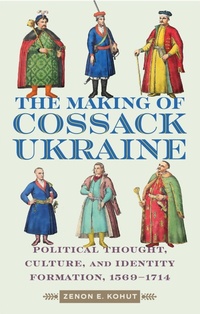
The Making of Cossack Ukraine
Political Thought, Culture, and Identity Formation, 1569-1714
Published on 2. September 2025
Book
Hardback
636 pages
978-0-2280-1901-5 (ISBN)
Description
Both modern Ukrainian nationhood and the historical preconditions of the country's contemporary conflict with Russia are rooted in a complex period of development in Cossack Ukraine. The Making of Cossack Ukraine traces the evolution of early modern Ukrainian political thought and culture from their sixteenth-century origins to 1714.
Early modern Ukraine was home to a multitude of interrelated political cultures, including those of the Ruthenian nobility, the Kyivan clergy, and the Cossacks. Zenon Kohut shows how constant interplay between these cultures contributed to the development of political, territorial, religious, ethnic, and national collective visions that reflected early modern concepts of nation, state, and identity. Two persistent narratives - the idea of Ukrainian autonomy and perpetual rights, and the idea of a continuous "Russian" tsardom stemming from medieval times - formed the foundation for not only Ukrainian state and nation building but also Russia's modern identity and sense of nationhood, creating the ideological underpinning for Russian imperialism.
Based in a classical analysis of ethnic, religious, and political ideas developed by early modern Ukrainian intellectuals, The Making of Cossack Ukraine brings to light the origins of present-day Ukrainian political thought.
Early modern Ukraine was home to a multitude of interrelated political cultures, including those of the Ruthenian nobility, the Kyivan clergy, and the Cossacks. Zenon Kohut shows how constant interplay between these cultures contributed to the development of political, territorial, religious, ethnic, and national collective visions that reflected early modern concepts of nation, state, and identity. Two persistent narratives - the idea of Ukrainian autonomy and perpetual rights, and the idea of a continuous "Russian" tsardom stemming from medieval times - formed the foundation for not only Ukrainian state and nation building but also Russia's modern identity and sense of nationhood, creating the ideological underpinning for Russian imperialism.
Based in a classical analysis of ethnic, religious, and political ideas developed by early modern Ukrainian intellectuals, The Making of Cossack Ukraine brings to light the origins of present-day Ukrainian political thought.
Reviews / Votes
"The Making of Cossack Ukraine is the result of decades of work by one of the leading experts on the history of Cossack nation building, nation writing, and political thought. It is a much-needed contribution to the field and a work that will withstand the test of time." Serhii Plokhy, Harvard University and author of The Cossack Myth: History and Nationhood in the Age of Empires "This book is the most comprehensive analysis of the phenomenon of Cossack political culture to date. Kohut provides a revolutionary and novel perspective on the early forms of Ukrainian national identity and the cross-cultural relations between Ukraine and Russia." Oleksii Sokyrko, Taras Shevchenko National University of KyivMore details
Language
English
Place of publication
Montreal
Canada
Target group
College/higher education
Illustrations
2 figures, 5 maps
Dimensions
Height: 232 mm
Width: 165 mm
Thickness: 50 mm
Weight
1063 gr
ISBN-13
978-0-2280-1901-5 (9780228019015)
Copyright in bibliographic data and cover images is held by Nielsen Book Services Limited or by the publishers or by their respective licensors: all rights reserved.
Schweitzer Classification
Person
Zenon E. Kohut is professor emeritus at the University of Alberta.
Content
Note on Transliteration, Translations, Dates, and Terminology vii
Acknowledgments xi
Abbreviations xiii
Maps xiv
Introduction 3
1 Ruthenian-Ukrainian Political Culture in the Polish-Lithuanian Commonwealth (1569-1640s) 17
2 Establishing Goals, Political Concepts, and Values: The Khmel'nyts'kyi Uprising and the Hetmanate (1648-68) 41
3 Uniting the Fatherland: Hetman Petro Doroshenko (1665-75) 74
4 The Left-Bank Hetmanate: Hetman Ivan Samoilovych (1672-87) 102
5 The Construction of Historical-Political Narratives (1660-80s) 146
6 In Service to Tsar and Ukraine: Hetman Ivan Mazepa 212
7 Mazepa: Modernizer and Enlightened Ruler (1687-1708) 250
8 Mazepa: Hetman of a Sacred Rutheno-Rossian Realm 286
9 From Tsarist Service to Swedish Protection (1705-09) 332
10 From Reprisals to Ideological Combat: Peter vs Mazepa 360
11 Liberating Ukraine: Hetman Pylyp Orlyk (1709-14) 391
12 Rethinking Ukraine: Envisioning a Free Cossack Commonwealth 428
Conclusions 455
Epilogue 467
Notes 479
Bibliography 553
Index 59
Acknowledgments xi
Abbreviations xiii
Maps xiv
Introduction 3
1 Ruthenian-Ukrainian Political Culture in the Polish-Lithuanian Commonwealth (1569-1640s) 17
2 Establishing Goals, Political Concepts, and Values: The Khmel'nyts'kyi Uprising and the Hetmanate (1648-68) 41
3 Uniting the Fatherland: Hetman Petro Doroshenko (1665-75) 74
4 The Left-Bank Hetmanate: Hetman Ivan Samoilovych (1672-87) 102
5 The Construction of Historical-Political Narratives (1660-80s) 146
6 In Service to Tsar and Ukraine: Hetman Ivan Mazepa 212
7 Mazepa: Modernizer and Enlightened Ruler (1687-1708) 250
8 Mazepa: Hetman of a Sacred Rutheno-Rossian Realm 286
9 From Tsarist Service to Swedish Protection (1705-09) 332
10 From Reprisals to Ideological Combat: Peter vs Mazepa 360
11 Liberating Ukraine: Hetman Pylyp Orlyk (1709-14) 391
12 Rethinking Ukraine: Envisioning a Free Cossack Commonwealth 428
Conclusions 455
Epilogue 467
Notes 479
Bibliography 553
Index 59