

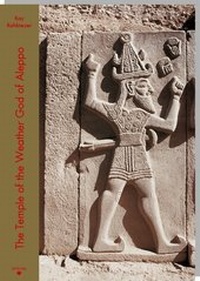
The Temple of the Weather God of Aleppo
1st Edition
Published on 25. August 2020
Book
Hardback
128 pages
978-3-86887-048-0 (ISBN)
Description
More information: http://rhema-verlag.de/books/ao_txt/kmw01.html
The Weather God of Aleppo played a supra-regional role in the ancient world which accounts for the enormous size of the temple and its brilliant relief decoration. The building, a so-called 'tower-temple', goes back to the middle of the 3rd millennium BC. Under Hittite rule in the second half of the 2nd millennium, the temple was decorated with reliefs showing images of 'false windows', two bull-men, and the Weather God. The entrance was protected with the relief of a fish-genius, as well as sphinx and lion portal figures.
In the 11th century BCE, Taita, "King and Hero of the Land of Palistin", restored the temple. He inserted his figure directly facing the Weather God. A final redecoration took place in the later 10th century BCE. It shows the Weather God entering his chariot, surrounded by his entourage. But, before all work had been even completed, the building burned down and was abandoned.
"Qalat Halab - Occasional Papers 1" gives an account on the most important discoveries in the temple.
Table of Contents
Preface
1. History of research
2. Historical overview
3. Stratigraphy and building type
4. Early Bronze Age
Architecture
Cult inventory and small finds
5. Middle Bronze Age and Late Bronze Age I
Architecture
Architectural decoration
Cult inventory and small finds
6. Late Bronze Age II
Architecture
Architectural decoration
Cult inventory and small finds
7. Early Iron Age
Architecture
Architectural decoration
Cult inventory and small finds
8. Quarries and re-use of sculptures
9. Spatial references
10. 3D-documentation of architecture and architectural decorations (Arie Kai-Browne)
Bibliography
The Weather God of Aleppo played a supra-regional role in the ancient world which accounts for the enormous size of the temple and its brilliant relief decoration. The building, a so-called 'tower-temple', goes back to the middle of the 3rd millennium BC. Under Hittite rule in the second half of the 2nd millennium, the temple was decorated with reliefs showing images of 'false windows', two bull-men, and the Weather God. The entrance was protected with the relief of a fish-genius, as well as sphinx and lion portal figures.
In the 11th century BCE, Taita, "King and Hero of the Land of Palistin", restored the temple. He inserted his figure directly facing the Weather God. A final redecoration took place in the later 10th century BCE. It shows the Weather God entering his chariot, surrounded by his entourage. But, before all work had been even completed, the building burned down and was abandoned.
"Qalat Halab - Occasional Papers 1" gives an account on the most important discoveries in the temple.
Table of Contents
Preface
1. History of research
2. Historical overview
3. Stratigraphy and building type
4. Early Bronze Age
Architecture
Cult inventory and small finds
5. Middle Bronze Age and Late Bronze Age I
Architecture
Architectural decoration
Cult inventory and small finds
6. Late Bronze Age II
Architecture
Architectural decoration
Cult inventory and small finds
7. Early Iron Age
Architecture
Architectural decoration
Cult inventory and small finds
8. Quarries and re-use of sculptures
9. Spatial references
10. 3D-documentation of architecture and architectural decorations (Arie Kai-Browne)
Bibliography
More details
Series
Language
Other
English
Place of publication
Münster
Germany
Target group
Professional and scholarly
Product notice
sewn/stitched
Illustrations
mosty color
Dimensions
Height: 29.7 cm
Width: 21 cm
Weight
800 gr
ISBN-13
978-3-86887-048-0 (9783868870480)
Schweitzer Classification