

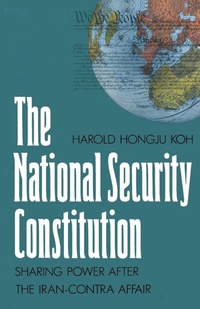
The National Security Constitution
Sharing Power after the Iran-Contra Affair
Will be published approx. on 20. June 1990
Book
Paperback/Softback
336 pages
978-0-300-04493-5 (ISBN)
Description
Was the Iran-Contra affair caused by executive lawlessness or legislative folly? Or did it result instead from structural defects in our national security decision-making system? In this important book, Harold Hongju Koh argues that the affair was not aberrational but symptomatic of a chronic dysfunction in America's foreign policy process. Combining practical knowledge of government with insights from law, history, and political science, Koh presents the definitive historical and constitutional analysis of the Iran-Contra affair, the subsequent investigations, and the trial of Oliver North. He then discusses the implications of the Iran-Contra scandal for the constitutional conduct of national security policy and offers prescriptions to improve this decision-making system.
Koh contends that the Iran-Contra affair arose not from Watergate, as many have claimed, but from Vietnam, for it was only the latest episode in a series of foreign policy decisions made by unrestrained executive discretion. Koh shows that throughout its history America has operated under a "National Security Constitution," a constitutionally defined national security process that views that administration of foreign affairs as a power shared by the president, Congress, and the courts. Yet the executive branch has increased its role in making foreign policy at the expense of the other branches, placing in jeopardy this vision of constitutional balance. Koh advocates a national security charter to reform the foreign policy-making process and offers innovative proposals about war powers, international agreements, emergency economic powers, intelligence oversight, and information control. His proposals would restrain the executive and restore and reinvigorate the constitutional roles of Congress and the federal judiciary in national security decision-making. This challenging book forces government decision-makers, scholars, and concerned citizens to reexamine the process by which the United States will conduct its foreign affairs into the next century.
Koh contends that the Iran-Contra affair arose not from Watergate, as many have claimed, but from Vietnam, for it was only the latest episode in a series of foreign policy decisions made by unrestrained executive discretion. Koh shows that throughout its history America has operated under a "National Security Constitution," a constitutionally defined national security process that views that administration of foreign affairs as a power shared by the president, Congress, and the courts. Yet the executive branch has increased its role in making foreign policy at the expense of the other branches, placing in jeopardy this vision of constitutional balance. Koh advocates a national security charter to reform the foreign policy-making process and offers innovative proposals about war powers, international agreements, emergency economic powers, intelligence oversight, and information control. His proposals would restrain the executive and restore and reinvigorate the constitutional roles of Congress and the federal judiciary in national security decision-making. This challenging book forces government decision-makers, scholars, and concerned citizens to reexamine the process by which the United States will conduct its foreign affairs into the next century.
More details
Series
Language
English
Place of publication
United States
Target group
College/higher education
Professional and scholarly
Product notice
Paperback (trade)
Dimensions
Height: 216 mm
Width: 140 mm
Thickness: 20 mm
Weight
449 gr
ISBN-13
978-0-300-04493-5 (9780300044935)
Copyright in bibliographic data and cover images is held by Nielsen Book Services Limited or by the publishers or by their respective licensors: all rights reserved.
Schweitzer Classification