

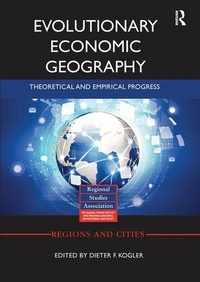
Evolutionary Economic Geography
Theoretical and Empirical Progress
1st Edition
Published on 16. June 2017
Book
Paperback/Softback
200 pages
978-1-138-29517-9 (ISBN)
Description
Economic geographers increasingly consider the significance of history in shaping the contemporary socio-economic landscape and believe that experiences and competencies, acquired over time by individuals and entities in particular localities, to a large degree determine present configurations as well as future regional trajectories. Attempts to trace, understand, and investigate the pathways from past to present have given rise to the thriving and exciting sub-field of Evolutionary Economic Geography (EEG).
EEG highlights the important factors that initiate, inhibit, or consolidate the contextual settings and relationships in which regions and their respective agents, which comprise and shape economic activity and social reproduction, change over time. It has at its core the production and destruction of novelty in space, and the links between innovation and regional economic fortunes. The creation of knowledge, its movement and recombination within different regional ensembles of economic agents and institutions plays a critical role in the evolution of the space-economy. EEG provides a framework to disentangle the complexity of technological change and regional economic development based on a variety of theoretical and methodological approaches.
In only a short time, EEG has established itself as a promising and rapidly evolving research framework with its focus on the driving forces of regional development across various scales and its attempt to translate findings into public policy. This book advances the theoretical foundations of EEG, and demonstrates how EEG utilises and operationalises conceptual frameworks, both established and new. Contributions also point to future research avenues and extensions of EEG, attempting to build stronger ties between theory, empirical evidence, and relevance to policy. This book was originally published as a special issue of Regional Studies.
EEG highlights the important factors that initiate, inhibit, or consolidate the contextual settings and relationships in which regions and their respective agents, which comprise and shape economic activity and social reproduction, change over time. It has at its core the production and destruction of novelty in space, and the links between innovation and regional economic fortunes. The creation of knowledge, its movement and recombination within different regional ensembles of economic agents and institutions plays a critical role in the evolution of the space-economy. EEG provides a framework to disentangle the complexity of technological change and regional economic development based on a variety of theoretical and methodological approaches.
In only a short time, EEG has established itself as a promising and rapidly evolving research framework with its focus on the driving forces of regional development across various scales and its attempt to translate findings into public policy. This book advances the theoretical foundations of EEG, and demonstrates how EEG utilises and operationalises conceptual frameworks, both established and new. Contributions also point to future research avenues and extensions of EEG, attempting to build stronger ties between theory, empirical evidence, and relevance to policy. This book was originally published as a special issue of Regional Studies.
More details
Series
Language
English
Place of publication
London
United Kingdom
Publishing group
Taylor & Francis Ltd
Target group
College/higher education
Dimensions
Height: 297 mm
Width: 210 mm
Weight
400 gr
ISBN-13
978-1-138-29517-9 (9781138295179)
Copyright in bibliographic data and cover images is held by Nielsen Book Services Limited or by the publishers or by their respective licensors: all rights reserved.
Schweitzer Classification
Other editions
Additional editions
E-Book
10/2017
1st Edition
Routledge
€69.99
Available for download
E-Book
10/2017
1st Edition
Routledge
€69.99
Available for download
Book
10/2015
1st Edition
Routledge
€230.27
Shipment within 10-20 days
Person
Dieter F. Kogler is a Lecturer in Economic Geography at University College Dublin, Ireland. His research focus is on the geography of innovation and evolutionary economic geography, with a particular emphasis on knowledge production and diffusion, and processes related to technological change and innovation. He is the co-editor of Global and Regional Dynamics in Knowledge Flows and Innovation (with Van Egeraat and Cooke, Routledge, 2014), and Beyond Territory: Dynamic Geographies of Knowledge Creation, Diffusion, and Innovation (with Bathelt and Feldman, Routledge, 2011).
Content
Introduction: Evolutionary Economic Geography - Theoretical and Empirical Progress 1. Towards a Developmental Turn in Evolutionary Economic Geography? 2. Towards an Evolutionary Perspective on Regional Resilience 3. Relatedness, Industrial Branching and Technological Cohesion in US Metropolitan Areas 4. Related Variety, Unrelated Variety and Technological Breakthroughs: An analysis of US State-Level Patenting 5. The Role of External Linkages and Gatekeepers for the Renewal and Expansion of US Cities' Knowledge Base, 1990-2004 6. rKnowledge: The Spatial Diffusion and Adoption of rDNA Methods 7. Interaction and Innovation across Different Sectors: Findings from Norwegian City-Regions 8. What Makes Clusters Decline? A Study on Disruption and Evolution of a High-Tech Cluster in Denmark 9. Path Renewal in Old Industrial Regions: Possibilities and Limitations for Regional Innovation Policy 10. Education-Job (Mis)Match and Interregional Migration: Italian University Graduates' Transition to Work 11. Knowledge Neighbourhoods: Urban Form and Evolutionary Economic Geography