

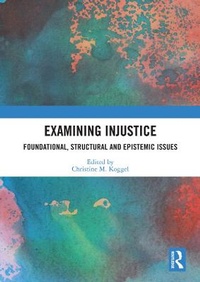
Examining Injustice
Foundational, Structural and Epistemic Issues
1st Edition
Published on 30. June 2020
Book
Paperback/Softback
154 pages
978-0-367-58714-7 (ISBN)
Description
The past several decades have witnessed a surge in critiques of justice theory by gender, race, disability, post-colonial, non-Western, and other anti-oppression theorists. These theorists tend to reject ideal theory and instead engage in 'theorizing' that takes the details of people's lives to be central to understanding and alleviating injustices. These theorists reveal injustices emerging from norms assumed in mainstream justice theory and uncover them to challenge liberal accounts of moral reasoning and responsibility rooted in individualist conceptions of the self. Instead, they defend a relational conception of selves as born into relationships and shaped by norms, institutions, and structures that determine needs, opportunities, and life prospects differently for different people and groups.
Attention to real world circumstances of injustice reveals inequalities in power between developed and developing countries; former colonizers and those colonized within and across nations; and the powerful and marginalized/oppressed where racism, classism, sexism, heterosexism, and so on still prevail. This volume sets out to examine a range of injustices emerging from, and shaped by, histories and contexts of patriarchy, racism, colonialism, capitalism, and so on. These are the kinds of injustices that affect the lives and well-being of people at the global, national, and local levels. The chapters in this book were originally published in the Ethics and Social Welfare journal.
Attention to real world circumstances of injustice reveals inequalities in power between developed and developing countries; former colonizers and those colonized within and across nations; and the powerful and marginalized/oppressed where racism, classism, sexism, heterosexism, and so on still prevail. This volume sets out to examine a range of injustices emerging from, and shaped by, histories and contexts of patriarchy, racism, colonialism, capitalism, and so on. These are the kinds of injustices that affect the lives and well-being of people at the global, national, and local levels. The chapters in this book were originally published in the Ethics and Social Welfare journal.
More details
Language
English
Place of publication
London
United Kingdom
Publishing group
Taylor & Francis Ltd
Target group
College/higher education
Postgraduate and Undergraduate
Dimensions
Height: 246 mm
Width: 174 mm
Weight
453 gr
ISBN-13
978-0-367-58714-7 (9780367587147)
Copyright in bibliographic data and cover images is held by Nielsen Book Services Limited or by the publishers or by their respective licensors: all rights reserved.
Schweitzer Classification
Other editions
Additional editions
E-Book
03/2020
1st Edition
Routledge
€61.99
Available for download
E-Book
03/2020
1st Edition
Routledge
€61.99
Available for download
Book
08/2018
1st Edition
Routledge
€215.41
Shipment within 10-20 days
Person
Christine M. Koggel is a Professor of Philosophy at Carleton University, Ottawa, Canada. Her main research and teaching interests are in the areas of moral, social, and political theory, practical ethics, and feminism. She is the author, editor, and co-editor of numerous books, chapters in books, and journal articles on topics in these areas.
Content
Introduction 1. Reconsidering Dignity Relationally 2. Oppression and professional ethics 3. Dealing with Oppression: Indigenous Relations with the State in Canada 4. Re-evaluating Sufficientarianism in Light of Evidence of Inequality's Harms 5. Safety and Sacrifice 6. Epistemic Injustice and Epistemic Redlining 7. Addressing Barriers to Deliberative Participation in Adaptive Preference Interventions 8. Challenging Hidden Hegemonies: Exploring the Links Between Education, Gender Justice, and Sustainable Development Practice 9. Assuming Responsibility for Justice in the Context of South Africa's Refugee Receiving Regime 10. Critical Commentary: Disorientation and Moral Life, by Ami Harbin