

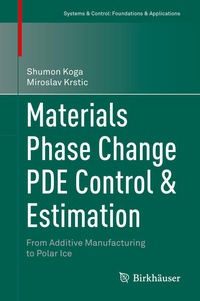
Materials Phase Change PDE Control & Estimation
From Additive Manufacturing to Polar Ice
Published on 1. November 2020
Book
Hardback
XIII, 352 pages
978-3-030-58489-4 (ISBN)
Description
This monograph introduces breakthrough control algorithms for partial differential equation models with moving boundaries, the study of which is known as the Stefan problem. The algorithms can be used to improve the performance of various processes with phase changes, such as additive manufacturing. Using the authors' innovative design solutions, readers will also be equipped to apply estimation algorithms for real-world phase change dynamics, from polar ice to lithium-ion batteries.
A historical treatment of the Stefan problem opens the book, situating readers in the larger context of the area. Following this, the chapters are organized into two parts. The first presents the design method and analysis of the boundary control and estimation algorithms. Part two then explores a number of applications, such as 3D printing via screw extrusion and laser sintering, and also discusses the experimental verifications conducted. A number of open problems and provided as well, offering readers multiple paths to explore in future research.
Materials Phase Change PDE Control & Estimation is ideal for researchers and graduate students working on control and dynamical systems, and particularly those studying partial differential equations and moving boundaries. It will also appeal to industrial engineers and graduate students in engineering who are interested in this area.
A historical treatment of the Stefan problem opens the book, situating readers in the larger context of the area. Following this, the chapters are organized into two parts. The first presents the design method and analysis of the boundary control and estimation algorithms. Part two then explores a number of applications, such as 3D printing via screw extrusion and laser sintering, and also discusses the experimental verifications conducted. A number of open problems and provided as well, offering readers multiple paths to explore in future research.
Materials Phase Change PDE Control & Estimation is ideal for researchers and graduate students working on control and dynamical systems, and particularly those studying partial differential equations and moving boundaries. It will also appeal to industrial engineers and graduate students in engineering who are interested in this area.
Reviews / Votes
"This text is suited for researchers and graduate students working on control and dynamical systems, specifically those studying PDEs and moving boundaries." (IEEE Control Systems Magazine, Vol. 41 (2), April, 2021)More details
Product info
Book
Series
Edition
1st ed. 2020
Language
English
Place of publication
Cham
Switzerland
Publishing group
Springer International Publishing
Target group
Professional and scholarly
Illustrations
59
7 s/w Abbildungen, 60 farbige Abbildungen, 59 farbige Tabellen
59 Tables, color; 60 Illustrations, color; 7 Illustrations, black and white; XIII, 352 p. 67 illus., 60 illus. in color.
Dimensions
Height: 241 mm
Width: 160 mm
Thickness: 26 mm
Weight
717 gr
ISBN-13
978-3-030-58489-4 (9783030584894)
DOI
10.1007/978-3-030-58490-0
Schweitzer Classification
Other editions
Additional editions
Shumon Koga | Miroslav Krstic
Materials Phase Change PDE Control & Estimation
From Additive Manufacturing to Polar Ice
Book
11/2021
Birkhäuser
€128.39
Shipment within 7-9 days
Shumon Koga | Miroslav Krstic
Materials Phase Change PDE Control & Estimation
From Additive Manufacturing to Polar Ice
E-Book
11/2020
1st Edition
Birkhäuser
€117.69
Available for download
Content
Preface.- Phase-Change Model - Stefan Problem.- Part I: Design and Analysis.- State Feedback Control Design.- State Estimation Design.- Extended Models and Design.- Two-Phase Stefan Problem.- Sampled-Data Design.- Open Problems.- Part II: Applications and Experiment.- Sea Ice.- Lithium-Ion Batteries.- Polymer 3D-Printing via Screw Extrusion.- Metal 3D-Printing via Selective Laser Sintering.- Experimental Study using PCM.- Open Problems.