

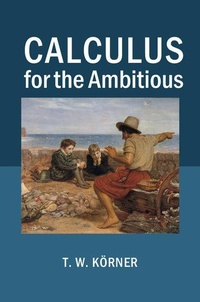
Calculus for the Ambitious
Published on 29. May 2014
Book
Paperback/Softback
174 pages
978-1-107-68674-8 (ISBN)
Description
From the author of The Pleasures of Counting and Naive Decision Making comes a calculus book perfect for self-study. It will open up the ideas of the calculus for any 16- to 18-year-old, about to begin studies in mathematics, and will be useful for anyone who would like to see a different account of the calculus from that given in the standard texts. In a lively and easy-to-read style, Professor Koerner uses approximation and estimates in a way that will easily merge into the standard development of analysis. By using Taylor's theorem with error bounds he is able to discuss topics that are rarely covered at this introductory level. This book describes important and interesting ideas in a way that will enthuse a new generation of mathematicians.
More details
Language
English
Place of publication
Cambridge
United Kingdom
Target group
College/higher education
Product notice
Paperback (trade)
Illustrations
Worked examples or Exercises; 7 Halftones, unspecified; 8 Line drawings, unspecified
Dimensions
Height: 229 mm
Width: 152 mm
Thickness: 10 mm
Weight
268 gr
ISBN-13
978-1-107-68674-8 (9781107686748)
Copyright in bibliographic data and cover images is held by Nielsen Book Services Limited or by the publishers or by their respective licensors: all rights reserved.
Schweitzer Classification
Other editions
Additional editions
T. W. Koerner
Calculus for the Ambitious
E-Book
06/2014
1st Edition
Cambridge University Press
€23.49
Available for download
T. W. Koerner
Calculus for the Ambitious
Book
05/2014
Cambridge University Press
€148.60
Shipment within 15-20 days
Person
T. W. Koerner is Professor of Fourier Analysis in the Department of Pure Mathematics and Mathematical Statistics at the University of Cambridge. His previous books include The Pleasures of Counting and Fourier Analysis.
Content
Introduction; 1. Preliminary ideas; 2. The integral; 3. Functions, old and new; 4. Falling bodies; 5. Compound interest and horse kicks; 6. Taylor's theorem; 7. Approximations, good and bad; 8. Hills and dales; 9. Differential equations via computers; 10. Paradise lost; 11. Paradise regained; Bibliography; Index.