

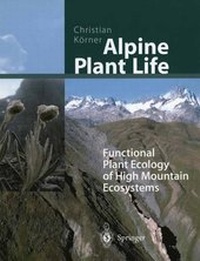
Alpine Plant Life
Functional Plant Ecology of High Mountain Ecosystems
Published on 26. May 1999
Book
Paperback/Softback
IX, 343 pages
978-3-540-65438-4 (ISBN)
Description
Generations of plant scientists have been fascinated by alpine plant life - with the exposure of organisms to dramatic climatic gradients over a very short distance. This comprehensive text treats a wide range of topics: alpine climate and soils, plant distribution and the treeline phenomenon, physiological ecology of water-, nutritional- and carbon relations of alpine plants, plant stress and plant development, biomass production, aspects of reproductive biology, and human impacts on alpine vegetation. Geographically the book covers all parts of the world including the tropics.
Reviews / Votes
From the reviews"This book should be required reading for all ecologists and ecology students. Modern treatment of alpine ecology and the inclusion of tropics and good treatment of tropical alpine environments makes this book unique. ...the best modern treatment of "functional ecology" of alpine plants. Both the author and the publisher should be commended for this book." (Botanical Electronic News)
"For anyone interested in alpine plant ecology (or ecophysiology) this book is a must, being encyclopaedic in both scope and information content. Though it deals with potentially complex topics, the book has been organised carefully and logically, and the topics are treated with a simple yet elegant writing style which exudes the author's enthusiasm and fascination. It was a delight to read, like a good novel that one is reluctant to set down. ... a most impressive and comprehensive, up-to-the-minute book by undoubtedly the world's foremost alpine plant ecologist and ecophysiologist." (New Zealand Journal of Ecology)
"The structure of the book and the approach in presenting information make it easy to read. Highlighted information throughout the chapters and summaries at the end of each chapter assist readers in recapturing important information. Color plates included at the end of the bok serve as a good summary of the book's contents. ... provides the most up-to-date information about the ecology of plants at high altitudes."(Mountain Research and Development)
More details
Edition
Softcover reprint of the original 1st ed. 1999
Language
English
Place of publication
Berlin
Germany
Publishing group
Springer Berlin
Target group
College/higher education
Professional and scholarly
Research
Illustrations
47 s/w Tabellen
47 black & white tables, biography
Dimensions
Height: 27 cm
Width: 19.3 cm
Weight
800 gr
ISBN-13
978-3-540-65438-4 (9783540654384)
DOI
10.1007/978-3-642-98018-3
Schweitzer Classification
Other editions
New editions
Book
02/2021
3rd Edition
Springer
€117.69
Shipment within 7-9 days
Book
08/2014
2nd Edition
Springer
€85.59
Article exhausted; check for reprint
Additional editions
Book
05/1999
Springer
€85.55
Article exhausted; check for reprint
Content
1 Plant ecology at high elevations.- The concept of limitation.- A regional and historical account.- The challenge of alpine plant research.- 2 The alpine life zone.- Altitudinal boundaries.- Global alpine land area.- Alpine plant diversity.- Origin of alpine floras.- Alpine growth forms.- 3 Alpine climate.- Which alpine climate?.- Common features of alpine climates.- Regional features of alpine climates.- 4 The climate plants experience.- Interactions of relief, wind and sun.- How alpine plants influence their climate.- 5 Life under snow: protection and limitation.- Temperatures under snow.- Solar radiation under snow.- Gas concentrations under snow.- Plant responses to snowpack.- 6 Alpine soils.- Physics of alpine soil formation.- The organic compound.- The interaction of organic and inorganic compounds.- 7 Alpine treelines.- About trees and lines.- Current altitudinal positions of climatic treelines.- Treeline-climate relationships.- Intrazonal variations and pantropical plateauing of alpine treelines.- Treelines in the past.- Attempts at a functional explanation of treelines.- A hypothesis for treeline formation.- Growth trends near treelines.- 8 Climatic stress.- Survival of low temperature extremes.- Avoidance and tolerance of low temperature extremes.- Heat stress in alpine plants.- Ultraviolet radiation - a stress factor?.- 9 Water relations.- Ecosystem water balance.- Soil moisture at high altitudes.- Plant water relations: a brief review of principles.- Water relations of alpine plants.- Desiccation stress.- Water relations of special plant types.- 10 Mineral nutrition.- Soil nutrients.- The nutrient status of alpine plants.- Nutrient cycling and nutrient budgets.- Nitrogen fixation.- Mycorrhiza.- Responses of vegetation to variable nutrient supply.- 11 Uptake and loss of carbon.- Photosynthetic capacity of alpine plants.- Photosynthetic responses to the environment.- Daily carbon gain of leaves.- The seasonal carbon gain of leaves.- C4 and CAM photosynthesis at high altitudes.- Tissue respiration of alpine plants.- Ecosystem carbon balance.- 12 Carbon investments.- Non-structural carbohydrates.- Lipids and energy content.- Carbon costs of leaves and roots.- Whole plant carbon allocation.- 13 Growth dynamics.- Seasonal growth.- Diurnal leaf extension.- Rates of plant dry matter accumulation.- Functional duration of leaves and roots.- 14 Cell division and tissue formation.- Cell size and plant size.- Mitosis and the cell cycle.- From meristem activity to growth control.- 15 Plant biomass production.- The structure of alpine plant canopies.- Primary productivity of alpine vegetation.- Plant dry matter pools.- Biomass losses through herbivores.- 16 Plant reproduction.- Flowering and pollination.- Seed development and seed size.- Germination.- Alpine seed banks and natural recruitment.- Clonal propagation.- Alpine plant age.- 17 Global change at high elevation.- Alpine land use.- The impact of altered atmospheric chemistry.- Climatic change and alpine ecosystems.- References (with chapter annotation).- Taxonomic index (genera).- Color Plates.- Plant life forms.- The alpine life zone.- Environmental stress.- The human dimension.