

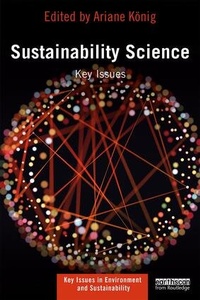
Sustainability Science
Key Issues
1st Edition
Published on 22. November 2017
Book
Paperback/Softback
364 pages
978-1-138-65928-5 (ISBN)
Description
Sustainability Science: Key Issues is a comprehensive textbook for undergraduates, postgraduates, and participants in executive trainings from any disciplinary background studying the theory and practice of sustainability science. Each chapter takes a critical and reflective stance on a key issue or method of sustainability science. Contributing authors offer perspectives from diverse disciplines, including physics, philosophy of science, agronomy, geography, and the learning sciences.
This book equips readers with a better understanding of how one might actively design, engage in, and guide collaborative processes for transforming human-environment-technology interactions, whilst embracing complexity, contingency, uncertainties, and contradictions emerging from diverse values and world views. Each reader of this book will thus have guidance on how to create and/or engage in similar initiatives or courses in their own context.
Sustainability Science: Key Issues is the ideal book for students and researchers engaged in problem and project based learning in sustainability science.
This book equips readers with a better understanding of how one might actively design, engage in, and guide collaborative processes for transforming human-environment-technology interactions, whilst embracing complexity, contingency, uncertainties, and contradictions emerging from diverse values and world views. Each reader of this book will thus have guidance on how to create and/or engage in similar initiatives or courses in their own context.
Sustainability Science: Key Issues is the ideal book for students and researchers engaged in problem and project based learning in sustainability science.
Reviews / Votes
"Transforming our world into one that is sustainable and desirable and that achieves the UN Sustainable Development Goals is the overarching challenge for humanity today. This book is an important and innovative guide to sustainability science as a transformative, whole system learning process that is essential to achieving this goal." - Professor Robert Costanza, The Australian National University, Australia"This book will certainly promote the debate on the role of scientific knowledge in sustainability transitions. It convinces by its enlightened perspective on appropriate forms of knowledge production in the 21st century." - Professor Uwe Schneidewind, Wuppertal Institute for Climate, Environment and Energy, Germany
"This book provides a powerful set of concepts and methods that have proved very effective for the participatory development of new perspectives and actionable knowledge on sustainability in practice, on campus and beyond. Whether for course-work or for practice - this book gives clear guidance. It is a gem!" - Associate Professor Maki Ikegami, Hokkaido University, Japan
More details
Series
Language
English
Place of publication
London
United Kingdom
Publishing group
Taylor & Francis Ltd
Target group
College/higher education
Illustrations
42 s/w Abbildungen, 2 s/w Photographien bzw. Rasterbilder, 40 s/w Zeichnungen, 26 s/w Tabellen
26 Tables, black and white; 40 Line drawings, black and white; 2 Halftones, black and white; 42 Illustrations, black and white
Dimensions
Height: 234 mm
Width: 156 mm
Weight
578 gr
ISBN-13
978-1-138-65928-5 (9781138659285)
Copyright in bibliographic data and cover images is held by Nielsen Book Services Limited or by the publishers or by their respective licensors: all rights reserved.
Schweitzer Classification
Other editions
Additional editions
E-Book
11/2017
Routledge
€69.99
Available for download
E-Book
11/2017
Routledge
€69.99
Available for download
Book
11/2017
1st Edition
Routledge
€232.80
Shipment within 10-20 days
Persons
Ariane Koenig is a Senior Researcher in the Research Unit for Education, Cognition, Culture and Society at the University of Luxembourg.
Jerome Ravetz is an Associate Fellow at the Institute for Science, Innovation and Society, University of Oxford.
Jerome Ravetz is an Associate Fellow at the Institute for Science, Innovation and Society, University of Oxford.
Content
Introduction
Chapter 1. Sustainability science as a transformative social learning process Ariane Koenig
Chapter 2. Flowers of resistance: Citizen science, ecological democracy and the transgressive education paradigm Arjen E.J. Wals, Michael A. Peters
Part I. Embracing complexity and alternative futures: Conceptual tools and methods
Chapter 3. Systems approaches for transforming social practice: Design requirements Ariane Koenig
Chapter 4. Cognitive pitfalls in dealing with sustainability Philipp Sonnleitner
Chapter 5. Escaping the complexity dilemma Barry Newell, Katrina Proust
Chapter 6. Exploring alternative futures with scenarios Gerard Drenth, Shirin Elahi, Ariane Koenig
Chapter 7. Social technology and Theory U: Co-creating actionable knowledge for
leadership Isabel Page
Chapter 8. Staging design-thinking for sustainability in practice: Guidance and watch-outs Kilian Gericke, Boris Eisenbart, Gregor Waltersdorfer
Part II. What might transformations look like? Sectoral challenges and interdependence
Chapter 9. Can ecosystem services help agricultural transitions? Nicolas Dendoncker, Emilie Crouzat
Chapter 10. Food systems and human ecology: An overview Federico Davila, Robert Dyball
Chapter 11. Energy: Physical and technical basics Susanne Siebentritt
Chapter 12. Urban energy transitions from innovations in green building Julia Affolderbach, Berenice Jung-Preller, Christian Schulz
Chapter 13. Democratising renewable energy production: A Luxembourgish perspective Kristina Hondrila, Simon Norcross, Paulina Golinska, Vladimir Broz, Aydeli Rios, Jules Muller
Chapter 14. Community-based monitoring for improved water governance Kim Chi Tran, Ariane Koenig
Part III. Tracking, steering and judging transformation
Chapter 15. Sustainability indicators: Quality and quantity Jerome Ravetz, Paula Hild, Olivier Thunus, Julien Bollati
Chapter 16. Complex learning Sebastian Manhart
Chapter 17. Uncertainty as a key to sustainability economics Jerome Ravetz
Chapter 18. Post-Script: Heuristics for sustainability science Jerome Ravetz
Chapter 19. Outlook: The changing relationship between citizens and science in the Anthropocene Ariane Koenig
Chapter 1. Sustainability science as a transformative social learning process Ariane Koenig
Chapter 2. Flowers of resistance: Citizen science, ecological democracy and the transgressive education paradigm Arjen E.J. Wals, Michael A. Peters
Part I. Embracing complexity and alternative futures: Conceptual tools and methods
Chapter 3. Systems approaches for transforming social practice: Design requirements Ariane Koenig
Chapter 4. Cognitive pitfalls in dealing with sustainability Philipp Sonnleitner
Chapter 5. Escaping the complexity dilemma Barry Newell, Katrina Proust
Chapter 6. Exploring alternative futures with scenarios Gerard Drenth, Shirin Elahi, Ariane Koenig
Chapter 7. Social technology and Theory U: Co-creating actionable knowledge for
leadership Isabel Page
Chapter 8. Staging design-thinking for sustainability in practice: Guidance and watch-outs Kilian Gericke, Boris Eisenbart, Gregor Waltersdorfer
Part II. What might transformations look like? Sectoral challenges and interdependence
Chapter 9. Can ecosystem services help agricultural transitions? Nicolas Dendoncker, Emilie Crouzat
Chapter 10. Food systems and human ecology: An overview Federico Davila, Robert Dyball
Chapter 11. Energy: Physical and technical basics Susanne Siebentritt
Chapter 12. Urban energy transitions from innovations in green building Julia Affolderbach, Berenice Jung-Preller, Christian Schulz
Chapter 13. Democratising renewable energy production: A Luxembourgish perspective Kristina Hondrila, Simon Norcross, Paulina Golinska, Vladimir Broz, Aydeli Rios, Jules Muller
Chapter 14. Community-based monitoring for improved water governance Kim Chi Tran, Ariane Koenig
Part III. Tracking, steering and judging transformation
Chapter 15. Sustainability indicators: Quality and quantity Jerome Ravetz, Paula Hild, Olivier Thunus, Julien Bollati
Chapter 16. Complex learning Sebastian Manhart
Chapter 17. Uncertainty as a key to sustainability economics Jerome Ravetz
Chapter 18. Post-Script: Heuristics for sustainability science Jerome Ravetz
Chapter 19. Outlook: The changing relationship between citizens and science in the Anthropocene Ariane Koenig