

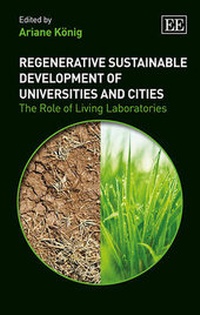
Regenerative Sustainable Development of Universities and Cities
The Role of Living Laboratories
Published on 30. September 2013
Book
Hardback
352 pages
978-1-78100-363-3 (ISBN)
Description
Now that the Earth has reached the limits of its biophysical carrying capacity, we have to change technologies, social practices and social norms relating to material production and consumption to ensure that we do not further jeopardize the functioning of our planet's life support systems. Through research, education and civic engagement, universities have a pivotal role to play in this transition. This timely book explores how universities are establishing living laboratories for sustainable development, and examines the communication networks and knowledge infrastructures that underpin impact both on and beyond the campus.
The expert contributors present case studies of living laboratories being built in leading universities across four continents. Their aim is to cultivate the transition to sustainable development by actively fostering social and technological change to improve use of natural resources and reduce pollution. They are designed to link research, education and practice and to integrate knowledge across disciplines to develop more socially robust approaches to improving sustainability. Directing attention to what enables and constrains learning in communities of multiple and very diverse stakeholders in such laboratories can contribute to a better general understanding of factors influencing the chance of success (or failure), and the institutional arrangements, norms and values that accompany it.
Focussing on social learning processes to drive societal change for sustainable development, this fascinating book will prove an invaluable read for academics, researchers, students and policy makers in the fields of higher education, regional and urban studies, public policy and the environment, and development studies.
Contributors: B. Baleti , T. Becker, T. Berkhout, A. Campbell, A. Cayuela, S. Chen, M. Dalbro, J. Evans, M. Hesse, J. Holmberg, M. Holme Samsoe, Y. Hua, J.-H. Kain, A. Kildahl, H. Komatsu, A. Koenig, N. Kurata, S. Liao, U. Lundgren, B. Meehan, E. Omrcen, T. Ozasa, M. Polk, C. Powell, J. Robinson, H. Tan, T. Ueno
The expert contributors present case studies of living laboratories being built in leading universities across four continents. Their aim is to cultivate the transition to sustainable development by actively fostering social and technological change to improve use of natural resources and reduce pollution. They are designed to link research, education and practice and to integrate knowledge across disciplines to develop more socially robust approaches to improving sustainability. Directing attention to what enables and constrains learning in communities of multiple and very diverse stakeholders in such laboratories can contribute to a better general understanding of factors influencing the chance of success (or failure), and the institutional arrangements, norms and values that accompany it.
Focussing on social learning processes to drive societal change for sustainable development, this fascinating book will prove an invaluable read for academics, researchers, students and policy makers in the fields of higher education, regional and urban studies, public policy and the environment, and development studies.
Contributors: B. Baleti , T. Becker, T. Berkhout, A. Campbell, A. Cayuela, S. Chen, M. Dalbro, J. Evans, M. Hesse, J. Holmberg, M. Holme Samsoe, Y. Hua, J.-H. Kain, A. Kildahl, H. Komatsu, A. Koenig, N. Kurata, S. Liao, U. Lundgren, B. Meehan, E. Omrcen, T. Ozasa, M. Polk, C. Powell, J. Robinson, H. Tan, T. Ueno
Reviews / Votes
'This book's case studies from North America, Europe and Asia highlight an enormous, but as yet untapped, potential for achieving social and technological change in cities worldwide. The authors show how university campuses around the world can be ''living laboratories'' to investigate and demonstrate the practicality of ''regenerative sustainability'', which looks beyond environmental damage control to a vision of urban development that actually improves environmental quality and human welfare. If these ideas catch on, they could literally change the world.'--Steve Rayner, Oxford University, UK
More details
Language
English
Place of publication
Cheltenham
United Kingdom
Target group
College/higher education
Dimensions
Height: 234 mm
Width: 156 mm
ISBN-13
978-1-78100-363-3 (9781781003633)
Copyright in bibliographic data and cover images is held by Nielsen Book Services Limited or by the publishers or by their respective licensors: all rights reserved.
Schweitzer Classification
Person
Edited by Ariane Koenig, Head of Sustainable Development and Senior Researcher, University of Luxembourg
Content
Contents:
Foreword: A Shared Exploration of 'Living Laboratories' for Sustainability
Bernd Kasemir and Roland Stulz
1. Introduction: Experimenting for Sustainable Development? Living Laboratories, Social Learning and the Role of the University
Ariane Koenig and James Evans
PART I: CAMPUS AS LIVING LABORATORY: ENGAGING COMMUNITIES IN EXPERIMENTATION
2. Next Generation Sustainability at The University of British Columbia: The University as Societal Test-bed for Sustainability
John Robinson, Tom Berkhout, Alberto Cayuela and Ann Campbell
3. Sustainable Campus as a Living Laboratory for Climate Change Mitigation and Adaptation: The Role of Design Thinking Processes
Ying Hua
4. Campus Building Energy Management in Tongji University: An Approach to Achieve Energy Efficiency of Buildings for Sustainability
Hongwei Tan and Shuqin Chen
5. Can an Environmental Management System be a Driving Force for Sustainability in Higher Education? A Case from the University of Gothenburg, Sweden
Eddi Omrcen, Ullika Lundgren and Marianne Dalbro
6. Creating Change: Building an Environmentally Sustainable Campus
Bart Meehan
7. Reconciling the Pursuit of Excellence with Sustainable Development at the University of Hong Kong
Ann Kildahl and Sarah Liao
8. What Might a Sustainable University Look Like? Challenges and Opportunities in the Development of the University of Luxembourg and its New Campus
Ariane Koenig
PART II: THE CHALLENGE FOR UNIVERSITIES TO FOSTER SUSTAINABLE DEVELOPMENT ACROSS MULTIPLE SCALES
9. Mistra Urban Futures: A Living Laboratory for Urban Transformations
Merritt Polk, Jaan-Henrik Kain and John Holmberg
10. Leading by Example: Developing an Effective Energy Efficiency Program for a Campus and Community
Christopher Powell
11. How Can Physical Campus Planning Support Universities in their Development and Ultimately Help Cities Change?
Bojan Baletic and Mikala Holme Samsoe
12. Campus Planning for Promoting Quality of Life in the Community
Naomichi Kurata, Takao Ozasa, Takeshi Ueno and Hisashi Komatsu
13. Building a Sustainable University from Scratch: Anticipating the Urban, Regional and Planning Dimension of the 'Cite des Sciences Belval' in Esch-sur-Alzette and Sanem, Luxembourg
Tom Becker and Markus Hesse
14. Conclusion: A Cross-cultural Exploration of the Co-creation of Knowledge in Living Laboratories for Societal Transformation Across Four Continents
Ariane Koenig
Annex A: ISCN/GULF Sustainable Campus Charter
Index
Foreword: A Shared Exploration of 'Living Laboratories' for Sustainability
Bernd Kasemir and Roland Stulz
1. Introduction: Experimenting for Sustainable Development? Living Laboratories, Social Learning and the Role of the University
Ariane Koenig and James Evans
PART I: CAMPUS AS LIVING LABORATORY: ENGAGING COMMUNITIES IN EXPERIMENTATION
2. Next Generation Sustainability at The University of British Columbia: The University as Societal Test-bed for Sustainability
John Robinson, Tom Berkhout, Alberto Cayuela and Ann Campbell
3. Sustainable Campus as a Living Laboratory for Climate Change Mitigation and Adaptation: The Role of Design Thinking Processes
Ying Hua
4. Campus Building Energy Management in Tongji University: An Approach to Achieve Energy Efficiency of Buildings for Sustainability
Hongwei Tan and Shuqin Chen
5. Can an Environmental Management System be a Driving Force for Sustainability in Higher Education? A Case from the University of Gothenburg, Sweden
Eddi Omrcen, Ullika Lundgren and Marianne Dalbro
6. Creating Change: Building an Environmentally Sustainable Campus
Bart Meehan
7. Reconciling the Pursuit of Excellence with Sustainable Development at the University of Hong Kong
Ann Kildahl and Sarah Liao
8. What Might a Sustainable University Look Like? Challenges and Opportunities in the Development of the University of Luxembourg and its New Campus
Ariane Koenig
PART II: THE CHALLENGE FOR UNIVERSITIES TO FOSTER SUSTAINABLE DEVELOPMENT ACROSS MULTIPLE SCALES
9. Mistra Urban Futures: A Living Laboratory for Urban Transformations
Merritt Polk, Jaan-Henrik Kain and John Holmberg
10. Leading by Example: Developing an Effective Energy Efficiency Program for a Campus and Community
Christopher Powell
11. How Can Physical Campus Planning Support Universities in their Development and Ultimately Help Cities Change?
Bojan Baletic and Mikala Holme Samsoe
12. Campus Planning for Promoting Quality of Life in the Community
Naomichi Kurata, Takao Ozasa, Takeshi Ueno and Hisashi Komatsu
13. Building a Sustainable University from Scratch: Anticipating the Urban, Regional and Planning Dimension of the 'Cite des Sciences Belval' in Esch-sur-Alzette and Sanem, Luxembourg
Tom Becker and Markus Hesse
14. Conclusion: A Cross-cultural Exploration of the Co-creation of Knowledge in Living Laboratories for Societal Transformation Across Four Continents
Ariane Koenig
Annex A: ISCN/GULF Sustainable Campus Charter
Index