

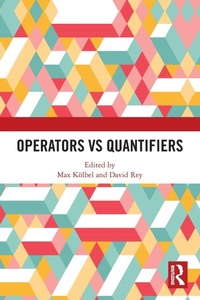
Operators vs Quantifiers
1st Edition
Published on 6. May 2025
Book
Paperback/Softback
170 pages
978-1-032-58096-8 (ISBN)
Description
In this volume, seven experts in logic and semantics examine reasons for using the intensional operator approach over the variable binding approach and vice versa.
In logic and semantics there are two alternative tools that can be applied to many types of embedding phrases (modal, temporal, etc): the intensional operator approach and the variable binding approach. A rivalry between operators and quantifiers occurs in many areas of semantics: e.g. tense, modality, locational operators, epistemic modality. There are areas where the operator approach dominates, and areas where quantifiers prevail. Sometimes, as in the case of tense, roles have switched, and where one approach used to dominate, the other has taken over. This volume features contributions from leading experts in the field that examine the following questions:
what exactly is at stake in a choice between the alternatives?
are there any principled reasons for deciding which approach to use in which case?
should we be purists and eliminate one approach completely in favour of the other?
Operators vs Quantifiers will be a key resource for academics, researchers, and advanced students of philosophy, linguistics, computer science and mathematics. This book was originally published as a special issue of Inquiry.
In logic and semantics there are two alternative tools that can be applied to many types of embedding phrases (modal, temporal, etc): the intensional operator approach and the variable binding approach. A rivalry between operators and quantifiers occurs in many areas of semantics: e.g. tense, modality, locational operators, epistemic modality. There are areas where the operator approach dominates, and areas where quantifiers prevail. Sometimes, as in the case of tense, roles have switched, and where one approach used to dominate, the other has taken over. This volume features contributions from leading experts in the field that examine the following questions:
what exactly is at stake in a choice between the alternatives?
are there any principled reasons for deciding which approach to use in which case?
should we be purists and eliminate one approach completely in favour of the other?
Operators vs Quantifiers will be a key resource for academics, researchers, and advanced students of philosophy, linguistics, computer science and mathematics. This book was originally published as a special issue of Inquiry.
More details
Language
English
Place of publication
London
United Kingdom
Publishing group
Taylor & Francis Ltd
Target group
College/higher education
Professional and scholarly
Postgraduate and Undergraduate
Dimensions
Height: 234 mm
Width: 156 mm
Thickness: 10 mm
Weight
284 gr
ISBN-13
978-1-032-58096-8 (9781032580968)
Copyright in bibliographic data and cover images is held by Nielsen Book Services Limited or by the publishers or by their respective licensors: all rights reserved.
Schweitzer Classification
Other editions
Additional editions
Max Koelbel | David Rey
Operators vs Quantifiers
E-Book
12/2023
1st Edition
Taylor & Francis
€60.49
Available for download
Max Koelbel | David Rey
Operators vs Quantifiers
Book
12/2023
1st Edition
Routledge
€205.90
Shipment within 10-20 days
Max Koelbel | David Rey
Operators vs Quantifiers
E-Book
12/2023
1st Edition
Taylor & Francis
€60.49
Available for download
Persons
Max Koelbel is Professor of Philosophy at the University of Vienna, Austria.
David Rey is Assistant Professor at the Department of Philosophy of Universidad del Valle, Colombia.
David Rey is Assistant Professor at the Department of Philosophy of Universidad del Valle, Colombia.
Content
Introduction 1. Are quantifiers intensional operators? 2. Binding bound variables in epistemic contexts 3. Operators vs. quantifiers: the view from linguistics 4. Confessions of a schmentencite: towards an explicit semantics 5. Positing covert variables and the quantifier theory of tense 6. Looking backwards in type logic