

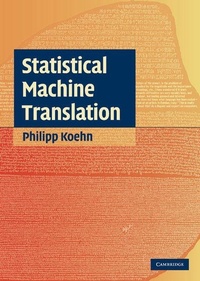
Statistical Machine Translation
Published on 17. December 2009
Book
Hardback
446 pages
978-0-521-87415-1 (ISBN)
Description
The dream of automatic language translation is now closer thanks to recent advances in the techniques that underpin statistical machine translation. This class-tested textbook from an active researcher in the field, provides a clear and careful introduction to the latest methods and explains how to build machine translation systems for any two languages. It introduces the subject's building blocks from linguistics and probability, then covers the major models for machine translation: word-based, phrase-based, and tree-based, as well as machine translation evaluation, language modeling, discriminative training and advanced methods to integrate linguistic annotation. The book also reports the latest research, presents the major outstanding challenges, and enables novices as well as experienced researchers to make novel contributions to this exciting area. Ideal for students at undergraduate and graduate level, or for anyone interested in the latest developments in machine translation.
Reviews / Votes
'Philipp Koehn has provided the first comprehensive text for the rapidly growing field of statistical machine translation. This book is an invaluable resource for students, researchers, and software developers, providing a lucid and detailed presentation of all the important ideas needed to understand or create a state-of-the-art statistical machine translation system.' Robert C. Moore, Principal Researcher, Microsoft Research 'The book primarily represents an ideal introduction to the field of statistical machine translation, but also tackles many of the recent results in this area. It is the product of the many years of both active research and extensive teaching of the author ... Each chapter is additionally endowed with a summary, further reading and exercises, achieving thus completely the proposed goal of an accessible introduction to the statistical machine translation field. Apart from its formative role for beginners, the book also stands as a complete guide for researchers in a domain of high interest and rapid expansion ... For all these reasons, this book should be welcomed as a highly valuable publication.' Zentralblatt MATH '... Statistical Machine Translation provides an excellent synthesis of a vast amount of literature (the bibliography section takes up 45 double-column pages) and presents it in a well-structured and articulate way. Moreover, the book has been class-tested and contains a set of exercises at the end of each chapter, as well as numerous references to open source tools and resources which enable the diligent reader to build MT systems for any language pair.' Target: International Journal of Translation StudiesMore details
Language
English
Place of publication
Cambridge
United Kingdom
Target group
Professional and scholarly
College/higher education
Illustrations
Worked examples or Exercises; 24 Halftones, unspecified
Dimensions
Height: 250 mm
Width: 175 mm
Thickness: 28 mm
Weight
944 gr
ISBN-13
978-0-521-87415-1 (9780521874151)
Copyright in bibliographic data and cover images is held by Nielsen Book Services Limited or by the publishers or by their respective licensors: all rights reserved.
Schweitzer Classification
Other editions
Additional editions
Philipp Koehn
Statistical Machine Translation
E-Book
06/2010
1st Edition
Cambridge University Press
€70.99
Available for download
Philipp Koehn
Statistical Machine Translation
E-Book
12/2009
Cambridge University Press
€56.49
Available for download
Person
Philipp Koehn is a lecturer in the School of Informatics at the University of Edinburgh. He is the scientific co-ordinator of the European EuroMatrix project and also involved in research funded by DARPA in the USA. He has also collaborated with leading companies in the field, such as Systran and Asia Online. He implemented the widely used decoder Pharoah, and is leading the development of the open source machine translation toolkit Moses.
Content
Preface; Part I. Foundations: 1. Introduction; 2. Words, sentences, corpora; 3. Probability theory; Part II. Core Methods: 4. Word-based models; 5. Phrase-based models; 6. Decoding; 7. Language models; 8. Evaluation; Part III. Advanced Topics: 9. Discriminative training; 10. Integrating linguistic information; 11. Tree-based models; Bibliography; Author index; Index.