

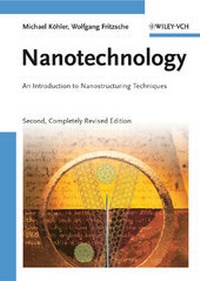
Nanotechnology
An Introduction to Nanostructuring Techniques
2nd Edition
Published on 20. September 2007
Book
Hardback
XII, 320 pages
978-3-527-31871-1 (ISBN)
Description
Expectations of a technological revolution are associated with nanotechnology, and indeed the generation, modification and utilization of objects with tiniest dimensions already permeates science and research in a way that the absence of nanotechnology is no longer conceivable. It has progressed to an independent interdisciplinary field, its great success due to the purposeful combination of physical, mechanical and molecular techniques.
This book starts out with the most important fundamentals of microtechnology and chemistry on which the understanding of shaping nanoscale structures are based. Next, a variety of examples illustrate the fabrication of nanostructures from different materials, before, finally, methods for characterization of the generated structures are presented.
This fascinating introduction provides both scientists and engineers with insights into the "other side" of nanotechnology.
Reviews / Votes
"The book is clearly written for people with a technical background who either wish to start research and development in nanotechnology or just want to learn more about nanotechnology and what it stands for. Once your mind becomes receptive to the idea of nanotechnology, this book is relatively easy to read, and I would recommend it as a good introductory text." Materials World "Through this fascinating introduction, both scientists and engineers gain insights into the "other side" of nanotechnology in this highly recommended publication." Advances in Food Sciences "...comprehensive coverage of all underlying principles...quite instructive diagrams..." Chemistry & Industry "Through this fascinating introduction, both scientists and engineers gain insights into the "other side" of nanotechnology in this highly recommended publication." AFS - Advances in Food Sciences "Of interest to scientists and engineers in many research areas of nanotechnology, this book offers a valuable referee source and some state-of-the-art reviews." Lifeng Chi, Physics Department, Universität Münster, small "In summary, the book offers a general survey of nanolitography and scanning probe techniques." Colloid & Polymer Science "Very recent progress are well addressed, together with a list of original publications for each method. Benefiting from their own research fields, the authors have a broad view of nanostructures. This book offers a valuable referee source and some state-of-the-art reviews." smallMore details
Edition
2. vollständig überarbeitete Auflage
Language
English
Place of publication
Berlin
Germany
Target group
Professional and scholarly
Edition type
New edition
Illustrations
171
163 s/w Abbildungen, 8 s/w Tabellen
Dimensions
Height: 24 cm
Width: 17 cm
Thickness: 2.1 cm
Weight
758 gr
ISBN-13
978-3-527-31871-1 (9783527318711)
Schweitzer Classification
Other editions
Additional editions
E-Book
01/2008
2nd Edition
Wiley-VCH
€192.99
Available for download
Previous edition
Book
02/2004
1st Edition
Wiley-VCH
€139.00
Article exhausted; check for reprint
Persons
Michael Köhler is a Professor of Physical Chemistry and Microreaction Technology at the Technical University of Ilmenau, Germany, since 2001 and at the same time Visiting Scientist at the Institute for Physical High Technology (IPHT) in Jena, also Germany. He studied chemistry and completed his Ph.D in Halle an der Saale and Jena and completed his habilitation in general and physical chemistry, giving lectures at Wuppertal University and serving from 1993 on as lecturer at the Friedrich-Schiller-University in Jena for microlithography, microsystem technology and nanotechnology.
Wolfgang Fritzsche heads the Biotechnical Microsystems Department at the Institute for Physical High Technology (IPHT) in Jena, Germany, since 2001. He obtained his diploma from the Friedrich-Schiller-University (FSU) Jena, then went on to research work on AFM of DNA-protein complexes at the Max-Planck-Institute for Biophysical Chemistry in Göttingen, receiving his Ph.D. degree in physical chemistry from the Georg-August-University in Göttingen. He held a postdoc position at Iowa State University, USA, working there from 1994 to 1996 on biological AFM and image processing.
Content
Introduction
Molecular Basics
Microtechnical Foundations
Preparation of Nanostructures
Nanotechnical Structures
Characterization of Nanostructures
Nanotransducers
Technical Nanosystems
Table of Examples
References
Index