

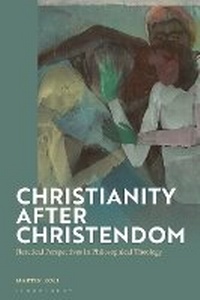
Christianity after Christendom
Heretical Perspectives in Philosophical Theology
Published on 5. October 2023
Book
Hardback
248 pages
978-1-350-32263-9 (ISBN)
Description
What comes after the end of Christendom? Christianity has ceased to function as the dominant force in society and yet the Christian faith continues. How are we to understand Christianity in this 'after'?
Bringing into conversation seven unorthodox or 'heretical' continental philosophers, including Jan Patocka, Jean-Luc Nancy, Gianni Vattimo and John D. Caputo, Martin Koci re-centres the debates around philosophy's so-called return to religion to address the current 'not-Christian, but not yet non-Christian' culture.
In the modern context of increasing secularization and pluralization, Christianity after Christendom boldly proposes that Christians must embrace the demise of Christianity as a meta-narrative and see their faith as an existential mode of being-in-the-world. Whilst not denying the religion's history, this 'after' of Christianity emancipates the discourse from the socio-historical focus on Christendom and introduces new perspectives on Christianity as an embodied religious tradition, as a way of being, even as a faithfulness to the world.
In dialogue with a broad range of philosophical movements, including deconstruction, phenomenology, hermeneutics and postmodern critiques of religion, this is a timely examination of the present and future of post-Christendom Christianity.
Bringing into conversation seven unorthodox or 'heretical' continental philosophers, including Jan Patocka, Jean-Luc Nancy, Gianni Vattimo and John D. Caputo, Martin Koci re-centres the debates around philosophy's so-called return to religion to address the current 'not-Christian, but not yet non-Christian' culture.
In the modern context of increasing secularization and pluralization, Christianity after Christendom boldly proposes that Christians must embrace the demise of Christianity as a meta-narrative and see their faith as an existential mode of being-in-the-world. Whilst not denying the religion's history, this 'after' of Christianity emancipates the discourse from the socio-historical focus on Christendom and introduces new perspectives on Christianity as an embodied religious tradition, as a way of being, even as a faithfulness to the world.
In dialogue with a broad range of philosophical movements, including deconstruction, phenomenology, hermeneutics and postmodern critiques of religion, this is a timely examination of the present and future of post-Christendom Christianity.
Reviews / Votes
A momentously fresh opportunity for theology, and for the church ... This is an important work. * Theology * Taking cues from recent figures working on the borders of theology and phenomenology, Koci pushes us toward the core of embodied religious existence without yet performing a phenomenological analysis, offering us a rich dialectical approach that seeks to appreciate both hermeneutical and phenomenological methods. Christianity is seen therefore as what it is, a way of life and not just a hermeneutical, or thought-based exercise. * Colby Dickinson, Professor of Theology, Loyola University Chicago, USA *More details
Language
English
Place of publication
London
United Kingdom
Publishing group
Bloomsbury Publishing PLC
Target group
Professional and scholarly
Dimensions
Height: 220 mm
Width: 146 mm
Thickness: 20 mm
Weight
440 gr
ISBN-13
978-1-350-32263-9 (9781350322639)
Copyright in bibliographic data and cover images is held by Nielsen Book Services Limited or by the publishers or by their respective licensors: all rights reserved.
Schweitzer Classification
Other editions
Additional editions
E-Book
09/2023
1st Edition
Bloomsbury Academic
€31.99
Available for download
Person
Martin Koci is Associate Professor at the Catholic University of Linz, Austria. He is the author of Thinking Faith after Christianity (2020) for which he received the Book Prize for the Theological Book of the Years 2019-2020 from the European Society for Catholic Theology.
Content
Introduction
Part I: The Postmodern Ends of Christianity
Chapter 1 Lost Credibility: Jean-Francois Lyotard's Critique of Meta-Narrative
Chapter 2 Deconstruction: Jean-Luc Nancy and the Essence of Christianity
Chapter 3 The Sense of the After: Jan Patocka and Post-Christian Epoch
Part II: The Figures of the After
Chapter 4 Weak Christianity: Gianni Vattimo
Chapter 5 Christianity without Religion: John D. Caputo
Chapter 6 Poetics of Anatheistic Christianity: Richard Kearney
Part III: The Spirituality of Being in the World
Chapter 7 Christianity Interrupted: A Theological Experiment of Lieven Boeve
Chapter 8 Being Shaken
Chapter 9 The Community of the Shaken
Conclusion: Into the World
Notes
Index
Part I: The Postmodern Ends of Christianity
Chapter 1 Lost Credibility: Jean-Francois Lyotard's Critique of Meta-Narrative
Chapter 2 Deconstruction: Jean-Luc Nancy and the Essence of Christianity
Chapter 3 The Sense of the After: Jan Patocka and Post-Christian Epoch
Part II: The Figures of the After
Chapter 4 Weak Christianity: Gianni Vattimo
Chapter 5 Christianity without Religion: John D. Caputo
Chapter 6 Poetics of Anatheistic Christianity: Richard Kearney
Part III: The Spirituality of Being in the World
Chapter 7 Christianity Interrupted: A Theological Experiment of Lieven Boeve
Chapter 8 Being Shaken
Chapter 9 The Community of the Shaken
Conclusion: Into the World
Notes
Index