

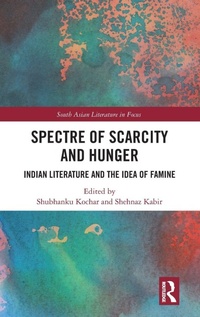
Spectre of Scarcity and Hunger
Indian Literature and the Idea of Famine
1st Edition
Will be published approx. on 10. July 2026
Book
Hardback
220 pages
978-1-041-12274-6 (ISBN)
Description
This book explores Indian English writing and English translations of Indian works through the framework of famine. It examines literary representations of famine across time, from ancient and medieval India to colonial and contemporary times. The chapters in the volume contribute to the contemporary debates on climate action and ecological crises. The volume will be of interest to scholars and researchers of South Asian studies and literature.
More details
Series
Language
English
Place of publication
London
United Kingdom
Publishing group
Taylor & Francis Ltd
Target group
College/higher education
Postgraduate
Illustrations
1 s/w Photographie bzw. Rasterbild, 1 s/w Abbildung
1 Halftones, black and white; 1 Illustrations, black and white
Dimensions
Height: 234 mm
Width: 156 mm
ISBN-13
978-1-041-12274-6 (9781041122746)
Copyright in bibliographic data and cover images is held by Nielsen Book Services Limited or by the publishers or by their respective licensors: all rights reserved.
Schweitzer Classification
Other editions
Additional editions
Shubhanku Kochar | Shehnaz Kabir
Spectre of Scarcity and Hunger
Indian Literature and the Idea of Famine
E-Book
approx. 07/2026
Routledge
€60.49
Available for download
Shubhanku Kochar | Shehnaz Kabir
Spectre of Scarcity and Hunger
Indian Literature and the Idea of Famine
E-Book
approx. 07/2026
Routledge
€60.49
Available for download
Persons
Shubhanku Kochar teaches at the University School of Humanities and Social Sciences at Guru Gobind Singh Indraprastha University, Delhi. He specialises in African literatures in English and eco-criticism. His latest publications are Environmental Post-Colonialism: A Literary Response (2021, Lexington Books), Literature from the Peripheries: Refrigerated Culture and Pluralism (2023, Lexington Books), and Pastoral and Anti-Pastoral: Representation of City and Village in Literature (2024, Ibidem/Columbia University Press). His forthcoming books are Beyond the Ocean: Literature History and the British Empire and Poverty and Pollution: Environmental Casteism and Dalit Literature, both to be published by Springer. His poems have been published in Protagonist, a popular literary magazine.
Shehnaz Kabir has been awarded with a doctorate degree by the Department of English at Jadavpur University. Her latest publications include "Negotiating Identities in the Indo-Caribbean Diaspora: Queer Bildungsroman and Gendered Spaces in Select Novels of Shani Mootoo" (The IACLALS Journal, 2020) and "Commodification of Identity: Dissecting the Coolie Body in the Indo-Caribbean Diaspora" (New Literaria, 2021). Her paper "Gendered Negotiations and Role of Female Agency in Select Indo-Caribbean Fiction" is published by Springer. Her areas of interest include hydro-colonialism, indenture trade, diaspora literature, material cultures, and postcolonial studies.
Shehnaz Kabir has been awarded with a doctorate degree by the Department of English at Jadavpur University. Her latest publications include "Negotiating Identities in the Indo-Caribbean Diaspora: Queer Bildungsroman and Gendered Spaces in Select Novels of Shani Mootoo" (The IACLALS Journal, 2020) and "Commodification of Identity: Dissecting the Coolie Body in the Indo-Caribbean Diaspora" (New Literaria, 2021). Her paper "Gendered Negotiations and Role of Female Agency in Select Indo-Caribbean Fiction" is published by Springer. Her areas of interest include hydro-colonialism, indenture trade, diaspora literature, material cultures, and postcolonial studies.
Content
Introduction Section I - Mythology, Morality, and Faith 1. Good Ruler, Good Earth: An Analysis of the Representation of Famine as Karmic Effect in Select Texts from Ancient India 2. Famished Ground, Hungry Being: Udgitha and Selfhood in Chandogya Upanishad 3. Ethical Dilemmas and Desperation during Famine: Exploring Moral Choices in Desperate Circumstances in the Mahabharata 4. Food and Crying for Food in the Bengal Ma?gala Kabyas of the 18th Century Section II - Alternative Approach to Plays and Paraliterature 5. Famine, Tughlaq and Girish Karnad: A Historical Analysis 6. Reclaiming the Memories of Famine in India through the Writings of Mughal Court Writers 7. Representation of Entitlement and Deprivation: Reading Bengal Famine through Bijan Bhattacharya's Plays Section III - Statehood and Community Trauma 8. Bankimchandra's Anandamath and the Spectre of the Bengal Famine of 1770 9. Alimentary Catastrophes and Tragedies of Hunger on Screen: Exploring Mrinal Sen's Baishey Srabon (1960) and Akaler Sandhane (In Search of a Famine, 1980) through a Postcolonial Lens 10. Hungry Man Reach for the Book. It is a Weapon!: The Political Economy of Famine, Caste, Class and Imperialism in Bhabani Bhattacharya's So Many Hungers and He Who Rides a Tiger 11. Bamboo Flowering and Rat Flood in Mizoram: Description of the 'Mautam' Famine in Malsawmi Jacob's 'Zorami: The Redemption Song' Section IV - Voice of the Marginalized 12. Chronicles of the Na'anka Durbhikhya: Understanding Famines and Social Realism in Odisha through the Writings of Kanhu Charan Mohanty 13. Where Famine is Life: A Study of the Select Karisal Short Stories 14. An Exploration of Kalahandi Famine as 'New Famine': Depiction of Hunger, Mass Starvation, and Death in Post-independence Odia Literature 15. Palamau is a Mirror of India": Famine, Seed, and Making the Subaltern Matter Afterword