

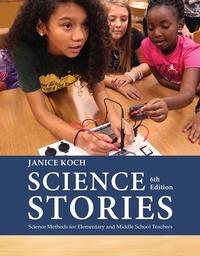
Science Stories
Science Methods for Elementary and Middle School Teachers
6th Edition
Published on 1. January 2017
Book
Paperback/Softback
432 pages
978-1-305-96072-5 (ISBN)
Description
SCIENCE STORIES helps you get in touch with your "scientific self" and become empowered to teach science in your own classrooms. This book's unique approach uses stories of science in real-world classrooms to demonstrate important science content and strategies in action. Following each story, you'll have the opportunity to reflect on the connections to the Next Generation Science Standards (NGSS) and to the teaching and disciplinary ideas behind the story. This approach makes the stories' instructional value explicit. Author Janice Koch helps you feel comfortable with the prospect of teaching science and encourages you in the discovery and exploration of life, physical, and earth and space sciences. Through a warm and inviting narrative style, the author also fosters an appreciation for engineering design and for science and engineering practices.
More details
Edition
6th edition
Language
English
Place of publication
Belmont, CA
United States
Publishing group
Cengage Learning, Inc
Target group
College/higher education
Product notice
Paperback (trade)
Unsewn / adhesive bound
Dimensions
Height: 284 mm
Width: 213 mm
Thickness: 15 mm
Weight
816 gr
ISBN-13
978-1-305-96072-5 (9781305960725)
Copyright in bibliographic data and cover images is held by Nielsen Book Services Limited or by the publishers or by their respective licensors: all rights reserved.
Schweitzer Classification
Person
Janice Koch is Professor Emeritus of Science Education in the Department of Curriculum and Teaching at Hofstra University, Long Island, New York. She developed and taught science education courses to elementary, middle, and secondary pre-and in-service teachers. Additionally, she taught courses addressing: Introduction to Education, Action Research, Qualitative Research, and Gender Issues in the classroom. Dr. Koch shares her passion for teaching and learning through presentations as well as through her introduction to education text TEACH, 3rd Edition (2016, Cengage Learning). Her acclaimed textbook SCIENCE STORIES has been used by thousands of pre-service and in-service educators interested in creating meaningful science experiences for their students. She and her husband currently reside in Central Maryland, where she consults on education projects across the country and internationally and evaluates grant funded science education initiatives. She presented her work at Oxford University in 2014.
Content
1. Science Teaching and You: Locating Your Scientific Self.
2. Teachers and Students as Science Learners.
3. Engaging Students in Scientific and Engineering Practices.
4. Scientific Explorations Inside and Outside the Classroom.
5. Exploring Matter: Scientific Observations of Everyday Materials.
6. Plants and Animals and Extended Investigations.
7. Physical Science Explorations: Density and Its Implications.
8. Using Models and Engineering Design for Teaching and Learning Science.
9. Beyond the "Science Kit".
10. Content and Curriculum: Science Concepts and Your Scientific Self.
11. Surrounded by Science: Science Connections Across Disciplines.
12. Creating the Science Experience in Your Classroom: Planning and Letting Go.
13. What's the Big Idea? Matching Assessment to Instruction.
14. Pulling It All Together.
2. Teachers and Students as Science Learners.
3. Engaging Students in Scientific and Engineering Practices.
4. Scientific Explorations Inside and Outside the Classroom.
5. Exploring Matter: Scientific Observations of Everyday Materials.
6. Plants and Animals and Extended Investigations.
7. Physical Science Explorations: Density and Its Implications.
8. Using Models and Engineering Design for Teaching and Learning Science.
9. Beyond the "Science Kit".
10. Content and Curriculum: Science Concepts and Your Scientific Self.
11. Surrounded by Science: Science Connections Across Disciplines.
12. Creating the Science Experience in Your Classroom: Planning and Letting Go.
13. What's the Big Idea? Matching Assessment to Instruction.
14. Pulling It All Together.