

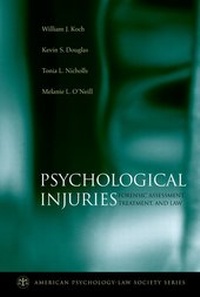
Psychological Injuries
Forensic Assessment, Treatment, and Law
Published on 3. November 2005
Book
Hardback
336 pages
978-0-19-518828-8 (ISBN)
Description
Human emotional suffering has been studied for centuries, but the significance of psychological injuries within legal contexts has only recently been recognized. As the public becomes increasingly aware of the ways in which mental health affects physical - and financial - well-being, psychological injuries comprise a rapidly growing set of personal injury insurance claims. Although the diverse range of problems that people claim to suffer from are serious and often genuine, the largely subjective and unobservable nature of psychological conditions has led to much skepticism about the authenticity of psychological injury claims. Improved assessment methods and research on the economic and physical health consequences of psychological distress has resulted in exponential growth in the litigation related to such conditions.
Integrating the history of psychological injuries both from legal and mental health perspectives, this book offers compelling discussions of relevant statutory and case law. Focussing especially on posttraumatic stress disorder, it addresses the current status and empirical limitations of forensic assessments of psychological injuries and alerts readers to common vulnerabilities in expert evidence from mental health professionals. In addition, it also uses the latest empirical research to provide the best forensic methods for assessing both clinical conditions such as posttraumatic stress disorder and for alternative explanations such as malingering. The authors offer state-of-the-art information on early intervention, psychological therapies, and pharmaceutical treatments for posttraumatic stress disorder and stimulating suggestions for further research into this complex phenomenon.
A comprehensive guide to psychological injuries, this book will be an indispensable resource for all mental health practitioners, researchers, and legal professionals who work with psychological injuries.
Integrating the history of psychological injuries both from legal and mental health perspectives, this book offers compelling discussions of relevant statutory and case law. Focussing especially on posttraumatic stress disorder, it addresses the current status and empirical limitations of forensic assessments of psychological injuries and alerts readers to common vulnerabilities in expert evidence from mental health professionals. In addition, it also uses the latest empirical research to provide the best forensic methods for assessing both clinical conditions such as posttraumatic stress disorder and for alternative explanations such as malingering. The authors offer state-of-the-art information on early intervention, psychological therapies, and pharmaceutical treatments for posttraumatic stress disorder and stimulating suggestions for further research into this complex phenomenon.
A comprehensive guide to psychological injuries, this book will be an indispensable resource for all mental health practitioners, researchers, and legal professionals who work with psychological injuries.
Reviews / Votes
"[the authors] present an in-depth review of the interaction effects of social economic factors, gender, culture, and the type of stressors--nowhere so carefully crafted and thoroughly researched as in this book...Whether you are a clinician who assesses and treats traumatized clients or a forensic psychologist who evaluates clients for legal proceedings, this book will improve your knowledge and understanding...My clinical awareness and practice has beensharpened by its reading."--PsycCRITIQUES
"This is a great book that fills a much needed void in the psychological and legal literature. A timely and scholarly piece, it is a well written work that provides critical information for anyone interested in the area."---- Edward J. Hickling, Psy.D., Center for Stress and Anxiety Disorders, SUNY-Albany Capital Psychological Associates, Albany, NY
"Dr. William J. Koch and colleagues have successfully produced a superbly comprehensive yet practical book about psychological trauma, its legal implications, and clinical practice ramifications. This outstanding work should be required reading for any practitioner involved in forensically oriented work, or for those who treat posttraumatic stress disorder and similar conditions. In an increasingly litigious world, practitioners need more and better resources
to inform, guide, and justify their activities; Psychological Injuries: Forensic Assessment, Treatment, and Law will probide clear, concise, and thorough direction to anyone involved in this kind of
work. Kudos to Koch and colleagues for providing both a timely and unique resource, which will no doubt become the new standard for excellence by integrating clinical research, legal-medical issues, and practice."----Johan Rosqvist, Psy.D., Solutions for Anxiety Clinic, Pacific University
"Essential reading for any lawyer handling cases involving psychological injuries. This book not only outlines the development and explains the research underpining the medical issues, but tracks the legal developments and challenges facing counsel. I came away better armed to advise clients, prepare expert witnesses and present my case."----Stephen McPhee, Trial Lawyer, British Columbia, Canada
"A landmark volume that provides a thoughtful and lucid discussion of issues related to psychological injury. Topics covered range from historical origins to the political and scientific issues that shape our current views of psychological disorders in a medical-legal context. The authors provide a number of savy clinical insights that reflect a wealth of clinical and legal experience. The comprehensive coverage of the research literature alone is worth the
price of the volume. This well written and important book should be required reading for all legal and health care professionals."----Lynn Alden, Associate Dean & Professor, Department of Psychology,
University of British Colombia, Vancouver, British Colombia, Canada
"[the authors] present an in-depth review of the interaction effects of social economic factors, gender, culture, and the type of stressors--nowhere so carefully crafted and thoroughly researched as in this book...Whether you are a clinician who assesses and treats traumatized clients or a forensic psychologist who evaluates clients for legal proceedings, this book will improve your knowledge and understanding...My clinical awareness and practice has been
sharpened by its reading."--PsycCRITIQUES
"This is a great book that fills a much needed void in the psychological and legal literature. A timely and scholarly piece, it is a well written work that provides critical information for anyone interested in the area."---- Edward J. Hickling, Psy.D., Center for Stress and Anxiety Disorders, SUNY-Albany Capital Psychological Associates, Albany, NY
"Dr. William J. Koch and colleagues have successfully produced a superbly comprehensive yet practical book about psychological trauma, its legal implications, and clinical practice ramifications. This outstanding work should be required reading for any practitioner involved in forensically oriented work, or for those who treat posttraumatic stress disorder and similar conditions. In an increasingly litigious world, practitioners need more and better resources
to inform, guide, and justify their activities; Psychological Injuries: Forensic Assessment, Treatment, and Law will probide clear, concise, and thorough direction to anyone involved in this kind of
work. Kudos to Koch and colleagues for providing both a timely and unique resource, which will no doubt become the new standard for excellence by integrating clinical research, legal-medical issues, and practice."----Johan Rosqvist, Psy.D., Solutions for Anxiety Clinic, Pacific University
"Essential reading for any lawyer handling cases involving psychological injuries. This book not only outlines the development and explains the research underpining the medical issues, but tracks the legal developments and challenges facing counsel. I came away better armed to advise clients, prepare expert witnesses and present my case."----Stephen McPhee, Trial Lawyer, British Columbia, Canada
"A landmark volume that provides a thoughtful and lucid discussion of issues related to psychological injury. Topics covered range from historical origins to the political and scientific issues that shape our current views of psychological disorders in a medical-legal context. The authors provide a number of savy clinical insights that reflect a wealth of clinical and legal experience. The comprehensive coverage of the research literature alone is worth the
price of the volume. This well written and important book should be required reading for all legal and health care professionals."----Lynn Alden, Associate Dean & Professor, Department of Psychology,
University of British Colombia, Vancouver, British Colombia, Canada
More details
Series
Language
English
Place of publication
New York
United States
Target group
Professional and scholarly
Clinical and forensic psychologists, psychiatrists, lawyers, graduate students in clinical or forensic psychology, researchers with special interest in this area.
Illustrations
Tables and line drawings
Dimensions
Height: 160 mm
Width: 234 mm
Thickness: 28 mm
Weight
601 gr
ISBN-13
978-0-19-518828-8 (9780195188288)
Copyright in bibliographic data and cover images is held by Nielsen Book Services Limited or by the publishers or by their respective licensors: all rights reserved.
Schweitzer Classification
Other editions
Additional editions
William J. Koch | Kevin S. Douglas | Tonia L. Nicholls
Psychological Injuries
Forensic Assessment, Treatment, and Law
E-Book
10/2005
1st Edition
OUP eBook
€47.49
Available for download
William J. Koch | Kevin S. Douglas | Tonia L. Nicholls
Psychological Injuries
Forensic Assessment, Treatment, and Law
E-Book
10/2005
1st Edition
OUP eBook
€47.49
Available for download
Persons
William Koch is a Clinical and Forensic Psychologist whose practice and research interests involve psychological injuries. He lives in West Vancouver, British Columbia, and has appointments at both the University of British Columbia and Simon Fraser University.
Kevin Douglas is on faculty at Simon Fraser University. He has a PhD in clinical-forensic psychology, as well as a law degree. His research interests and professional activities focus on forensic assessment, and he has published 40+ chapters and articles within this area.
Tonia Nicholls is a Social Sciences and Humanities Research Council of Canada and Michael Smith Foundation for Health Research Post Doctoral Fellow with the Department of Psychiatry, University of British Columbia and the British Columbia Institute Against Family Violence. Her research and publications address issues of relevance to women and violence including, abuse in intimate relationships, violence risk assessments with mentally disordered women, psychopathy, and women in conflict with the law.
Melanie O'Neill is University College Professor at Malaspina University College in Nanaimo, British Columbia. Her clinical and research interests focus on developing and refining treatments for anxiety disorders including posttraumatic stress disorder (PTSD) and obsessive compulsive disorder (OCD). She maintains a small private practice that focuses exclusively on proving evidence based therapy for the anxiety disorders with individuals of all ages.
Kevin Douglas is on faculty at Simon Fraser University. He has a PhD in clinical-forensic psychology, as well as a law degree. His research interests and professional activities focus on forensic assessment, and he has published 40+ chapters and articles within this area.
Tonia Nicholls is a Social Sciences and Humanities Research Council of Canada and Michael Smith Foundation for Health Research Post Doctoral Fellow with the Department of Psychiatry, University of British Columbia and the British Columbia Institute Against Family Violence. Her research and publications address issues of relevance to women and violence including, abuse in intimate relationships, violence risk assessments with mentally disordered women, psychopathy, and women in conflict with the law.
Melanie O'Neill is University College Professor at Malaspina University College in Nanaimo, British Columbia. Her clinical and research interests focus on developing and refining treatments for anxiety disorders including posttraumatic stress disorder (PTSD) and obsessive compulsive disorder (OCD). She maintains a small private practice that focuses exclusively on proving evidence based therapy for the anxiety disorders with individuals of all ages.
Author
Professor of Clinical PsychiatryProfessor of Clinical Psychiatry, University of British Columbia, Canada
Assistant Professor, Department of PsychologyAssistant Professor, Department of Psychology, Simon Fraser University, Canada
Postdoctoral Fellow, Department of PsychiatryPostdoctoral Fellow, Department of Psychiatry, University of British Columbia, Canada
University College Professor, Department of PsychologyUniversity College Professor, Department of Psychology, Malaspina University College, Canada
Content
INDEX