

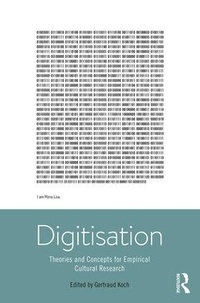
Digitisation
Theories and Concepts for Empirical Cultural Research
1st Edition
Published on 23. June 2017
Book
Hardback
320 pages
978-1-138-64610-0 (ISBN)
Description
In recent years, digital technologies have become pervasive in academic and everyday life. This comprehensive volume covers a wide range of concepts for studying the new cultural dynamics that are evident as a result of digitisation. It considers how the cultural changes triggered by digitisation processes can be approached empirically. The chapters include carefully chosen examples and help readers from disciplines such as Anthropology, Sociology, Media Studies, and Science & Technology Studies to grasp digitisation theoretically as well as methodologically.
More details
Language
English
Place of publication
London
United Kingdom
Publishing group
Taylor & Francis Ltd
Target group
College/higher education
Illustrations
16 s/w Abbildungen, 15 s/w Photographien bzw. Rasterbilder, 1 s/w Zeichnung
1 Line drawings, black and white; 15 Halftones, black and white; 16 Illustrations, black and white
Dimensions
Height: 234 mm
Width: 156 mm
Weight
750 gr
ISBN-13
978-1-138-64610-0 (9781138646100)
Copyright in bibliographic data and cover images is held by Nielsen Book Services Limited or by the publishers or by their respective licensors: all rights reserved.
Schweitzer Classification
Other editions
Additional editions
Book
12/2019
1st Edition
Routledge
€53.22
Shipment within 15-20 days
E-Book
07/2017
Routledge
€60.49
Available for download
E-Book
07/2017
Routledge
€60.49
Available for download
Person
Gertraud Koch is a Professor and Head of Institute of European Ethnology / Cultural Anthropology at the University of Hamburg, Germany.
Content
Introduction: Digitisation as challenge for empirical cultural research 1. Cultural techniques, practices, programmes: How to study the anthropo-logic of digitisation 2. Archive 3. Imperfect imaginaries: Digitisation, mundanisation, and the ungraspable 4. Ethnography of digital infrastructures 5. Hackers and hacking 6. 'A brilliant copy every time!': Aspects of a cultural proportion 7. The manifestation of mash-up categories 8. Big Data 9. From GUI to No-UI: Locating the interface for the Internet of Things 10. Ubiquitous computing and the Internet of Things 11. Calculating spaces: Digital encounters with maps and geodata 12. Augmented realities 13. The political economy of digital technologies: Outlining an emerging field of research 14. Ludification of culture: The significance of play and games in everyday practices of the digital era 15. Media genealogy: Back to the present of digital cultures