

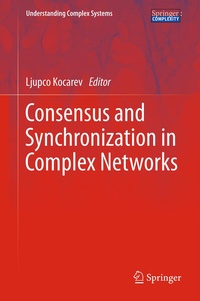
Consensus and Synchronization in Complex Networks
Published on 16. January 2013
Book
Hardback
IX, 275 pages
978-3-642-33358-3 (ISBN)
Description
In this book for the first time two scientific fields - consensus formation and synchronization of communications - are presented together and examined through their interrelational aspects, of rapidly growing importance. Both fields have indeed attracted enormous research interest especially in relation to complex networks.
In networks of dynamic systems (or agents), consensus means to reach an agreement regarding a certain quantity of interest that depends on the state of all dynamical systems (agents). Consensus problems have a long history in control theory and computer sciences, and form the foundation of the field of distributed computing. Synchronization, which defines correlated-in-time behavior between different processes and roots going back to Huygens to the least, is now a highly popular, exciting and rapidly developing topic, with applications ranging from biological networks to mathematical epidemiology, and from processing information in the brain to engineering of communications devices.
The book reviews recent finding in both fields and describes novel approaches to consensus formation, where consensus is realized as an instance of the nonlinear dynamics paradigm of chaos synchronization. The chapters are written by world-known experts in both fields and cover topics ranging from fundaments to various applications of consensus and synchronization.
In networks of dynamic systems (or agents), consensus means to reach an agreement regarding a certain quantity of interest that depends on the state of all dynamical systems (agents). Consensus problems have a long history in control theory and computer sciences, and form the foundation of the field of distributed computing. Synchronization, which defines correlated-in-time behavior between different processes and roots going back to Huygens to the least, is now a highly popular, exciting and rapidly developing topic, with applications ranging from biological networks to mathematical epidemiology, and from processing information in the brain to engineering of communications devices.
The book reviews recent finding in both fields and describes novel approaches to consensus formation, where consensus is realized as an instance of the nonlinear dynamics paradigm of chaos synchronization. The chapters are written by world-known experts in both fields and cover topics ranging from fundaments to various applications of consensus and synchronization.
Reviews / Votes
From the reviews:
"This book contains ten papers that discuss different aspects of consensus and synchronization problems in complex networks. . The book is targeted to an audience that works on synchronization problems. The editor and authors have tried to introduce this audience to existing work on consensus problems. It is certainly suitable for such an audience." (Burkhard Englert, Computing Reviews, June, 2013)More details
Series
Edition
2013 ed.
Language
English
Place of publication
Berlin
Germany
Publishing group
Springer Berlin
Target group
Professional and scholarly
Research
Illustrations
IX, 275 p.
Dimensions
Height: 241 mm
Width: 160 mm
Thickness: 21 mm
Weight
600 gr
ISBN-13
978-3-642-33358-3 (9783642333583)
DOI
10.1007/978-3-642-33359-0
Schweitzer Classification
Other editions
Additional editions
Ljupco Kocarev
Consensus and Synchronization in Complex Networks
Book
06/2015
Springer
€106.99
Shipment within 7-9 days
Ljupco Kocarev
Consensus and Synchronization in Complex Networks
E-Book
01/2013
Springer
€96.29
Available for download
Content
Consensus theory in networked systems.- Control of Networks of Coupled Dynamical Systems.- Distributed consensus and coordination control of networked multi-agent systems.- Consensus of Networked Multi-Agent Systems with Delays and Fractional-Order Dynamics.- Synchronization in complex networks: properties and tools.- Enhancing Synchronizability of Complex Networks via Optimization.- Synchronization-based parameter estimation in chaotic dynamical systems.- Data Assimilation as Artificial Perception and Supermodeling as Artificial Consciousness.- Supermodeling dynamics and learning mechanisms.- On the limit of large couplings and weighted averaged dynamics.