

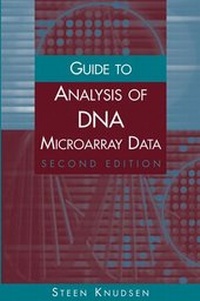
Guide to Analysis of DNA Microarray Data
2nd Edition
Published on 19. March 2004
Book
Paperback/Softback
184 pages
978-0-471-65604-3 (ISBN)
Description
Written for biologists and medical researchers who don't have any special training in data analysis and statistics, Guide to Analysis of DNA Microarray Data, Second Edition begins where DNA array equipment leaves off: the image produced by the microarray. The text deals with the questions that arise starting at this point, providing an introduction to microarray technology, then moving on to image analysis, data analysis, cluster analysis, and beyond.
With all chapters rewritten, updated, and expanded to include the latest generation of technology and methods, Guide to Analysis of DNA Microarray Data, Second Edition offers practitioners reliable information using concrete examples and a clear, comprehensible style. This Second Edition features entirely new chapters on:
* Image analysis
* Experiment design
* Automated analysis, integrated analysis, and systems biology
* Interpretation of results
Intended for readers seeking practical applications, this text covers a broad spectrum of proven approaches in this rapidly growing technology. Additional features include further reading suggestions for each chapter, as well as a thorough review of available analysis software.
Reviews / Votes
"Bioinformaticians, statisticians, computer scientists, biologists, and medical researchers will find this well written book extremely useful." (Journal of Statistical Computation and Simulation, September 2005) "...useful for anybody who wants to catch up with the marvels of modern laboratory technology..." (Chemistry & Industry, 17th January 2005)"This book would be useful for anyone working with the DNA microarray technology." (Annals of Biomedical Engineering, November 2004)
"...concisely written with clear illustrations and tables [with]...a good deal of new material." (E-STREAMS, November 2004)
More details
Product info
PB
Edition
2., Auflage
Language
English
Place of publication
New York
United States
Publishing group
John Wiley & Sons Inc
Target group
Professional and scholarly
Edition type
New edition
Product notice
Paperback (trade)
Unsewn / adhesive bound
Illustrations
Charts: 1 B&W, 0 Color; Photos: 8 B&W, 0 Color; Drawings: 46 B&W, 0 Color; Tables: 22 B&W, 0 Color; Graphs: 3 B&W, 0 Color
Dimensions
Height: 233 mm
Width: 158 mm
Thickness: 14 mm
Weight
331 gr
ISBN-13
978-0-471-65604-3 (9780471656043)
Schweitzer Classification
Other editions
Previous edition
Steen Knudsen
A Biologist's Guide to Analysis of DNA Microarray Data
Book
04/2002
1st Edition
Wiley
€42.90
Article exhausted; check for reprint
Person
Steen Knudsen received his Ph.D. from the University of Copenhagen in 1990 and was among the pioneers of bioinformatics with a publication in Nature the same year. His postdoctoral training in bioinformatics at Harvard University concerned computational gene finding in the human genome. Since 1998 he has been working with methods for analysis of DNA microarray data. He currently heads the DNA microarray group at the Technical University of Denmark.
Content
Preface.
Acknowledgments.
1. Introduction to DNA Microarray Technology.
1.1 Hybridization.
1.2 Gold Rush?
1.3 The Technology behind DNA Microarrays.
1.4 Parallel Sequencing on Microbead Arrays.
1.5 Example: Affymetrix vs. Spotted Arrays.
1.6 Summary.
1.7 Further Reading.
2. Overview of Data Analysis.
3. Image Analysis.
3.1 Gridding.
3.2 Segmentation.
3.3 Intensity Extraction.
3.4 Background Correction.
3.5 Software.
3.6 Summary.
3.7 Further Reading.
4. Basic Data Analysis.
4.1 Normalization.
4.2 Dye Bias, Spatial Bias, Print Tip Bias.
4.3 Expression Indices.
4.4 Detection of Outliers.
4.5 Fold Change.
4.6 Significance.
4.7 Mixed Cell Populations.
4.8 Summary.
4.9 Further Reading.
5. Visualization by Reduction of Dimensionality.
5.1 Principal Component Analysis.
5.2 Example 1: PCA on Small Data Matrix.
5.3 Example 2: PCA on Real Data.
5.4 Summary.
5.5 Further Reading.
6. Cluster Analysis.
6.1 Hierarchical Clustering.
6.2 K-means Clustering.
6.3 Self-Organizing Maps.
6.4 Distance Measures.
6.5 Gene Normalization.
6.6 Visualization of Clusters.
6.7 Summary.
6.8 Further Reading.
7. Beyond Cluster Analysis.
7.1 Function Prediction.
7.2 Discovery of Regulatory Elements in Promoter Regions.
7.3 Summary.
7.4 Further Reading.
8. Automated Analysis, Integrated Analysis and Systems Biology.
8.1 Integrated Analysis.
8.2 Systems Biology.
8.3 Further Reading.
9. Reverse Engineering of Regulatory Networks.
9.1 The Time-Series Approach.
9.2 The Steady-State Approach.
9.3 Limitations of Network Modeling.
9.4 Example 1: Steady-State Model.
9.5 Example 2: Steady-State Model on Bacillus Data.
9.6 Example 3: Linear Time-Series Model.
9.7 Further Reading.
10. Molecular Classifiers.
10.1 Feature Selection.
10.2 Validation.
10.4 Performance Evaluation.
10.5 Example I: Classification of Bladder Cancer Subtypes.
10.6 Example II: Classification of SRBCT Cancer Subtypes.
10.7 Summary.
10.8 Further Reading.
11. The Design of Probes for Arrays.
11.1 Selection of Genes for an Array.
11.2 Gene Finding.
11.3 Selection of Regions Within Genes.
11.4 Selection of Primers for PCR.
11.5 Selection of Unique Oligomer Probes.
11.6 Remapping of Probes.
11.7 Further Reading.
12. Genotyping and Resequencing Chips.
12.1 Example: Neural Networks for GeneChip Prediction.
12.2 Further Reading.
13. Experiment Design and Interpretation of Results.
13.1 Factorial Designs.
13.2 Designs for Two-Channel Arrays.
13.3 Hypothesis Driven Experiments.
13.4 Independent Verification.
13.5 Interpretation of Results.
13.6 Limitations of Expression Analysis.
13.7 Further Reading.
14. Software Issues and Data Formats.
14.1 Standardization Efforts.
14.2 Databases.
14.3 Standard File Format.
14.4 Software for Clustering.
14.5 Software for Statistical Analysis.
14.6 Summary.
14.7 Further Reading.
Appendix A: Web Resources: Commercial Software Packages.
References.
Index.