

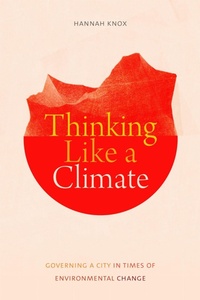
Thinking Like a Climate
Governing a City in Times of Environmental Change
Published on 2. October 2020
Book
Hardback
328 pages
978-1-4780-0981-8 (ISBN)
Description
In Thinking Like a Climate Hannah Knox confronts the challenges that climate change poses to knowledge production and modern politics. Drawing on ethnographic fieldwork among policy makers, politicians, activists, scholars, and the public in Manchester, England-birthplace of the Industrial Revolution-Knox explores the city's strategies for understanding and responding to deteriorating environmental conditions. Climate science, Knox argues, frames climate change as a very particular kind of social problem that confronts the limits of administrative and bureaucratic techniques of knowing people, places, and things. Exceeding these limits requires forging new modes of relating to climate in ways that reimagine the social in climatological terms. Knox contends that the day-to-day work of crafting and implementing climate policy and translating climate knowledge into the work of governance demonstrates that local responses to climate change can be scaled up to effect change on a global scale.
Reviews / Votes
"What makes climate change mitigation so challenging, even for activists and municipal officials committed to the project? Working with planners, experts, and citizens seeking to redress the most pernicious impacts of climate change in Manchester, Hannah Knox has produced the most stunning and thought-provoking ethnographic account of climate change that I have read. She urges us to consider climate change as a 'form of thought'-a pattern produced when spreadsheets, green moralities, technologies, and modes of calculation interact. These interactions, she argues, not only remake what climate means, or what counts as climate action: they demand nothing less than a revolutionary transformation of our understandings of humanity and responsibility in the contemporary moment." - Nikhil Anand, author of (Hydraulic City: Water and the Infrastructures of Citizenship in Mumbai) "We know that industrial activity is altering our planet's atmosphere, and that we need to act fast to mitigate it. But what should we do, exactly? Through her careful and inventive exploration of climate change activism in Manchester, anthropologist Hannah Knox provides pathways to answering this vital yet difficult question. Her stellar ethnography demonstrates that we will learn how to 'think like a climate,' building connections rather than boundaries." - Goekce Guenel, author of (Spaceship in the Desert: Energy, Climate Change, and Urban Design in Abu Dhabi) "In this innovative ethnographic study, Hannah Knox takes the reader on a journey through the city of Manchester, UK, telling the story of climate change through the lives of those who model, govern, and enact it.... Researchers interested in environmental politics...will find great value in reading this book." - Danial H. Naqvi (Environmental Politics) "Thinking Like a Climate has a sense of urgency.... The book shows the vitality of new anthropological and geographical analyses of climate action in practice and their creativity in a collective effort to take seriously the material conditions of climate action." - Vanesa Castan Broto (AAG Review of Books) "One of the most important contributions of [Thinking Like a Climate] is Knox's position as an engaged researcher who is implicated in Manchester's contextually specific climate dynamics. . . . Knox argues that addressing the climate crisis requires a fundamental recalibration of how we think about and act upon the world."- Andrew Karvonen (LSE Review of Books) "Thinking Like A Climate convincingly demonstrates why an anthropologi-cal approach is essential to the study of climate change. Methodologically, Knox has produced a compelling case that to understand climate change as a material-discursive phenomenon, the methods of ethnography are not only useful but crucial."
- Sydney Giacalone (Anthropological Quarterly)
More details
Language
English
Place of publication
North Carolina
United States
Target group
Professional and scholarly
Product notice
Cloth over boards
Illustrations
15 illustrations
Dimensions
Height: 229 mm
Width: 156 mm
Thickness: 23 mm
Weight
598 gr
ISBN-13
978-1-4780-0981-8 (9781478009818)
Copyright in bibliographic data and cover images is held by Nielsen Book Services Limited or by the publishers or by their respective licensors: all rights reserved.
Schweitzer Classification
Person
Hannah Knox is Associate Professor of Anthropology at University College London, coauthor of Roads: An Anthropology of Infrastructure and Expertise, and coeditor of Ethnography for a Data-Saturated World and Objects and Materials: A Routledge Companion.
Content
Abbreviations ix
Preface and Acknowledgments xi
Introduction. Matter, Politics, and Climate Change 1
Part I. Contact Zones
Climate Change in Manchester: An Origin Story 35
1. 41% and the Problem of Proportion 40
How the Climate Takes Shape 63
2. The Carbon Life of Buildings 67
Footprints and Traces, or Learning to Think Like a Climate 89
3. Footprints, Objects, and the Endlessness of Relations 95
When Global Climate Meets Local Nature(s) 122
4. An Irrelevant Apocalypse: Futures, Models, and Scenarios 127
Cities, Mayors, and Climate Change 156
5. Stuck in Strategies 159
Part II. Rematerializing Politics
6. Test Houses and Vernacular Engineers 179
7. Activist Devices and the Art of Politics 205
8. Symptoms, Diagnoses, and the Politics of the Hack 234
Conclusion. "Going Native" in the Anthropocene 259
Notes 273
References 285
Index 305
Preface and Acknowledgments xi
Introduction. Matter, Politics, and Climate Change 1
Part I. Contact Zones
Climate Change in Manchester: An Origin Story 35
1. 41% and the Problem of Proportion 40
How the Climate Takes Shape 63
2. The Carbon Life of Buildings 67
Footprints and Traces, or Learning to Think Like a Climate 89
3. Footprints, Objects, and the Endlessness of Relations 95
When Global Climate Meets Local Nature(s) 122
4. An Irrelevant Apocalypse: Futures, Models, and Scenarios 127
Cities, Mayors, and Climate Change 156
5. Stuck in Strategies 159
Part II. Rematerializing Politics
6. Test Houses and Vernacular Engineers 179
7. Activist Devices and the Art of Politics 205
8. Symptoms, Diagnoses, and the Politics of the Hack 234
Conclusion. "Going Native" in the Anthropocene 259
Notes 273
References 285
Index 305