

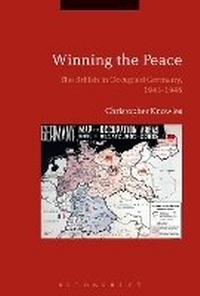
Winning the Peace
The British in Occupied Germany, 1945-1948
Published on 20. September 2018
Book
Paperback/Softback
288 pages
978-1-350-10187-6 (ISBN)
Description
By adopting a unique biographical approach, this book examines the aims and intentions of twelve important and influential individuals who worked for the British Military Government in occupied Germany during the first three years after the end of the Second World War. British policy was distinctive, and the British zone was the largest and economically most important of all four zones. Although the three Western Allies all ended in the same place with the creation of an independent Federal Republic of (West) Germany in 1949, they took different paths to get there. The role of the British has been much misunderstood.
Winning the Peace strikes a balance between earlier self-congratulatory accounts of the British occupation, and the later more critical historiography. It highlights diversity of aims and personal backgrounds and in so doing explains some of the complexities and apparent contradictions in British occupation policy. The book concludes that, despite diversity among those studied, all twelve individuals followed a policy described as the 'three Rs' - Reconstruction, Renewal and Reconciliation - rather than the 'four Ds' - De-militarisation, De-nazification, De-industrialisation, and Democratisation - highlighted in earlier histories of the occupation.
Whilst reflecting on the role of human agency, Christopher Knowles examines why individuals sometimes failed to achieve what they originally intended, and how their aims and perceptions changed over time to reveal broader political, sociological and cultural forces, outside their direct control. This book is an innovative study for those interested in the Allied occupation, the post-war history of Germany and the study of military occupation generally.
Winning the Peace strikes a balance between earlier self-congratulatory accounts of the British occupation, and the later more critical historiography. It highlights diversity of aims and personal backgrounds and in so doing explains some of the complexities and apparent contradictions in British occupation policy. The book concludes that, despite diversity among those studied, all twelve individuals followed a policy described as the 'three Rs' - Reconstruction, Renewal and Reconciliation - rather than the 'four Ds' - De-militarisation, De-nazification, De-industrialisation, and Democratisation - highlighted in earlier histories of the occupation.
Whilst reflecting on the role of human agency, Christopher Knowles examines why individuals sometimes failed to achieve what they originally intended, and how their aims and perceptions changed over time to reveal broader political, sociological and cultural forces, outside their direct control. This book is an innovative study for those interested in the Allied occupation, the post-war history of Germany and the study of military occupation generally.
Reviews / Votes
Christopher Knowles has written a compelling, perceptive, and analytically rigorous monograph ... His book is a welcome contribution to a fast-evolving literature. * Journal of Modern History * [An] informative and well-written account of the transition from war to peace and the British occupation policies in Germany which sheds light on agency and the motives and attitudes of key individuals ... Knowles interprets the occupation period as a complex and multifaceted process and adds valuable aspects to existing explanations. * Cercles * This is a valuable contribution to any reading list devoted to this phase of British-German history or to the study of military occupation. * Journal of British Studies * [This] persuasive monograph will be essential reading for anyone interested in the subject. * German History * A knowledgeable and very well-written book, which fosters detailed research ... [and] provides a good overview of the structures, background and developments of the early British occupation. * H-Soz-Kult (Bloomsbury translation) * Approaching the British occupation regime in Germany through a range of biographies sheds a new light on the occupation regime itself. The book is particularly strong in reconstructing the mental worlds of military governors, civilian administrators and diplomats as well as younger military officers. Making good use of diverse generational experiences, Christopher Knowles argues convincingly that the positive contribution of these people to the remaking of Germany after the Second World War should be recognised. * Stefan Berger, Director of the Institute for Social Movements and Chairman of the committee of the History of the Ruhr Foundation, Bochum, Germany * Chris Knowles' multi-layered appraisal of the aims, intentions and achievements of the British occupation of Germany through his examination of the diverse views and experiences of a sample of British generals, civilian administrators and young junior military government officers not only uniquely exposes and deconstructs the constraints on the occupiers and their potential for agency but also makes a significant contribution to the new field of occupation studies. * Rebecca Boehling, University of Maryland-Baltimore County, USA * Christopher Knowles' Winning the Peace is a significant contribution to the history of the British occupation in Germany after 1945. Investigating the collective biography of twelve officers it considerably extends our knowledge of the British policies by highlighting the wide variety of often conflicting ideas and strategies within the military and civil administration of Germany. * Michael Schaich, Research Fellow and Deputy Director of the German Historical Institute London, UK * [T]his book is invaluable reading for anyone wishing to study the British zone of occupation in Germany - a category, it is hoped, that will soon rival the already burgeoning literature on the US zone of Germany. * European Review of History *More details
Language
English
Place of publication
London
United Kingdom
Publishing group
Bloomsbury Publishing PLC
Target group
College/higher education
Illustrations
11 bw illus
Dimensions
Height: 234 mm
Width: 156 mm
Weight
413 gr
ISBN-13
978-1-350-10187-6 (9781350101876)
Copyright in bibliographic data and cover images is held by Nielsen Book Services Limited or by the publishers or by their respective licensors: all rights reserved.
Schweitzer Classification
Other editions
Additional editions
E-Book
01/2017
1st Edition
Bloomsbury Academic
€39.99
Available for download
E-Book
01/2017
1st Edition
Bloomsbury Academic
€39.99
Available for download
Person
Christopher Knowles is Visiting Research Fellow at Kings College London, UK.
Content
1. Introduction
Part I. Physical Reconstruction - The Military Governors and Army Generals
2. Creating Order Out of Chaos
3. The Occupation as a Moral Crusade
4. Criticism at Home and Allegations of Corruption
Part II. Political Renewal: Civilian Diplomats and Administrators
5. 'Trying to Beat the Swastika into the Parish Pump' - First Steps Towards Political Renewal
6. International Socialist Visions of Political Renewal
7. Regional Administration in Hamburg
Part III. Personal Reconciliation - Young Men with No Adult Experience but War
8. A Younger Generation
9. The English Army Officer who Created the German News Magazine Der Spiegel
10. Getting to Know the Germans
Conclusion
Notes
Bibliography
Index
Part I. Physical Reconstruction - The Military Governors and Army Generals
2. Creating Order Out of Chaos
3. The Occupation as a Moral Crusade
4. Criticism at Home and Allegations of Corruption
Part II. Political Renewal: Civilian Diplomats and Administrators
5. 'Trying to Beat the Swastika into the Parish Pump' - First Steps Towards Political Renewal
6. International Socialist Visions of Political Renewal
7. Regional Administration in Hamburg
Part III. Personal Reconciliation - Young Men with No Adult Experience but War
8. A Younger Generation
9. The English Army Officer who Created the German News Magazine Der Spiegel
10. Getting to Know the Germans
Conclusion
Notes
Bibliography
Index