

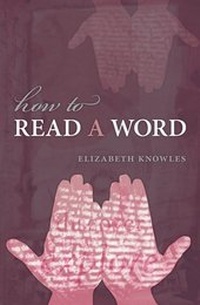
How to Read a Word
1st Edition
Published on 28. October 2010
Book
Hardback
208 pages
978-0-19-957489-6 (ISBN)
Description
Have you ever wondered how you can find out more about a word: Where did it come from? How has its meaning altered? How can it be pronounced? What is its relationship to other words? Language is not fixed, but is an evolutionary process: words develop and change, in meaning, association, and pronunciation, as well as in many other ways. Exploring the routes taken by the words we choose to investigate leads us on fascinating journeys. How to Read a
Word, written by the noted lexicographer Elizabeth Knowles, shows us how we might delve into the origins, associations, and evolution of words, and is primarily concerned with the following two points: what questions can be asked about a word? And how can they be answered?
Utilising the unrivalled resources and the language-monitoring programs of the Oxford English Dictionary, the book leads you through the various stages of investigation into the myriad aspects of individual words, from etymology to date of first use and regional distribution, and from spelling and pronunciation to shifts in meaning.
Supported by many examples of investigation into specific words, and featuring a full index, a wide selection of useful online resources, and reams of useful tips for avoiding common pitfalls, it is both a thought-provoking and practical handbook, providing readers with the essential tools to confidently interrogate the words by which they are surrounded. How to Read a Word is the perfect gift for anyone who is fascinated by the development and intricacies of the English
language.
Word, written by the noted lexicographer Elizabeth Knowles, shows us how we might delve into the origins, associations, and evolution of words, and is primarily concerned with the following two points: what questions can be asked about a word? And how can they be answered?
Utilising the unrivalled resources and the language-monitoring programs of the Oxford English Dictionary, the book leads you through the various stages of investigation into the myriad aspects of individual words, from etymology to date of first use and regional distribution, and from spelling and pronunciation to shifts in meaning.
Supported by many examples of investigation into specific words, and featuring a full index, a wide selection of useful online resources, and reams of useful tips for avoiding common pitfalls, it is both a thought-provoking and practical handbook, providing readers with the essential tools to confidently interrogate the words by which they are surrounded. How to Read a Word is the perfect gift for anyone who is fascinated by the development and intricacies of the English
language.
Reviews / Votes
For anyone interested in dictionaries, and in getting the best out of them, this is an excellent little text: ideal for library and science students and novices at the enquiry desk. * Bob Ducket, Reference Reviews Journal *More details
Language
English
Place of publication
Oxford
United Kingdom
Target group
The general reader who is interested in words, and who would like to explore their history, origins, and development with more confidence. Readers of books such as Balderdash and Piffle and Damp Squid. Students of English language and literature.
Dimensions
Height: 200 mm
Width: 136 mm
Thickness: 22 mm
Weight
318 gr
ISBN-13
978-0-19-957489-6 (9780199574896)
Copyright in bibliographic data and cover images is held by Nielsen Book Services Limited or by the publishers or by their respective licensors: all rights reserved.
Schweitzer Classification
Other editions
Additional editions
Elizabeth Knowles
How to Read a Word
E-Book
10/2010
1st Edition
OUP Oxford
€30.09
Available for download
Person
Elizabeth Knowles became a historical lexicographer through working as a library researcher for the Oxford English Dictionary Supplement, and then as a Senior Editor for the 4th edition of the Shorter Oxford English Dictionary (1993). She has been Editor of the Oxford Dictionary of Quotations (7th edition, 2009), and her editorial credits include What They Didn't Say: A Book of Misquotations (2006), and the Little Oxford
Dictionary of Proverbs (2009).
Dictionary of Proverbs (2009).
Content
INTRODUCTION; APPENDICES; INDICES