

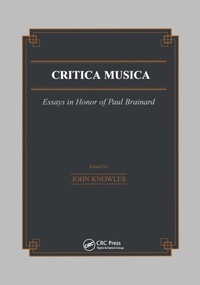
Critica Musica
Essays in Honour of Paul Brainard
1st Edition
Published on 17. January 2019
Book
Paperback/Softback
504 pages
978-1-138-99049-4 (ISBN)
Description
This is Volume 18 of eighteen in a book series on Musicology. Originally published in 1996, this is a collection of essays in honor or Paul Brainard. Critica Musica-thinking critically about music-is at the heart of Paul Brainard's long career, and of his legacy to his students, colleagues, and friends. As a scholar, performer, and teacher, Professor Brainard has embodied a thorough, meticulous, and reasoned approach to music and scholarship that has set a high standard for all who have come in contact with him.
More details
Series
Language
English
Place of publication
London
United Kingdom
Publishing group
Taylor & Francis Ltd
Target group
College/higher education
Dimensions
Height: 254 mm
Width: 178 mm
Thickness: 27 mm
Weight
942 gr
ISBN-13
978-1-138-99049-4 (9781138990494)
Copyright in bibliographic data and cover images is held by Nielsen Book Services Limited or by the publishers or by their respective licensors: all rights reserved.
Schweitzer Classification
Other editions
Additional editions
E-Book
03/2016
Routledge
€39.49
Available for download
E-Book
03/2016
Routledge
€39.49
Available for download
Book
11/1997
1st Edition
Gordon & Breach Science Publishers,The Netherlands
€133.69
Shipment within 15-20 days
Person
J. Knowles
Content
Principal Publications of Paul Brainard; Some Considerations of the Sources of Cristobal Galan's Music; The Speaking Body: Gaspero Angiolini's Rhetorique Muette and the Ballet d'Action in the Eighteenth Century; Costanzo Festa's lnviolata, integra et casta es Maria: a Double Homage Motet; Bach, Theology, and Harmony: A New Look at the Arias; The Symphony and the Artist's Creed: Camille Saint-Saens and His Third Symphony; The Letter as Convention in Seventeenth-Century Venetian Opera; Poetic and Musical Forms in the Laude of Innocenti us Dammonis; Melody and Motive in Schenker's Earliest Writings; Twins, Cousins, and Heirs: Relationships among Editions of Music Printed in Sixteenth-Century Venice; Rhetoric, Rhythm, and Harmony as Keys to Schlitz's Saul, Saul, was verfolgst du mich? Bach's tempo ordinaria: A Plaine and Easie Introduction to the System; Amorous Dialogues: Poetic Topos and Polyphonic Texture in Some Polytextual Songs of the Late Middle Ages; The Violins in Bach's St. John Passion; French Opera in Transition: Silvie ( 1765) by Trial and Berton; Kindling the Compositional Fire: Haydn's Keyboard Phantasiren; When Sources Seem to Fail: The Clarinet Parts in Mozart's K. 581 and K. 622; From Madrigal to Toccata: Frescobaldi and the Seconda Prattica; Beethoven and Shakespeare; Tenors Lost and Found: The Reconstruction of Motets in Two Medieval Chansonniers