

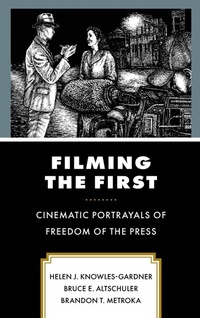
Filming the First
Cinematic Portrayals of Freedom of the Press
Published on 15. October 2024
Book
Hardback
304 pages
978-1-7936-5044-3 (ISBN)
Description
The First Amendment to the U.S. Constitution prohibits Congress from abridging freedom of the press. But, as the printed press has been transformed into mass media with Americans now more likely to get their political information from television or social media than from print, confidence in this important, mediating institution has fallen dramatically. Movies, in their role as cultural artifacts, have long reflected and influenced those public attitudes, inventing such iconic phrases as "follow the money" from All the President's Men and "I'm mad as hell and I'm not going to take this anymore" from Network. Filming the First: Cinematic Portrayals of Freedom of the Press analyzes eighteen films that span from Citizen Kane to Spotlight showing changes in how the press have been portrayed over time, which voices receive the most attention and why, the relationship between the press's "Fourth Estate" role and the imperatives of capitalism, and how, despite the First Amendment's seemingly absolute language, the government has sometimes been able to limit what the public can read or view.
Reviews / Votes
Although judges declare what the law is, ordinary citizens usually learn more about legal principles from watching movies than from reading court decisions. Filming the First expertly evaluates the ways in which films portray the constitutional guarantee of a free press. From Citizen Kane to The Social Network and Spotlight, Knowles-Gardner, Altschuler, and Metroka seamlessly weave together discussions of cinematic technique, historical context, primary sources, and polling data. The result is an insightful and accessible assessment of how filmmakers dramatize freedom of the press and how the public processes these dramas in a time of increasing distrust. -- Keith J. Bybee, author of How Civility Works "Filming the First is a deeply thought-provoking exploration of America's cinematic engagement with 'the press.' Through the revealing social implications of the big screen, Filming the First interrogates press freedom from yellow-journalism sensationalism to Watergate and Vietnam heroics, to the existential threat of misinformation. Organizing 18 films into 10 thematic chapters, Filming the First embraces both classics and the avant-garde and treats readers to perspectives on mass media from the reverent paean to the ruthless critique. Knowles-Gardner, Altschuler, and Metroka locate their diverse film selections each in its social, cultural, and legal context. Upon each exposition, the writers relate key takeaways to the perils and uncertainties that surround the business of media in our polarized present day. Filming the First is a thrill ride for film buffs, free speech aficionados, and anyone willing to engage with the struggle to define media's place in modern democracy." -- Richard J. Peltz-Steele, Chancellor Professor, University of Massachusetts Law School "Filming the First provides an invaluable resource by allowing readers to see the First Amendment in action. Through an exciting selection of films, the authors explore not only how media presents the First Amendment but also how their products themselves become subjects of the First. Complicated issues are presented in accessible, interesting breakdowns that will be an invaluable resource for anyone who teaches free speech and press issues." -- Richard Price, Weber State UniversityMore details
Series
Language
English
Place of publication
United States
Publishing group
Bloomsbury Publishing Plc
Target group
Professional and scholarly
Dimensions
Height: 235 mm
Width: 157 mm
Thickness: 22 mm
Weight
647 gr
ISBN-13
978-1-7936-5044-3 (9781793650443)
Copyright in bibliographic data and cover images is held by Nielsen Book Services Limited or by the publishers or by their respective licensors: all rights reserved.
Schweitzer Classification
Other editions
Additional editions
Helen J. Knowles-Gardner | Bruce E. Altschuler | Brandon T. Metroka
Filming the First
Cinematic Portrayals of Freedom of the Press
E-Book
10/2024
1st Edition
Lexington Books
€107.99
Available for download
Helen J. Knowles-Gardner | Bruce E. Altschuler | Brandon T. Metroka
Filming the First
Cinematic Portrayals of Freedom of the Press
E-Book
10/2024
1st Edition
Lexington Books
€107.99
Available for download
Persons
Bruce Altschuler is Professor Emeritus of Political Science at SUNY Oswego.
Helen J. Knowles-Gardner is Research Director at the Institute for Free Speech.
Brandon T. Metroka is Associate Professor of Political Science and Pre-Law Program Coordinator at University of the Incarnate Word in San Antonio, Texas.
Helen J. Knowles-Gardner is Research Director at the Institute for Free Speech.
Brandon T. Metroka is Associate Professor of Political Science and Pre-Law Program Coordinator at University of the Incarnate Word in San Antonio, Texas.
Content
Chapter 1. Censorship in a Time of War: Good Morning, Vietnam
By Helen J. Knowles-Gardner
Chapter 2. A Media Mogul Battles Against His Fictional Doppelganger: Citizen Kane and RKO 281
By Bruce E. Altschuler
Chapter 3. Heroic Newspaper Reporters, Editors, and Publishers Battle the President - All the President's Men and The Post
By Bruce E. Altschuler
Chapter 4. Technology Transforms the Press into the Media: Network and The Social Network
By Bruce E. Altschuler
Chapter 5. "How Can We Possibly Approve and Check the Story...?": Good Night, and Good Luck and The China Syndrome
By Helen J. Knowles-Gardner
Chapter 6. Testing the Limits of Freedom: Denial and Deliberate Intent
By Helen J. Knowles-Gardner
Chapter 7. Responsibility Matters: Shattered Glass
By Helen J. Knowles-Gardner
Chapter 8. Creating Protagonists, Competing Interests, and Uncertain Legal Standards: The People vs. Larry Flynt and Citizenfour
By Brandon T. Metroka
Chapter 9. A Tale of One Press Clause and Two Journalisms: Spotlight and Out in the Night
By Brandon T. Metroka
Chapter 10. Mainstream Press Negligence and its Effects: The Normal Heart and Tongues Untied
By Brandon T. Metroka
By Helen J. Knowles-Gardner
Chapter 2. A Media Mogul Battles Against His Fictional Doppelganger: Citizen Kane and RKO 281
By Bruce E. Altschuler
Chapter 3. Heroic Newspaper Reporters, Editors, and Publishers Battle the President - All the President's Men and The Post
By Bruce E. Altschuler
Chapter 4. Technology Transforms the Press into the Media: Network and The Social Network
By Bruce E. Altschuler
Chapter 5. "How Can We Possibly Approve and Check the Story...?": Good Night, and Good Luck and The China Syndrome
By Helen J. Knowles-Gardner
Chapter 6. Testing the Limits of Freedom: Denial and Deliberate Intent
By Helen J. Knowles-Gardner
Chapter 7. Responsibility Matters: Shattered Glass
By Helen J. Knowles-Gardner
Chapter 8. Creating Protagonists, Competing Interests, and Uncertain Legal Standards: The People vs. Larry Flynt and Citizenfour
By Brandon T. Metroka
Chapter 9. A Tale of One Press Clause and Two Journalisms: Spotlight and Out in the Night
By Brandon T. Metroka
Chapter 10. Mainstream Press Negligence and its Effects: The Normal Heart and Tongues Untied
By Brandon T. Metroka