

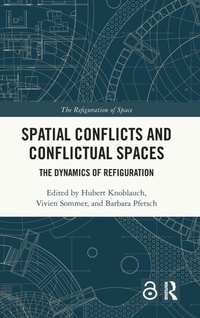
Spatial Conflicts and Conflictual Spaces
The Dynamics of Refiguration
1st Edition
Published on 7. August 2025
Book
Hardback
384 pages
978-1-032-86816-5 (ISBN)
Description
This volume explores the refiguration of space as a theoretical framework, presenting empirical studies on spatial conflicts and emerging conflictual spaces across different regions and scales. It contains contributions which follow varied theoretical threads and represent different geospatial standpoints, but which relate to the thesis of the refiguration of space as a new phase after globalization.
By adopting a spatial lens, the book offers insights into the dynamics of social order in the post-globalization era, examining how conflicts arise within space and how spatial dynamics shape social tensions. The chapters unpack the interplay between human aspirations and geographical limitations and use the concept of (re)figuration to underline the trans-scalar dimension of most social conflicts, which is massively expanded by digital mediatization, public communication and its refigured infrastructures. While emphasizing the empirical analysis of conflicts in space, the edited volume also seeks to identify general principles of the spatial dynamics of social conflicts. It is this "spatial logic" underlying conflictual situations that the book addresses with the term "spatial conflicts."
This volume will be of interest to students and researchers in sociology, anthropology, geography, urban studies, communication studies, political science, and globalization and peace studies.
The Open Access version of this book, available at www.taylorfrancis.com, has been made available under a Creative Commons [Attribution-Non Commercial-No Derivatives (CC-BY-NC-ND)] 4.0 International license.
By adopting a spatial lens, the book offers insights into the dynamics of social order in the post-globalization era, examining how conflicts arise within space and how spatial dynamics shape social tensions. The chapters unpack the interplay between human aspirations and geographical limitations and use the concept of (re)figuration to underline the trans-scalar dimension of most social conflicts, which is massively expanded by digital mediatization, public communication and its refigured infrastructures. While emphasizing the empirical analysis of conflicts in space, the edited volume also seeks to identify general principles of the spatial dynamics of social conflicts. It is this "spatial logic" underlying conflictual situations that the book addresses with the term "spatial conflicts."
This volume will be of interest to students and researchers in sociology, anthropology, geography, urban studies, communication studies, political science, and globalization and peace studies.
The Open Access version of this book, available at www.taylorfrancis.com, has been made available under a Creative Commons [Attribution-Non Commercial-No Derivatives (CC-BY-NC-ND)] 4.0 International license.
More details
Series
Language
English
Place of publication
London
United Kingdom
Publishing group
Taylor & Francis Ltd
Target group
College/higher education
Professional and scholarly
Academic and Postgraduate
Illustrations
63 s/w Abbildungen, 58 s/w Photographien bzw. Rasterbilder, 5 s/w Zeichnungen, 7 s/w Tabellen
7 Tables, black and white; 5 Line drawings, black and white; 58 Halftones, black and white; 63 Illustrations, black and white
Dimensions
Height: 235 mm
Width: 157 mm
Thickness: 26 mm
Weight
731 gr
ISBN-13
978-1-032-86816-5 (9781032868165)
Copyright in bibliographic data and cover images is held by Nielsen Book Services Limited or by the publishers or by their respective licensors: all rights reserved.
Schweitzer Classification
Other editions
Additional editions
Hubert Knoblauch | Vivien Sommer | Barbara Pfetsch
Spatial Conflicts and Conflictual Spaces
The Dynamics of Refiguration
E-Book
08/2025
Routledge
€0.00
Available for download
Hubert Knoblauch | Vivien Sommer | Barbara Pfetsch
Spatial Conflicts and Conflictual Spaces
The Dynamics of Refiguration
E-Book
08/2025
Routledge
€0.00
Available for download
Persons
Hubert Knoblauch is Professor for General Sociology/Theories of Modern Society at the Technische Universitaet Berlin and Co-Chair of the Collaborative Research Center (CRC 1265) "Re-Figuration of Spaces" with Martina Loew. His main research areas include Sociological Theory, Sociology of Knowledge, Religion, Language, Qualitative Methods, Videography. He recently published the monograph The Communicative Construction of Reality (2020).
Dr. Vivien Sommer is a sociologist researching knowledge, practices, and memory with a focus on European borders. Since 2023, she leads the Emmy Noether Junior Research Group on socio-spatial memory at the Leibniz Institute for Research on Society and Space and is part of the Collaborative Research Center (CRC 1265) "Re-Figuration of Spaces" at Technische Universitaet Berlin. Her work focuses on empirically grounded theory development in the fields of Sociology of Knowledge and Space, as well as the development of innovative qualitative methods.
Barbara Pfetsch is Professor of Communication Theory and Media Effects research at Freie Universitaet Berlin and a principal investigator at the Weizenbaum Institute for the Networked Society. Her research and publications focus on comparative political communication, online communication and digital issue networks, and transnational and European public spheres.
Dr. Vivien Sommer is a sociologist researching knowledge, practices, and memory with a focus on European borders. Since 2023, she leads the Emmy Noether Junior Research Group on socio-spatial memory at the Leibniz Institute for Research on Society and Space and is part of the Collaborative Research Center (CRC 1265) "Re-Figuration of Spaces" at Technische Universitaet Berlin. Her work focuses on empirically grounded theory development in the fields of Sociology of Knowledge and Space, as well as the development of innovative qualitative methods.
Barbara Pfetsch is Professor of Communication Theory and Media Effects research at Freie Universitaet Berlin and a principal investigator at the Weizenbaum Institute for the Networked Society. Her research and publications focus on comparative political communication, online communication and digital issue networks, and transnational and European public spheres.
Content
1. Introduction: Spatial conflicts and conflictual spaces in the age of refiguration-Current research perspectives
Hubert Knoblauch, Vivien Sommer, and Barbara Pfetsch
2. Containing or acting on conflict through space: A heuristic of conflict-space interplay
Zozan Baran and Barbara Pfetsch
Part 1. Macroregimes and spatial conflicts
3. Regional free movement: Ongoing spatial conflicts between macroterritorial and national levels-A case study of ECOWAS, the EU, and Mercosur
Zoe Perko and Dorothea Biaback Anong
4. Conflicts of modernities: The spaces of health care in French-speaking West African popular culture
Severine Marguin and Daddy Dibinga
Part 2. Tensions in digital spaces
5. Borders on the internet? The RIPE debate about the internet in the wake of the war in Ukraine
Sezgin Soenmez and Hubert Knoblauch
6. From safe(r) space to safe(r) spacing: Queer spatial conflict in Cape Town and Berlin
Nicolas Zehner, Ingo Schulz-Schaeffer, Daniel Groenefeld, and Philip Baumbach
7. Algorithmic regulation across physical and digital spaces: Analyzing Airbnb's marketplace in US and European cities over time
Stefan Kirchner and Simon C. Pohl
Part 3. Land rights and conflictual spaces
8. Notions of land-Figurations of conflict: Spatial forms of conflicts and the making of Kaloleni and Makongeni
Makau Kitata and Jochen Kibel
9. The (re)making of conflictual spaces: New urban frontiers and infrastructure-led development in Nairobi
Alexander Kohrs, Linda Hering, and John K. Shadrack
10. Spatial tensions and conflict: Forcibly displaced people in Lagos and Amman
Qusay Amer, Rebecca Enobong Roberts, and Francesca Ceola
Part 4. Social exclusion and spatial knowledge
11. Spatial conflict containment in Singapore: Pacifying conflictual spaces by (in)visibilizing them in urban infrastructure
Nina Baur and Elmar Kulke
12. Growing up (un)knowingly in a cage: Youths' conflictive spatial knowledge
Ignacio Castillo Ulloa, Anna Juliane Heinrich, Angela Million, and Ludovica Tomarchio
13. Beyond remembrance: Spatial dynamics in commemorating racist violence in Solingen and Rostock
Kuebra Gencal, Emma Luna Brahm, and Daniel Kubiak
Part 5. Struggles over ecology and space
14. Socioecological transformation and conflict: Arenas, topics, and dimensions
Miriam Schad and Bernd Sommer
15. The spatial dimension of climate justice conflicts and solidarities: A conceptual model
Daniela Stoltenberg, Barbara Pfetsch, Zozan Baran, and Annie Waldherr
16. Conflicts along the "fresh air corridors" of Stuttgart: The figurational politics of climate adaptation
Indrawan Prabaharyaka and Ignacio Farias
Hubert Knoblauch, Vivien Sommer, and Barbara Pfetsch
2. Containing or acting on conflict through space: A heuristic of conflict-space interplay
Zozan Baran and Barbara Pfetsch
Part 1. Macroregimes and spatial conflicts
3. Regional free movement: Ongoing spatial conflicts between macroterritorial and national levels-A case study of ECOWAS, the EU, and Mercosur
Zoe Perko and Dorothea Biaback Anong
4. Conflicts of modernities: The spaces of health care in French-speaking West African popular culture
Severine Marguin and Daddy Dibinga
Part 2. Tensions in digital spaces
5. Borders on the internet? The RIPE debate about the internet in the wake of the war in Ukraine
Sezgin Soenmez and Hubert Knoblauch
6. From safe(r) space to safe(r) spacing: Queer spatial conflict in Cape Town and Berlin
Nicolas Zehner, Ingo Schulz-Schaeffer, Daniel Groenefeld, and Philip Baumbach
7. Algorithmic regulation across physical and digital spaces: Analyzing Airbnb's marketplace in US and European cities over time
Stefan Kirchner and Simon C. Pohl
Part 3. Land rights and conflictual spaces
8. Notions of land-Figurations of conflict: Spatial forms of conflicts and the making of Kaloleni and Makongeni
Makau Kitata and Jochen Kibel
9. The (re)making of conflictual spaces: New urban frontiers and infrastructure-led development in Nairobi
Alexander Kohrs, Linda Hering, and John K. Shadrack
10. Spatial tensions and conflict: Forcibly displaced people in Lagos and Amman
Qusay Amer, Rebecca Enobong Roberts, and Francesca Ceola
Part 4. Social exclusion and spatial knowledge
11. Spatial conflict containment in Singapore: Pacifying conflictual spaces by (in)visibilizing them in urban infrastructure
Nina Baur and Elmar Kulke
12. Growing up (un)knowingly in a cage: Youths' conflictive spatial knowledge
Ignacio Castillo Ulloa, Anna Juliane Heinrich, Angela Million, and Ludovica Tomarchio
13. Beyond remembrance: Spatial dynamics in commemorating racist violence in Solingen and Rostock
Kuebra Gencal, Emma Luna Brahm, and Daniel Kubiak
Part 5. Struggles over ecology and space
14. Socioecological transformation and conflict: Arenas, topics, and dimensions
Miriam Schad and Bernd Sommer
15. The spatial dimension of climate justice conflicts and solidarities: A conceptual model
Daniela Stoltenberg, Barbara Pfetsch, Zozan Baran, and Annie Waldherr
16. Conflicts along the "fresh air corridors" of Stuttgart: The figurational politics of climate adaptation
Indrawan Prabaharyaka and Ignacio Farias