

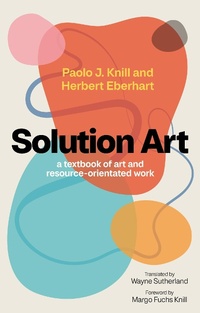
Solution Art
A textbook of art and resource-orientated work
Published on 18. May 2023
Book
Paperback/Softback
304 pages
978-1-83997-760-2 (ISBN)
Description
Counselling, therapy, and coaching always work with the use of language. With art-oriented approaches, the limitations of language can be overcome.
One of the most important works of expressive arts therapy, Loesungskunst is now available in English translation.
The key concept of intermodality- the authors' term for oscillation between art-analog methods- combines with the primary focus on resources and strong emphasis on solutions to lay the groundwork for the method that is as vital now as it was originally. The importance of imagination, artistic and aesthetic experience to mental wellbeing is showcased, challenging the common focus on the cognitive and emotional facets of mental health.
In-depth case studies and explanations illuminate the origins and use of the theoretical frameworks, helping experienced practitioners and trainees alike to engage with the fundamental methods and concepts of expressive arts therapy.
One of the most important works of expressive arts therapy, Loesungskunst is now available in English translation.
The key concept of intermodality- the authors' term for oscillation between art-analog methods- combines with the primary focus on resources and strong emphasis on solutions to lay the groundwork for the method that is as vital now as it was originally. The importance of imagination, artistic and aesthetic experience to mental wellbeing is showcased, challenging the common focus on the cognitive and emotional facets of mental health.
In-depth case studies and explanations illuminate the origins and use of the theoretical frameworks, helping experienced practitioners and trainees alike to engage with the fundamental methods and concepts of expressive arts therapy.
Reviews / Votes
The seminal Solution Art is a welcome translation for many reasons. Readers are treated to a rare glimpse into the foundations of expressive arts therapy. And it validates what many of us now understand about the arts -- that experiencing the senses are key to the healing process. -- Cathy Malchiodi, PhD, author, Trauma and Expressive Arts Therapy: Brain, Body, and Imagination in the Healing Process What a gift! This elegant, generous translation makes the wisdom of Loesungskunst available in English. As a helpful clarification and expansion of Principles and Practice of Expressive Arts Therapy (2005), it further supports keeping the arts at the center of helping practices. -- Ellen G. Levine, MSW, Ph.D, EGS Core Faculty Member In the translation of Solution Art, the spirit of the authors reaches back through time offering an invitation, an open door beckoning us beyond conditioned existence. To change the world, we must change our minds, our approach. We must de-center from who we think we are and remember who we really are and the resources that lie within. If we accept their invitation, we cross a threshold into the wilderness-unmapped, untamed, unknown. To live as awake and sensitive beings in these problem-saturated times, we must improvise, welcome back the marginalized aspects of ourselves-the vastness of the human imagination, our embodied curiosity and our capacity to make, to play, to love, to listen. And, what of unseen forces, the grace of surprise, the sudden shift of perception that redirects a life? As a therapist, educator, and poet I am grateful to stand on the shoulders of these elders whose spirited invitations have shaped my work and my Self. May we all be incorporated into the 'solution' the authors offer, one that is alchemical and transformational, decentralized and grounded in the very qualities that make us human. -- Melia Snyder, Ph.D., LPC, REAT, Education Director & Clinical Therapist at Open Sky This book is a gift. First published in 2010 in German, this literal translation now offers readers of English the unique opportunity to glimpse a 30-year discursive journey about art, psychology, and change between two pioneers whose thinking is foundational to the development of expressive arts work in the world. With references to theoretical and philosophical underpinnings and numerous examples of application, the authors elaborate the emerging theories and practice from which developed the unique methodological practice of Intermodal Decentering for creating processes of change in therapy, coaching, supervision, and group work in a variety of settings. -- Sally Atkins, Ed.D., REAT, REACE, Licensed Psychologist Professor Emerita, Appalachian State University Core Faculty, The European Graduate School This textbook contains both the theoretical roots of the concept and many examples of advice in which we can look over the shoulders of the actors. They touch you with serious lightness. -- E. Kandziora, reviewing Loesungskunst in 2010, review extract translated by Margo Fuchs KnillMore details
Language
English
Place of publication
London
United Kingdom
Target group
College/higher education
Professional and scholarly
Product notice
Paperback (UK-trade)
Dimensions
Height: 214 mm
Width: 136 mm
Thickness: 18 mm
Weight
380 gr
ISBN-13
978-1-83997-760-2 (9781839977602)
Copyright in bibliographic data and cover images is held by Nielsen Book Services Limited or by the publishers or by their respective licensors: all rights reserved.
Schweitzer Classification
Other editions
Additional editions
E-Book
05/2023
Jessica Kingsley Publishers
€45.99
Available for download
Persons
Herbert Eberhart, Ph.D., is a social worker and clinical psychologist. He worked for 25 years as a Senior Professor at the Zurich School of Social Work, and he teaches at several higher education institutions, including the European Graduate School in Switzerland.
Paolo J. Knill was one of the founders of the expressive arts therapy program at Lesley University, USA and was the founding Provost of the European Graduate School (EGS) in Switzerland, which offers MA and PhD degrees in expressive arts therapy.
Wayne Sutherland was initially social anthropologist, postgraduate studies in journalism and media sciences, has degree in adult education, and is now an examination expert at the European Graduate School. His PhD was supervised by Paolo J. Knill.
Paolo J. Knill was one of the founders of the expressive arts therapy program at Lesley University, USA and was the founding Provost of the European Graduate School (EGS) in Switzerland, which offers MA and PhD degrees in expressive arts therapy.
Wayne Sutherland was initially social anthropologist, postgraduate studies in journalism and media sciences, has degree in adult education, and is now an examination expert at the European Graduate School. His PhD was supervised by Paolo J. Knill.