

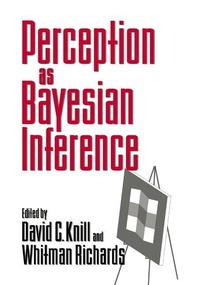
Perception as Bayesian Inference
Published on 12. June 2008
Book
Paperback/Softback
532 pages
978-0-521-06499-6 (ISBN)
Description
Bayesian probability theory has emerged not only as a powerful tool for building computational theories of vision, but also as a general paradigm for studying human visual perception. This 1996 book provides an introduction to and critical analysis of the Bayesian paradigm. Leading researchers in computer vision and experimental vision science describe general theoretical frameworks for modelling vision, detailed applications to specific problems and implications for experimental studies of human perception. The book provides a dialogue between different perspectives both within chapters, which draw on insights from experimental and computational work, and between chapters, through commentaries written by the contributors on each others' work. Students and researchers in cognitive and visual science will find much to interest them in this thought-provoking collection.
More details
Language
English
Place of publication
Cambridge
United Kingdom
Target group
Professional and scholarly
Product notice
Paperback (trade)
Illustrations
8 Halftones, unspecified; 132 Line drawings, unspecified
Dimensions
Height: 254 mm
Width: 178 mm
Thickness: 29 mm
Weight
989 gr
ISBN-13
978-0-521-06499-6 (9780521064996)
Copyright in bibliographic data and cover images is held by Nielsen Book Services Limited or by the publishers or by their respective licensors: all rights reserved.
Schweitzer Classification
Other editions
Additional editions
David C. Knill | Whitman Richards
Perception as Bayesian Inference
E-Book
09/1996
1st Edition
Cambridge University Press
€64.99
Available for download
Previous edition
David C. Knill | Whitman Richards
Perception as Bayesian Inference
Book
09/1996
Cambridge University Press
€192.20
Shipment within 15-20 days
Persons
Content
1. Introduction D. C. Knill, D. Kersten and A. Yuille; 2. Pattern theory: a unifying perspective D. Mumford; 3. Modal structure and reliable inference A. Jepson, W. Richards and D. C. Knill; 4. Priors, preferences and categorical percepts W. Richards, A. Jepson and J. Feldman; 5. Bayesian decision theory and psychophysics A. L. Yuille and H. H. Bulthoff; 6. Observer theory, Bayes theory, and psychophysics B. M. Bennett, D. D. Hoffman, C. Prakash and S. N. Richman; 7. Implications of a Bayesian formulation D. C. Knill, D. Kersten and P. Mamassian; 8. Shape from texture: ideal observers and human psychophysics A. Blake, H. H. Bulthoff and D. Sheinberg; 9. A computational theory for binocular stereopsis P. N. Belhumeur; 10. The generic viewpoint assumption in a Bayesian framework W. T. Freeman; 11. Experiencing and perceiving visual surfaces K. Nakayama and S. Shimojo; 12. The perception of shading and reflectance E. H. Adelson and A. P. Pentland; 13. Banishing the Homunculus H. Barlow.