

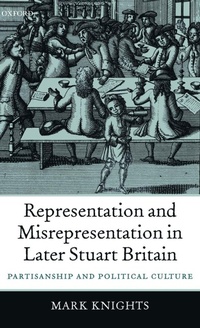
Representation and Misrepresentation in Later Stuart Britain
Partisanship and Political Culture
Published on 24. March 2005
Book
Hardback
448 pages
978-0-19-925833-8 (ISBN)
Description
In this original and illuminating study, Mark Knights reveals how the political culture of the eighteenth century grew out of earlier trends and innovations. Arguing that the period 1675-1720 needs to be seen as the second stage of a seventeenth-century revolution that ran on until c.1720, the book traces the development of the public as an arbiter of politics, the growth of a national political culture, the shift towards a representative society, a crisis of public discourse and credibility, and a political enlightenment rooted in local and national partisan conflict.
The 'public' acquired a new status in the later Stuart period as a result of frequent elections, the lapse of pre-publication licensing, the emergence of party politics, the creation of a public debt and ideological conflict over popular sovereignty. These factors enlarged the role of the public and required it to make frequent acts of judgement. Yet contemporaries from across the political spectrum feared that the public might be misled by the misrepresentations peddled by their rivals. Each side, and those ostensibly of no side, discerned a culture of passion, slander, libel, lies, hypocrisy, dissimulation, conspiracy, private languages and fictions. 'Truth' appeared an ambiguous, political matter. But the reaction to partisanship was also creative, for it helped to construct an ideal form of political discourse. This was one based on reason rather than passion, on politeness rather than incivility, on moderation rather than partisan zeal, on critical reading rather than credulity; and the realisation of those ideals rested on infrequent rather than frequent elections.
Finding synergies between social, political, religious, scientific, literary, cultural and intellectual history, 'Representation and Misrepresentation' reinvigorates the debate about the emergence of 'the public sphere' in the later Stuart period.
The 'public' acquired a new status in the later Stuart period as a result of frequent elections, the lapse of pre-publication licensing, the emergence of party politics, the creation of a public debt and ideological conflict over popular sovereignty. These factors enlarged the role of the public and required it to make frequent acts of judgement. Yet contemporaries from across the political spectrum feared that the public might be misled by the misrepresentations peddled by their rivals. Each side, and those ostensibly of no side, discerned a culture of passion, slander, libel, lies, hypocrisy, dissimulation, conspiracy, private languages and fictions. 'Truth' appeared an ambiguous, political matter. But the reaction to partisanship was also creative, for it helped to construct an ideal form of political discourse. This was one based on reason rather than passion, on politeness rather than incivility, on moderation rather than partisan zeal, on critical reading rather than credulity; and the realisation of those ideals rested on infrequent rather than frequent elections.
Finding synergies between social, political, religious, scientific, literary, cultural and intellectual history, 'Representation and Misrepresentation' reinvigorates the debate about the emergence of 'the public sphere' in the later Stuart period.
Reviews / Votes
A remarkable study of the culture of late-seventeenth-century politics and the politics of the period's scientific, economic and literary culture. * TLS * Representation and Misrepresentation has an importance even beyond its field... Knights writes a new kind of history... Reading this book one not only appreciates a thoroughly researched, well-structured work of scholarship, but is dazzled by the possibilities it opens for a new political history. * TLS * This brilliant book deserves a wide audience. * TLS *More details
Language
English
Place of publication
Oxford
United Kingdom
Target group
Professional and scholarly
Scholars and students of Stuart literature, history, and politics.
Illustrations
32 s/w Abbildungen
32 black & white illustrations
Dimensions
Height: 222 mm
Width: 145 mm
Thickness: 30 mm
Weight
759 gr
ISBN-13
978-0-19-925833-8 (9780199258338)
Copyright in bibliographic data and cover images is held by Nielsen Book Services Limited or by the publishers or by their respective licensors: all rights reserved.
Schweitzer Classification
Other editions
Additional editions
Mark Knights
Representation and Misrepresentation in Later Stuart Britain
Partisanship and Political Culture
E-Book
09/2006
OUP eBook
€57.99
Available for download
Mark Knights
Representation and Misrepresentation in Later Stuart Britain
Partisanship and Political Culture
Book
09/2006
Oxford University Press
€96.56
Shipment within 15-20 days
Person
Mark Knights, Senior Lecturer in British History, University of East Anglia, Norwich.
Content
REPRESENTATION AND THE PUBLIC ; 1. Introduction ; 2. Public Politics ; 3. Petitions and Addresses ; 4. Informing Public Judgement at the Polls ; PUBLIC DISCOURSE AND TRUTH ; 5. The Evolution of Print Culture and the Libels of Public Discourse ; 6. Truth and Fiction in Age of Party ; 7. Consequences ; Bibliography