

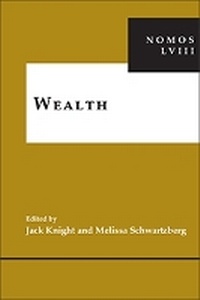
Wealth
NOMOS LVIII
Published on 2. June 2017
Book
Hardback
352 pages
978-1-4798-2700-8 (ISBN)
Description
An in-depth political, legal, and philosophical study into the implications of wealth inequality in modern societies.
Wealth, and specifically its distribution, has been a topic of great debate in recent years. Calls for justice against corporations implicated in the 2008 financial crash; populist rallying against "the one percent"; distrust of the influence of wealthy donors on elections and policy-all of these issues have their roots in a larger discussion of how wealth operates in American economic and political life.
In Wealth a distinguished interdisciplinary group of scholars in political science, law and philosophy address the complex set of questions that relate to economic wealth and its implications for social and political life in modern societies. The volume thus brings together a range of perspectives on wealth, inequality, capitalism, oligarchy, and democracy. The essays also cover a number of more specific topics including limitarianism, US Constitutional history, the wealth defense industry, slavery, and tax policy.
Wealth offers analysis and prescription including original assessment of existing forms of economic wealth and creative policy responses for the negative implications of wealth inequality. Economic wealth and its distribution is a pressing issue and this latest installment in the NOMOS series offers new and thought provoking insights.
Wealth, and specifically its distribution, has been a topic of great debate in recent years. Calls for justice against corporations implicated in the 2008 financial crash; populist rallying against "the one percent"; distrust of the influence of wealthy donors on elections and policy-all of these issues have their roots in a larger discussion of how wealth operates in American economic and political life.
In Wealth a distinguished interdisciplinary group of scholars in political science, law and philosophy address the complex set of questions that relate to economic wealth and its implications for social and political life in modern societies. The volume thus brings together a range of perspectives on wealth, inequality, capitalism, oligarchy, and democracy. The essays also cover a number of more specific topics including limitarianism, US Constitutional history, the wealth defense industry, slavery, and tax policy.
Wealth offers analysis and prescription including original assessment of existing forms of economic wealth and creative policy responses for the negative implications of wealth inequality. Economic wealth and its distribution is a pressing issue and this latest installment in the NOMOS series offers new and thought provoking insights.
More details
Series
Language
English
Place of publication
New York
United States
Target group
Professional and scholarly
Product notice
Trade binding
Dimensions
Height: 210 mm
Width: 140 mm
Weight
499 gr
ISBN-13
978-1-4798-2700-8 (9781479827008)
Copyright in bibliographic data and cover images is held by Nielsen Book Services Limited or by the publishers or by their respective licensors: all rights reserved.
Schweitzer Classification
Other editions
Additional editions
E-Book
06/2017
New York University Press
€52.99
Available for download
Persons
Jack Knight is the Frederic Cleaveland Professor of Law and Political Science at Duke University. His primary areas of interest lie at the intersection of law and politics. His major research focuses on issues in modern social and political theory, law and legal theory, and the political economy of institutions. His publications include Institutions and Social Conflict, The Choices Justices Make (with Lee Epstein), and The Priority of Democracy (with James Johnson).
Melissa Schwartzberg is Silver Professor of Politics at New York University. She is the author of Counting the Many: The Origins and Limits of Supermajority Rule and Democracy and Legal Change.
Melissa Schwartzberg is Silver Professor of Politics at New York University. She is the author of Counting the Many: The Origins and Limits of Supermajority Rule and Democracy and Legal Change.