

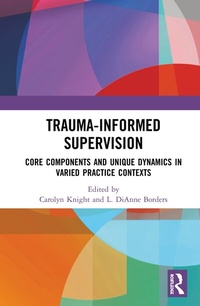
Trauma-Informed Supervision
Core Components and Unique Dynamics in Varied Practice Contexts
1st Edition
Published on 29. October 2019
Book
Hardback
254 pages
978-0-367-35280-6 (ISBN)
Description
Survivors of trauma are disproportionately represented in agencies providing a broad range of behavioral, social, and mental health services. Practitioners in these settings must understand and be able to respond to survivors of trauma in ways that are empowering, normalize and validate their experiences and reactions, and minimize the risk of retraumatization. Practitioners also will be indirectly traumatized as a result of their work with trauma survivors.
Practitioners' ability to help clients with histories of trauma depends upon clinical supervision that is trauma-informed. The trauma-informed supervisor has the dual responsibility of enhancing supervisees' skills as trauma-informed practitioners and helping them manage the impact their work has on them.
Nevertheless, many clinical supervisors only have limited knowledge and training in trauma and may not recognize either the needs of those whom they supervise or the clients their supervisees serve. This book compiles important recommendations from trauma-informed practitioners, supervisors, and researchers who share their professional reflections and personal stories based on their hands-on experiences across mental health and medical contexts.
This book was originally published as a special issue of The Clinical Supervisor.
Practitioners' ability to help clients with histories of trauma depends upon clinical supervision that is trauma-informed. The trauma-informed supervisor has the dual responsibility of enhancing supervisees' skills as trauma-informed practitioners and helping them manage the impact their work has on them.
Nevertheless, many clinical supervisors only have limited knowledge and training in trauma and may not recognize either the needs of those whom they supervise or the clients their supervisees serve. This book compiles important recommendations from trauma-informed practitioners, supervisors, and researchers who share their professional reflections and personal stories based on their hands-on experiences across mental health and medical contexts.
This book was originally published as a special issue of The Clinical Supervisor.
More details
Language
English
Place of publication
London
United Kingdom
Publishing group
Taylor & Francis Ltd
Target group
College/higher education
Professional and scholarly
Academic and Postgraduate
Dimensions
Height: 246 mm
Width: 174 mm
Weight
740 gr
ISBN-13
978-0-367-35280-6 (9780367352806)
Copyright in bibliographic data and cover images is held by Nielsen Book Services Limited or by the publishers or by their respective licensors: all rights reserved.
Schweitzer Classification
Other editions
Additional editions
Carolyn Knight | L. DiAnne Borders
Trauma-Informed Supervision
Core Components and Unique Dynamics in Varied Practice Contexts
Book
06/2021
1st Edition
Routledge
€63.10
Shipment within 10-20 days
Carolyn Knight | L. DiAnne Borders
Trauma-Informed Supervision
Core Components and Unique Dynamics in Varied Practice Contexts
E-Book
07/2020
1st Edition
Routledge
€54.99
Available for download
Carolyn Knight | L. DiAnne Borders
Trauma-Informed Supervision
Core Components and Unique Dynamics in Varied Practice Contexts
E-Book
07/2020
1st Edition
Routledge
€55.49
Available for download
Persons
Carolyn Knight is a professor of Social Work at the University of Maryland, Baltimore County, United States. She is a social worker with 30 years of experience, mostly pro bono, working individually and in groups with adult survivors of childhood trauma, particularly sexual abuse. She is the author of Introduction to Working with Adult Survivors of Childhood Trauma: Strategies and Skills (2008) and Group Therapy for Adult Survivors of Child Sexual Abuse (1996), co-editor of Group Work with Populations at Risk (with Geoffrey Grief, 4th ed., 2016), and co-author of a textbook on social work practice The life model of social work practice, 4th ed. Her recent presentations have focused on how to adopt a trauma-informed lens in clinical supervision and practice.
L. DiAnne Borders is the Burlington Industries Excellence Professor in the Counseling program at The University of North Carolina at Greensboro, United States. She teaches clinical supervision and supervises doctoral students' clinical supervision internships. Her current research focuses on supervision education and pedagogy as well as traumainformed supervision. She is the author of several books and numerous empirical and conceptual articles on clinical supervision, and serves as editor of The Clinical Supervisor.
L. DiAnne Borders is the Burlington Industries Excellence Professor in the Counseling program at The University of North Carolina at Greensboro, United States. She teaches clinical supervision and supervises doctoral students' clinical supervision internships. Her current research focuses on supervision education and pedagogy as well as traumainformed supervision. She is the author of several books and numerous empirical and conceptual articles on clinical supervision, and serves as editor of The Clinical Supervisor.
Content
Introduction - Trauma-informed supervision: Core components and unique dynamics in varied practice contexts 1. Trauma-informed supervision: Historical antecedents, current practice, and future directions 2. Trauma-informed supervision and consultation: Personal reflections 3. Child welfare supervision: Special issues related to trauma-informed care in a unique environment 4. Trauma-informed supervision: Counselors in a Level I hospital trauma center 5. Trauma-informed supervision in deployed military settings 6. The intersection of identities in supervision for trauma-informed practice: Challenges and strategies 7. A personal narrative on responding to the tragedy at Pulse in Orlando: A volunteer supervisor's perspective 8. Trauma-informed intercultural group supervision 9. When religion hurts: Supervising cases of religious abuse 10. Attending to racial trauma in clinical supervision: Enhancing client and supervisee outcomes 11. Trauma-informed supervision in the disaster context