

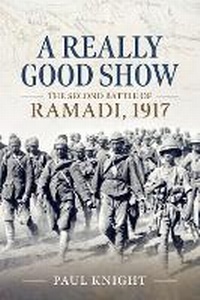
A Really Good Show
The Second Battle of Ramadi, 1917
Will be published approx. on 15. June 2026
Book
Paperback/Softback
190 pages
978-1-80451-916-5 (ISBN)
Description
How did an Anglo-Indian division, fighting its first battle, in an obscure sideshow, facing the worst environmental conditions, fight and win what is possibly the most perfectly fought battle of the First World War?
Histories of the Mesopotamia (Iraq) Campaign are overshadowed by the disaster that was the Siege of Kut. However, the battles fought before and after the Siege of Kut showed that British commanders understood the nature of conflict and had the correct tactical approach to battle. Unfortunately, the extreme environmental conditions experienced prevented the decisive blow being delivered against the enemy, resulting in further battles and further casualties.
15th (Indian) Division was a wartime raised division. It consisted of newly raised Indian battalions and British Territorial units originally sent to India to replace Regulars for service in Europe or Gallipoli.
They were supported by 6th Cavalry Brigade, another Anglo-Indian formation, Rolls-Royce armoured cars, water-carrying lorries and aviation. All the technology of 1917 came together to deliver a very modern, manoeuvrist battle.
The tactics employed used a fixing force to distract the enemy while another force conducted a flanking attack. Simultaneously, cavalry, and later armoured cars, conducted a deeper flanking move to cut off the enemy's retreat. This often required a deep move through waterless desert to the blocking position which usually had the road and river in close proximity.
Histories of the Mesopotamia (Iraq) Campaign are overshadowed by the disaster that was the Siege of Kut. However, the battles fought before and after the Siege of Kut showed that British commanders understood the nature of conflict and had the correct tactical approach to battle. Unfortunately, the extreme environmental conditions experienced prevented the decisive blow being delivered against the enemy, resulting in further battles and further casualties.
15th (Indian) Division was a wartime raised division. It consisted of newly raised Indian battalions and British Territorial units originally sent to India to replace Regulars for service in Europe or Gallipoli.
They were supported by 6th Cavalry Brigade, another Anglo-Indian formation, Rolls-Royce armoured cars, water-carrying lorries and aviation. All the technology of 1917 came together to deliver a very modern, manoeuvrist battle.
The tactics employed used a fixing force to distract the enemy while another force conducted a flanking attack. Simultaneously, cavalry, and later armoured cars, conducted a deeper flanking move to cut off the enemy's retreat. This often required a deep move through waterless desert to the blocking position which usually had the road and river in close proximity.
More details
Language
English
Place of publication
Solihull
United Kingdom
Product notice
Paperback (trade)
Unsewn / adhesive bound
Illustrations
20 b/w photos, 1 b/w map, 1 colour map, 2 charts
Dimensions
Height: 234 mm
Width: 156 mm
ISBN-13
978-1-80451-916-5 (9781804519165)
Copyright in bibliographic data and cover images is held by Nielsen Book Services Limited or by the publishers or by their respective licensors: all rights reserved.
Schweitzer Classification
Person
Paul Knight is a hugely experienced fisherman who has traveled the globe with rod and line. He has worked on offshore trawlers as well as fished idyllic salmon streams. Paul is a leading figure among UK anglers, as CEO of the Salmon and Trout Association, and contributor to a wide range of angling magazines, including Gamefisher. His wide experience, remarkable network of fishing friends and wonderful writing style make him the perfect author of such a collection of unforgettable tales.