

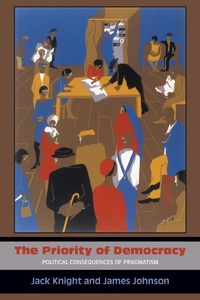
The Priority of Democracy
Political Consequences of Pragmatism
Will be published approx. on 3. November 2014
Book
Paperback/Softback
348 pages
978-0-691-16333-8 (ISBN)
Description
Pragmatism and its consequences are central issues in American politics today, yet scholars rarely examine in detail the relationship between pragmatism and politics. In The Priority of Democracy, Jack Knight and James Johnson systematically explore the subject and make a strong case for adopting a pragmatist approach to democratic politics--and for giving priority to democracy in the process of selecting and reforming political institutions. What is the primary value of democracy? When should we make decisions democratically and when should we rely on markets? And when should we accept the decisions of unelected officials, such as judges or bureaucrats? Knight and Johnson explore how a commitment to pragmatism should affect our answers to such important questions. They conclude that democracy is a good way of determining how these kinds of decisions should be made--even if what the democratic process determines is that not all decisions should be made democratically. So, for example, the democratically elected U.S. Congress may legitimately remove monetary policy from democratic decision-making by putting it under the control of the Federal Reserve.
Knight and Johnson argue that pragmatism offers an original and compelling justification of democracy in terms of the unique contributions democratic institutions can make to processes of institutional choice. This focus highlights the important role that democracy plays, not in achieving consensus or commonality, but rather in addressing conflicts. Indeed, Knight and Johnson suggest that democratic politics is perhaps best seen less as a way of reaching consensus or agreement than as a way of structuring the terms of persistent disagreement.
Knight and Johnson argue that pragmatism offers an original and compelling justification of democracy in terms of the unique contributions democratic institutions can make to processes of institutional choice. This focus highlights the important role that democracy plays, not in achieving consensus or commonality, but rather in addressing conflicts. Indeed, Knight and Johnson suggest that democratic politics is perhaps best seen less as a way of reaching consensus or agreement than as a way of structuring the terms of persistent disagreement.
Reviews / Votes
"Overall, this study is a deeply considered, well argued contribution to contemporary debates about the relationship between democratic processes and context in normative political theory."--Hussein Banai, Political Studies Review "The Priority of Democracy is the result of a long and productive partnership between two serious and seriously smart scholars. Much in the book will be familiar to readers who have been following the article trail of these two over the last 20 years. But nothing to my knowledge puts it all together into a full theory of democracy like this book. Unlike so many books these days, it is not a collection of their greatest hits marketed as a coherent whole. It is a real book that benefits from being read from beginning to end."--Simone Chambers, Perspectives on Politics "[T]he book is a significant contribution to the academic literature on democratic politics and institutional design, one that will hopefully inspire critical response and perhaps some experimentation with democratic institutions."--Shane J. Ralston, Philosophy in ReviewMore details
Language
English
Place of publication
New Jersey
United States
Target group
College/higher education
Professional and scholarly
Product notice
Paperback (trade)
Dimensions
Height: 234 mm
Width: 156 mm
Thickness: 20 mm
Weight
586 gr
ISBN-13
978-0-691-16333-8 (9780691163338)
Copyright in bibliographic data and cover images is held by Nielsen Book Services Limited or by the publishers or by their respective licensors: all rights reserved.
Schweitzer Classification
Other editions
Additional editions
E-Book
06/2015
1st Edition
Princeton University Press
from
€116.95
Available for download
Persons
Jack Knight is professor of political science and law at Duke University and the author of Institutions and Social Conflict. James Johnson is associate professor of political science at the University of Rochester and former editor of Perspectives on Politics.
Content
Preface ix Part One Chapter 1: Preliminaries 1 Chapter 2: Pragmatism and the Problem of Institutional Design 25 Chapter 3: The Appeal of Decentralization 51 Part Two Chapter 4: The Priority of Democracy and the Burden of Justification 93 Chapter 5: Reconsidering the Role of Political Argument in Democratic Politics 128 Chapter 6: Refining Reflexivity 167 Part Three Chapter 7: Formal Conditions: Institutionalizing Liberal Guarantees 193 Chapter 8: Substantive Conditions: Pragmatism and Effectiveness 222 Chapter 9: Conclusion 256 References 287 Index 307