

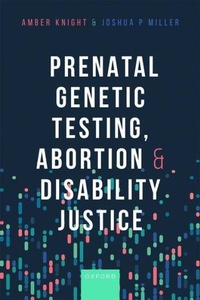
Prenatal Genetic Testing, Abortion, and Disability Justice
Published on 23. March 2023
Book
Hardback
224 pages
978-0-19-287095-7 (ISBN)
Description
The routinization of non-invasive prenatal genetic testing (NIPT) raises urgent questions about disability rights and reproductive justice. Supporters defend NIPT on the grounds that genetic information about the fetus helps would-be parents make better family planning choices. Prenatal Genetic Testing, Abortion, and Disability Justice challenges that assessment by exploring how NIPT can actually constrain pregnant women's options. Prospective parents must balance a complicated array of factors, including the familial, social, and financial support they can reasonably expect to receive if they choose to carry a disabled fetus to term and raise after birth, causing many pregnant women to "choose" termination.
Focusing on the US, the book explores the intent and effects of prenatal screening in connection to women's bodily autonomy and disability rights, addressing themes at the intersection of genetic medicine, policymaking, critical disabilities studies, and political theory. Knight and Miller shift debates about reprogenetics from bioethics to political practice, as well as thoroughly critiquing the neoliberal state and the eugenic technologies that support it. Providing concrete suggestions for reforming medical practice, welfare policy, and cultural norms surrounding disability, this book highlights sites of necessary reform to envision how prospective parents can make truly free choices about prenatal genetic testing and selection abortion.
Focusing on the US, the book explores the intent and effects of prenatal screening in connection to women's bodily autonomy and disability rights, addressing themes at the intersection of genetic medicine, policymaking, critical disabilities studies, and political theory. Knight and Miller shift debates about reprogenetics from bioethics to political practice, as well as thoroughly critiquing the neoliberal state and the eugenic technologies that support it. Providing concrete suggestions for reforming medical practice, welfare policy, and cultural norms surrounding disability, this book highlights sites of necessary reform to envision how prospective parents can make truly free choices about prenatal genetic testing and selection abortion.
Reviews / Votes
The authors of this book support the legality and accessibility of abortion and decry the "prenatal non-discrimination acts"...Recommended. * Choice *More details
Edition
Prenatal Genetic Testing, Abortion, an edition
Language
English
Place of publication
Oxford
United Kingdom
Target group
Professional and scholarly
Product notice
sewn/stitched
Cloth over boards
Dimensions
Height: 221 mm
Width: 160 mm
Thickness: 28 mm
Weight
476 gr
ISBN-13
978-0-19-287095-7 (9780192870957)
Copyright in bibliographic data and cover images is held by Nielsen Book Services Limited or by the publishers or by their respective licensors: all rights reserved.
Schweitzer Classification
Other editions
Additional editions
Amber Knight | Joshua Miller
Prenatal Genetic Testing, Abortion, and Disability Justice
E-Book
03/2023
1st Edition
OUP eBook
€59.99
Available for download
Amber Knight | Joshua Miller
Prenatal Genetic Testing, Abortion, and Disability Justice
E-Book
02/2023
1st Edition
OUP eBook
€59.99
Available for download
Persons
Amber Knight is an Associate Professor of Political Science and Public Administration at the University of North Carolina at Charlotte. Her research interests include feminist theory, critical disability studies, beiothics, and contemporary political philosophy.
Joshua P. Miller is an Assistant Teaching Professor of Political Science and Public Administration at the University of North Carolina at Charlotte. His research and teaching interests include feminist political theory, applied ethics, and the history of political thought.
Joshua P. Miller is an Assistant Teaching Professor of Political Science and Public Administration at the University of North Carolina at Charlotte. His research and teaching interests include feminist political theory, applied ethics, and the history of political thought.
Author
Associate Professor of Political Science and Public AdministrationAssociate Professor of Political Science and Public Administration, University of North Carolina at Charlotte
Assistant Teaching Professor of Political Science and Public AdministrationLecturer of Political Science and Public Administration, University of North Carolina at Charlotte
Content
Section I: Theory
1: Autonomy in Political Theory
2: Reproductive Autonomy and Genomic Medicine
Section II. Applications
3: The Healthcare System
4: The Neoliberal Welfare State
5: Ableist and Sexist Society
1: Autonomy in Political Theory
2: Reproductive Autonomy and Genomic Medicine
Section II. Applications
3: The Healthcare System
4: The Neoliberal Welfare State
5: Ableist and Sexist Society