

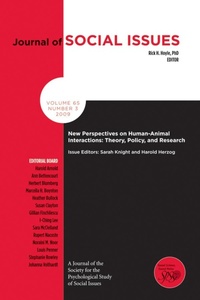
New Perspectives on Human-Animal Interactions
Theory, Policy, and Research
1st Edition
Published on 18. September 2009
Book
Paperback/Softback
208 pages
978-1-4443-3306-0 (ISBN)
Description
Animals are important in human psychological and cultural life, and our relationships with other species are psychological and morally complicated. This special issue presents a series of original research articles concerning attitudes towards animals, the ethics of their treatment, the effects of companion animals on human health and psychological well-being, and the role that culture plays in our interactions with other species. The articles illustrate the scope of the new field of human-animal relationships, the variety of research approaches, and the implications of research findings for social policy.
More details
Series
Language
English
Place of publication
Hoboken
United Kingdom
Publishing group
John Wiley and Sons Ltd
Target group
Professional and scholarly
Product notice
Paperback (trade)
Unsewn / adhesive bound
Dimensions
Height: 229 mm
Width: 150 mm
Thickness: 10 mm
Weight
272 gr
ISBN-13
978-1-4443-3306-0 (9781444333060)
Copyright in bibliographic data and cover images is held by Nielsen Book Services Limited or by the publishers or by their respective licensors: all rights reserved.
Schweitzer Classification
Persons
Sarah Knight is Senior Social Psychologist for the Defense Science and Technology Laboratory (Portsmouth, UK), an agency of the Ministry of Defense. She was awarded full-time bursaries from the Economic Social Research Council for her PhD project and a one year Postdoctoral Research Fellowship to study the inter-relationship between attitudes, beliefs and behavior. She has published research on attitudes toward animal use and the benefits of dog ownership in retired populations.
Harold Herzog is Professor of Psychology at Western Carolina University. His research includes studies of attitudes towards other species, the psychology of animal activism, and moral decision-making.
Harold Herzog is Professor of Psychology at Western Carolina University. His research includes studies of attitudes towards other species, the psychology of animal activism, and moral decision-making.
Content
INTRODUCTION. All Creatures Great and Small: New Perspectives on Psychology and Human-Animal Interactions (Sarah Knight and Harold Herzog).
1. FACTORS UNDERLYING OPINIONS AND THE TREATMENT OF ANIMALS.
Science versus Human Welfare? Understanding Attitudes toward Animal Use (Sarah Knight, Aldert Vrij, Kim Bard, and Doug Brandon).
2. Moral Emotions and Social Activism: The Case of Animal Rights (Harold A. Herzog and Lauren L. Golden).
3. Ethics and Animal Consciousness: How Rubber the Ethical Ruler? (Gordon M. Burghardt).
4. EFFECTS OF ANIMALS ON HUMAN HEALTH, WELL-BEING, AND SOCIAL INTERACTIONS
The Effects of Animals on Human Health and Well-Being (Deborah L. Wells).
5. Robotic Pets in Human Lives: Implications for the Human-Animal Bond and for Human Relationships with Personified Technologies (Gail F. Melson, Peter H. Kahn, Jr., Alan Beck, and Batya Friedman).
6. ANIMALS IN SOCIETY: RESEARCH, POLICY, AND PRACTICE.
People and Animals, Kindness and Cruelty: Research Directions and Policy Implications (Frank R. Ascione and Kenneth Shapiro).
7. Animal Abuse as a Sentinel for Human Violence: A Critique (Emily G. Patterson-Kane and Heather Piper).
8. Good to Pet and Eat: The Keeping and Consuming of Dogs and Cats in South Korea (Anthony L. Podberscek).
COMMENTARY.
Having Our Dogs and Eating Them Too: Why Animals Are a Social Issue.
1. FACTORS UNDERLYING OPINIONS AND THE TREATMENT OF ANIMALS.
Science versus Human Welfare? Understanding Attitudes toward Animal Use (Sarah Knight, Aldert Vrij, Kim Bard, and Doug Brandon).
2. Moral Emotions and Social Activism: The Case of Animal Rights (Harold A. Herzog and Lauren L. Golden).
3. Ethics and Animal Consciousness: How Rubber the Ethical Ruler? (Gordon M. Burghardt).
4. EFFECTS OF ANIMALS ON HUMAN HEALTH, WELL-BEING, AND SOCIAL INTERACTIONS
The Effects of Animals on Human Health and Well-Being (Deborah L. Wells).
5. Robotic Pets in Human Lives: Implications for the Human-Animal Bond and for Human Relationships with Personified Technologies (Gail F. Melson, Peter H. Kahn, Jr., Alan Beck, and Batya Friedman).
6. ANIMALS IN SOCIETY: RESEARCH, POLICY, AND PRACTICE.
People and Animals, Kindness and Cruelty: Research Directions and Policy Implications (Frank R. Ascione and Kenneth Shapiro).
7. Animal Abuse as a Sentinel for Human Violence: A Critique (Emily G. Patterson-Kane and Heather Piper).
8. Good to Pet and Eat: The Keeping and Consuming of Dogs and Cats in South Korea (Anthony L. Podberscek).
COMMENTARY.
Having Our Dogs and Eating Them Too: Why Animals Are a Social Issue.