

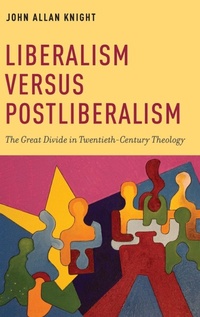
Liberalism versus Postliberalism
The Great Divide in Twentieth-Century Theology
Published on 17. January 2013
Book
Hardback
336 pages
978-0-19-996938-8 (ISBN)
Description
The divide between liberal and postliberal theology is one of the most important and far-reaching methodological disputes in twentieth-century theology. This split in the understanding of religious language is widely acknowledged, but rigorous philosophical analysis and assessment of these divergent understandings is seldom seen.
Liberalism versus Postliberalism provides such analyses, using the developments in analytic philosophy of language over the past forty years. The book provides an original analysis of the "theology and falsification" debates of the 1950s and 60s. The debates supply the philosophical lens that brings into focus the centrality of the issue of religious language in the methodological dispute between liberal and postliberal theologians in the latter part of the twentieth century. Knight argues that recent philosophical developments reveal serious problems with both positions. His philosophical work clears the ground for a more inclusive method that takes seriously the aspirations of both liberal and postliberal theologians; his book makes an important contribution to contemporary theological method, to the understanding of liberal and postliberal theologies, and to our understanding of the role of analytic philosophy in contemporary theology and religious studies.
Liberalism versus Postliberalism provides such analyses, using the developments in analytic philosophy of language over the past forty years. The book provides an original analysis of the "theology and falsification" debates of the 1950s and 60s. The debates supply the philosophical lens that brings into focus the centrality of the issue of religious language in the methodological dispute between liberal and postliberal theologians in the latter part of the twentieth century. Knight argues that recent philosophical developments reveal serious problems with both positions. His philosophical work clears the ground for a more inclusive method that takes seriously the aspirations of both liberal and postliberal theologians; his book makes an important contribution to contemporary theological method, to the understanding of liberal and postliberal theologies, and to our understanding of the role of analytic philosophy in contemporary theology and religious studies.
Reviews / Votes
There are few contemporary theological disputes more divisive and acrimonious than that referenced in Knights title, yet his book is a model of precision, analytical rigour and methodological clarity * Travis E. Ables, Theology *More details
Series
Language
English
Place of publication
New York
United States
Target group
College/higher education
Dimensions
Height: 240 mm
Width: 161 mm
Thickness: 24 mm
Weight
714 gr
ISBN-13
978-0-19-996938-8 (9780199969388)
Copyright in bibliographic data and cover images is held by Nielsen Book Services Limited or by the publishers or by their respective licensors: all rights reserved.
Schweitzer Classification
Other editions
Additional editions
E-Book
11/2012
1st Edition
OUP eBook
€43.49
Available for download
Person
John Allan Knight is Assistant Professor of Religious Studies and Coordinator of the Catholic Studies Program at Marist College. He received his Ph.D. from the University of Chicago. His essays have appeared in edited volumes and journals such as the Journal of Religion, the Scottish Journal of Theology and the American Journal of Theology and Philosophy.
Content
Table of Contents ; Acknowledgments ; Introduction ; Part One: Liberal Theology and the Falsification Challenge ; Chapter 1: Liberal Theology in the Nineteenth and Early Twentieth Centuries ; Chapter 2: The Falsification Challenge ; Chapter 3: The Liberal Response ; Chapter 4: A Purified Liberal Theology ; Part Two: Postliberal Theology and Ordinary Language Philosophy ; Chapter 5: The Barthian Project in Postliberal Perspective ; Chapter 6: Allies for Barth's Heirs: Wittgenstein and Ordinary Language Philosophy ; Chapter 7: Earlier Postliberalism: Narrative Theology and Hans Frei's Synthesis of Wittgenstein and Barth ; Chapter 8: Postliberalism II: George Lindbeck and Frei's Later Work ; Part Three: Problems and Prospects ; Chapter 9: A Tale of Two Dead Ends: The Linguistic Problems of Liberal and Postliberal Theology ; Chapter 10: Conclusion: Navigating the Divide Between Liberal and Postliberal Theology ; Bibliography