

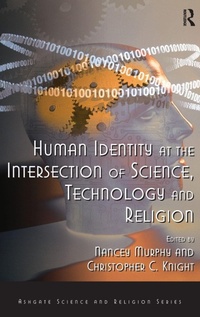
Human Identity at the Intersection of Science, Technology and Religion
1st Edition
Published on 18. October 2010
Book
Hardback
256 pages
978-1-4094-1050-8 (ISBN)
Description
Humans are unique in their ability to reflect on themselves. Recently a number of scholars have pointed out that human self-conceptions have a history. Ideas of human nature in the West have always been shaped by the interplay of philosophy, theology, science, and technology. The fast pace of developments in the latter two spheres (neuroscience, genetics, artificial intelligence, biomedical engineering) call for fresh reflections on what it means, now, to be human, and for theological and ethical judgments on how we might shape our own destiny in the future. The leading scholars in this book offer fresh contributions to the lively quest for an account of ourselves that does justice to current developments in theology, science, technology, and philosophy.
Reviews / Votes
'This is a serious and stimulating collection asking what it is to have a religious understanding of what it is to be a human in the light of modern science. I am sure that it will be of help to students and scholars alike, and will rightfully take its place on the front shelves of discussions of the relationship between science and religion.' Michael Ruse, Florida State University, USA '...anthology of profound reflections...Highly recommended. All academic, general, and professional readers.' Choice 'Taken together with recent developments in neuroscience, genetics, artificial intelligence and biomedical engineering it becomes clear that the question of Human Identity at the Intersection of Science, Technology and Religion is an urgent one. ... [This] book is well written and a very interesting reflection upon human self-conceptions.' ESSSAT NewsMore details
Series
Language
English
Place of publication
London
United Kingdom
Publishing group
Taylor & Francis Ltd
Dimensions
Height: 240 mm
Width: 161 mm
Thickness: 18 mm
Weight
552 gr
ISBN-13
978-1-4094-1050-8 (9781409410508)
Copyright in bibliographic data and cover images is held by Nielsen Book Services Limited or by the publishers or by their respective licensors: all rights reserved.
Schweitzer Classification
Other editions
Additional editions
Christopher C. Knight | Nancey Murphy
Human Identity at the Intersection of Science, Technology and Religion
Book
11/2016
1st Edition
Routledge
€85.70
Shipment within 10-20 days
Christopher C. Knight | Nancey Murphy
Human Identity at the Intersection of Science, Technology and Religion
E-Book
05/2016
Routledge
€78.99
Available for download
Christopher C. Knight | Nancey Murphy
Human Identity at the Intersection of Science, Technology and Religion
E-Book
05/2016
Routledge
€78.99
Available for download
Persons
Nancey Murphy is Professor of Philosophy at Fuller Theological Seminary, Pasadena, CA, USA; Christopher C. Knight is Executive Secretary of the International Society for Science and Religion based at Benet House, St. Edmund's College, Cambridge, UK.
Content
Preface; Introduction, Nancey Murphy; Part 1 The Limits of Religion, the Limits of Science; Chapter 1 Homo Religiosus A Theological Proposal for a Scientific and Pluralistic Age, Christopher C. Knight; Chapter 2 Religious Symbolism Engaging the Limits of Human Identification, F. LeRon Shults; Chapter 3 Fundamentalism in Science, Theology, and the Academy, George F. R. Ellis; Part 2 The Emergence of the Distinctively Human; Chapter 4 Reductionism and Emergence A Critical Perspective, Nancey Murphy; Chapter 5 Nonreductive Human Uniqueness Immaterial,Human and Artificial Intelligence A Theological Response, Noreen Herzfeld; Chapter 7 The Emergence of Morality, James W. Haag; Part 3 The Future of Human Identity; Chapter 8 What Does It Mean to Be Human? Genetics and Human Identity, Martinez Hewlett; Chapter 9 Distributed Identity, Wesley J. Wildman; Chapter 10 Without a Horse, Noah Efron; Chapter 11 From Human to Posthuman Theology and Technology, Brent Waters; Chapter 12 Can We Enhance the Imago Dei?, Ted Peters;