

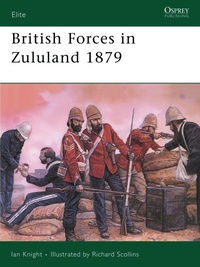
British Forces in Zululand 1879
Published on 24. January 1991
Book
Paperback/Softback
64 pages
978-1-85532-109-0 (ISBN)
Description
On 4 March, 1878 at King William's Town, British Kaffraria, Gen. Sir Arthur Cunnynghame handed over supreme command of the British forces in southern Africa to his successor, Lt. Gen. Sir Frederic Thesiger.
The High Commissioner, Sir Henry Bartle Frere, was convinced that one solution to the complex problems which beset the region was to overthrow the last powerful independent black kingdom bordering British possessions - the Zulu kingdom of King Cetshwayo KaMapande. However Cetshwayo had remained on the political defensive.
This book describes the uniforms and equipment of the forces that Thesiger led across the border to wage war in Zululand.
The High Commissioner, Sir Henry Bartle Frere, was convinced that one solution to the complex problems which beset the region was to overthrow the last powerful independent black kingdom bordering British possessions - the Zulu kingdom of King Cetshwayo KaMapande. However Cetshwayo had remained on the political defensive.
This book describes the uniforms and equipment of the forces that Thesiger led across the border to wage war in Zululand.
More details
Series
Language
English
Place of publication
United Kingdom
Publishing group
Bloomsbury Publishing PLC
Product notice
Paperback (trade)
Unsewn / adhesive bound
Illustrations
55 b/w; 10 col
Dimensions
Height: 249 mm
Width: 184 mm
Thickness: 7 mm
Weight
259 gr
ISBN-13
978-1-85532-109-0 (9781855321090)
Copyright in bibliographic data and cover images is held by Nielsen Book Services Limited or by the publishers or by their respective licensors: all rights reserved.
Schweitzer Classification
Persons
Ian Knight is widely regarded as a leading international expert on the Anglo-Zulu War. He has written, co-written or edited over 30 books, and is an Honorary Research Associate of the Natal Museum and Vice President of the Anglo Zulu War Historical Society. He has also contributed to a number of television documentaries on the war. In 2000 he was the historian advising the Glasgow University team who made the first archaeological survey of the Isandlwana battlefield.
Richard Scollins was one of the most popular artists ever to work for Osprey. He was born in 1946 and pursued a career as an artist after four years at art college and a postgraduate teaching course at Cardiff. He quickly developed a distinct style and, despite being a pacifist, he gained a feel for military subjects. His artwork was always realistic and is highly sought after by collectors. He died on 7th December 1992.
Richard Scollins was one of the most popular artists ever to work for Osprey. He was born in 1946 and pursued a career as an artist after four years at art college and a postgraduate teaching course at Cardiff. He quickly developed a distinct style and, despite being a pacifist, he gained a feel for military subjects. His artwork was always realistic and is highly sought after by collectors. He died on 7th December 1992.
Content
The Zulu War
Infantry
Infantry Uniforms
Artillery
Departmental Corps
Naval Brigades
Volunteers and Irregulars
Natal's African Troops
British Columns in Zululand, 1879
The Plates
Infantry
Infantry Uniforms
Artillery
Departmental Corps
Naval Brigades
Volunteers and Irregulars
Natal's African Troops
British Columns in Zululand, 1879
The Plates