

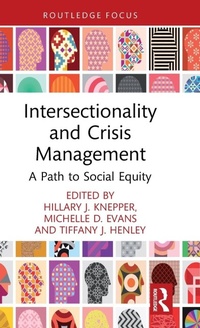
Intersectionality and Crisis Management
A Path to Social Equity
1st Edition
Published on 31. January 2023
Book
Hardback
128 pages
978-1-032-02684-8 (ISBN)
Description
Intersectionality and Crisis Management: A Path to Social Equity aims to embed the social equity discourse into crisis management while exploring the potential of a new tool, the Integrative Crisis Management Model. Leaders and managers navigate a complex and networked environment of policy-making and action, frequently occurring in real time, under constant media exposure. The pervasive availability of this news on all platforms and devices produces a lingering anxiety about the inevitability of danger. Consequently, crisis affords a time-sensitive exploration of management practices and sheds a critical spotlight on deficiencies that may yield novel approaches to doing business.
As the book engages contributing authors who are foremost in their field, it also includes practitioners, students, and junior scholars in a creative new discourse about equity. Bringing these diverse voices together in one volume presents a unique opportunity to generate new insights. Intersectionality provides a framework for understanding how categorizations of people drive social constructs of discrimination and oppression. Each chapter covers a different subject - exploring intersectionality in healthcare, nonprofit management, and human resources - and is accompanied by discussion questions. The book provides something for the classroom, for practitioners, and for scholars who want to include more intersectional thinking into their work.
Chapters 1 and 6 of this book are freely available as a downloadable Open Access PDF at http://www.taylorfrancis.com under a Creative Commons Attribution-Non Commercial-No Derivatives (CC-BY-NC-ND) 4.0 license.
As the book engages contributing authors who are foremost in their field, it also includes practitioners, students, and junior scholars in a creative new discourse about equity. Bringing these diverse voices together in one volume presents a unique opportunity to generate new insights. Intersectionality provides a framework for understanding how categorizations of people drive social constructs of discrimination and oppression. Each chapter covers a different subject - exploring intersectionality in healthcare, nonprofit management, and human resources - and is accompanied by discussion questions. The book provides something for the classroom, for practitioners, and for scholars who want to include more intersectional thinking into their work.
Chapters 1 and 6 of this book are freely available as a downloadable Open Access PDF at http://www.taylorfrancis.com under a Creative Commons Attribution-Non Commercial-No Derivatives (CC-BY-NC-ND) 4.0 license.
Reviews / Votes
"The book, weaving together topical issues from intersections of identities, disaster resilience, healthcare, human resource management, approaches by public and non-profit organizations in crisis management, and the challenge of equity, provides evidence and interesting contemporary debates. The examples offered are timely and illustrate clearly both how and why intersectionality is a critical component of effective, equitable, and fair crisis management. This text will be a must-read for both academics and practitioners in the fields of crisis/emergency management, diversity and inclusion, social equity!" Mary E. Guy, PhD, Distinguished Professor, School of Public Affairs, University of Colorado, Denver"Resilience demands cohesive communities, interwoven social fabric, and democratic strengths. Intersectionality and Crisis Management: A Path to Social Equity provides a timely and important addition to growing interdisciplinary literature. This edited volume utilizes intersectionality to better inform crisis management in building resilient communities with specific emphasis on social equity and community vulnerabilities." Naim Kapucu, PhD, Pegasus Professor, School of Public Administration & School of Politics, Security, and International Affairs, University of Central Florida
"Intersectionality and Crisis Management: A Path to Social Equity addresses important social equity issues at a time where crisis management is becoming increasingly important in public, nonprofit, and health organizations. Readers will appreciate diverse perspectives from both established and emerging scholars." Andy Crosby, PhD, Assistant Professor of Instruction, Master of Arts in Public Policy and Administration Program, Northwestern University
"Intersectionality and Crisis Management: A Path to Social Equity is a timely book given unprecedented global crises such as the pandemic, economic recession, natural and environmental disasters, etc. The book provides thought-provoking discussions on how crises expose population groups to vulnerabilities and social equity challenges. A unique contribution of the book is the incorporation of an intersectional lens to expose social equity challenges because the impact of crises are felt at varying degrees by different people. The book, weaving together topical issues from intersections of identities, disaster resilience, healthcare, human resource management, approaches by public and non-profit organizations in crisis management, and the challenge of equity, provides evidence and interesting contemporary debates. Scholars and policy practitioners will find this book of interest in managing crises across social groups for building more resilient communities." Karen Johnston, PhD, Professor of Organisational Studies at the University of Portsmouth, and Associate Dean for Research and Innovation for the Faculty of Business and Law
"Intersectionality and Crisis Management: A Path to Social Equity is an edited volume that utilizes intersectionality to better inform crisis management in building resilient communities with specific emphasis on social equity brings important insights into social equity issues at a time where crisis management is becoming increasingly important in public, nonprofit, and health organizations. Readers will appreciate diverse perspectives from both established and emerging scholars." Phin Xaypangna, Diversity, Equity & Inclusion Officer, County of Ventura, California
"This volume offers a much-needed examination of issues of race, gender, sexual orientation, ethnicity, and socioeconomic factors and the ways in which these issues play out in crisis management. The various treatments presented by the contributing authors offer a compelling and insightful case for intersectionality in crisis management. The examples offered are timely, and illustrate clearly both how and why intersectionality is a critical component of effective, equitable, and fair crisis management. This text will be a must-read for both academics and practitioners in the fields of crisis/emergency management, diversity and inclusion, social equity, and intersectionality. Highly recommended!" John C. Morris, PhD, Professor Auburn University
"The editors insert social equity discourse into crisis management and introduce the Integrative Crisis Management Model as a new tool for managers. The editors visualize society as being in a perpetual, pervasive state of emergency and put a spotlight on public planning, risk management, and crisis management. They supply definitions for terms used in the rest of the book and issue a challenge to readers to use "a critical eye toward disrupting the status quo to create more equitable practices" (p. 3). In the last chapter, the editors explore the Integrative Crisis Management Model. When a crisis occurs, the individuals, families, and communities most affected are those needing a voice in the planning process. By adding places for intersectional processes into the Crisis Management Model, the editors hope to build a path to social equity. The contributing authors are mostly academics in US higher education. All are considered experts in their field. Each chapter covers a different sector of society, has a bibliography, and includes discussion questions." L. Hickey, Austin College
More details
Series
Language
English
Place of publication
London
United Kingdom
Publishing group
Taylor & Francis Ltd
Target group
Professional and scholarly
College/higher education
Academic and Postgraduate
Illustrations
8 s/w Abbildungen, 8 s/w Zeichnungen, 5 s/w Tabellen
5 Tables, black and white; 8 Line drawings, black and white; 8 Illustrations, black and white
Dimensions
Height: 222 mm
Width: 145 mm
Thickness: 12 mm
Weight
329 gr
ISBN-13
978-1-032-02684-8 (9781032026848)
Copyright in bibliographic data and cover images is held by Nielsen Book Services Limited or by the publishers or by their respective licensors: all rights reserved.
Schweitzer Classification
Other editions
Additional editions
Hillary J. Knepper | Michelle D. Evans | Tiffany J. Henley
Intersectionality and Crisis Management
A Path to Social Equity
Book
08/2024
1st Edition
Routledge
€33.00
Shipment within 10-20 days
Hillary J. Knepper | Michelle D. Evans | Tiffany J. Henley
Intersectionality and Crisis Management
A Path to Social Equity
E-Book
01/2023
1st Edition
Routledge
€25.99
Available for download
Hillary J. Knepper | Michelle D. Evans | Tiffany J. Henley
Intersectionality and Crisis Management
A Path to Social Equity
E-Book
01/2023
1st Edition
Routledge
€25.99
Available for download
Persons
Hillary J. Knepper is a professor in the Department of Public Administration at Pace University, USA.
Michelle D. Evans is an assistant professor in the Department of Political Science and Public Service at the University of Tennessee at Chattanooga, USA.
Tiffany J. Henley is an assistant professor in the Department of Public Administration at Pace University, USA.
Michelle D. Evans is an assistant professor in the Department of Political Science and Public Service at the University of Tennessee at Chattanooga, USA.
Tiffany J. Henley is an assistant professor in the Department of Public Administration at Pace University, USA.
Content
Chapter 1 - Considering intersectionality and its implications for crisis management Chapter 2 - Understanding intersectionality and vulnerable populations: A missing part in building disaster resilient communities? Chapter 3 - Intersectionality and healthcare management: The case of crisis & COVID-19 Chapter 4 - Women falling through the cracks: Intersectionality during crisis and implications for human resource management Chapter 5 - Intersectional disparities during crisis: Improving social equity through public and nonprofit management Chapter 6 - The Integrative Crisis Management Model