

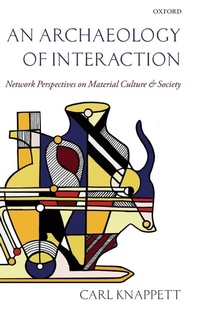
An Archaeology of Interaction
Network Perspectives on Material Culture and Society
Published on 25. August 2011
Book
Hardback
264 pages
978-0-19-921545-4 (ISBN)
Description
Think of a souvenir from a foreign trip, or an heirloom passed down the generations - distinctive individual artefacts allow us to think and act beyond the proximate, across both space and time. While this makes anecdotal sense, what does scholarship have to say about the role of artefacts in human thought? Surprisingly, material culture research tends also to focus on individual artefacts. But objects rarely stand independently from one another they are interconnected in complex constellations. This innovative volume asserts that it is such 'networks of objects' that instill objects with their power, enabling them to evoke distant times and places for both individuals and communities.
Using archaeological case studies from the Bronze Age of Greece throughout, Knappett develops a long-term, archaeological angle on the development of object networks in human societies. He explores the benefits such networks create for human interaction across scales, and the challenges faced by ancient societies in balancing these benefits against their costs. In objectifying and controlling artefacts in networks, human communities can lose track of the recalcitrant pull that artefacts exercise. Materials do not always do as they are asked. We never fully understand all their aspects. This we grasp in our everyday, unconscious working in the phenomenal world, but overlook in our network thinking. And this failure to attend to things and give them their due can lead to societal 'disorientation'.
Using archaeological case studies from the Bronze Age of Greece throughout, Knappett develops a long-term, archaeological angle on the development of object networks in human societies. He explores the benefits such networks create for human interaction across scales, and the challenges faced by ancient societies in balancing these benefits against their costs. In objectifying and controlling artefacts in networks, human communities can lose track of the recalcitrant pull that artefacts exercise. Materials do not always do as they are asked. We never fully understand all their aspects. This we grasp in our everyday, unconscious working in the phenomenal world, but overlook in our network thinking. And this failure to attend to things and give them their due can lead to societal 'disorientation'.
Reviews / Votes
The reader should come away from this book with a new appreciation for network thinking and for the complex relationships between objects (artifacts and assemblages) and things. In a practical sense, network thinking provides new ways of looking at the development of Bronze Age pottery and the spread of Minoan material culture and identity across the Aegean. As Knappett indicates ... it is a solid foundation for the future. * Michael Deal, Mouseion: Journal of the Classical Association of Canada * Carl Knappett's An Archaeology of Interaction sets the agenda for archaeological studies of networks. This volume traverses different theoretical approaches with astonishing breadth making it an important resource for archaeologists interested in applying a network perspective in their work, as well as for those more generally interested in contemporary material culture studies. * Barbara Mills, University of Arizona * Carl Knappett's book represents a milestone in the study of archaeological distribution patterns. Network analysis has in recent years become highly influential in the study of past human interaction as represented by material culture. Knappett shows, through the skilful use of a range of case-studies and theoretical standpoints, how the network approach to material culture can shed new and sometimes unexpected light on many aspects of interactions in the ancient past. * Anthony Harding, University of Exeter *More details
Language
English
Place of publication
Oxford
United Kingdom
Target group
College/higher education
Professional and scholarly
Illustrations
60 b/w in text
Dimensions
Height: 240 mm
Width: 161 mm
Thickness: 19 mm
Weight
561 gr
ISBN-13
978-0-19-921545-4 (9780199215454)
Copyright in bibliographic data and cover images is held by Nielsen Book Services Limited or by the publishers or by their respective licensors: all rights reserved.
Schweitzer Classification
Other editions
Additional editions
Book
06/2014
Oxford University Press
€60.12
Shipment within 15-20 days
Person
Professor Carl Knappett teaches in the Department of Art at the University of Toronto, where he is Walter Graham/ Homer Thompson Professor of Aegean Prehistory. His previous books include Thinking Through Material Culture: An Interdisciplinary Perspective, and Material Agency: Towards a Non-Anthropocentric Approach, the latter coedited with Lambros Malafouris. He conducts fieldwork at various Bronze Age sites across the Aegean, focussing recently on the Minoan town of Palaikastro in east Crete.
Content
PART 1; PART 2; PART 3; EPILOGUE