

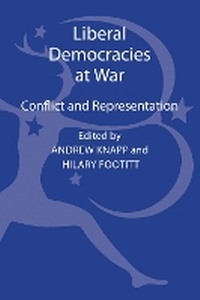
Liberal Democracies at War
Conflict and Representation
Published on 1. August 2013
Book
Hardback
264 pages
978-1-4411-4684-7 (ISBN)
Description
Liberal democracies have always accepted the need to go to war, despite the fact that war can undermine liberal values. Wars may be won or lost, not only on the battlefield, but in the perceptions of the publics who pay for them. Presentation is therefore increasingly important.
Starting with the First World War, the first major war fought by liberal democracies after the emergence on mass media, Liberal Democracies at War explores the relationship between representations of liberal violence and the ways in which the liberal state understands 'rights' in war. Experts in the field explore crucial questions such as:
? How have the violences of war perpetrated in their names been communicated to publics of liberal democracies?
? How have representations of conflict changed over time?
? How far have the victims of liberal wars been able to insert their stories into the record?
Starting with the First World War, the first major war fought by liberal democracies after the emergence on mass media, Liberal Democracies at War explores the relationship between representations of liberal violence and the ways in which the liberal state understands 'rights' in war. Experts in the field explore crucial questions such as:
? How have the violences of war perpetrated in their names been communicated to publics of liberal democracies?
? How have representations of conflict changed over time?
? How far have the victims of liberal wars been able to insert their stories into the record?
Reviews / Votes
This is an exciting and thought-provoking work. It provides examples from a range of cases from the First World war to the War on Terror, with detailed analysis of specific incidents and a generous portfolio of illustrations. * Michael Kelly, Southampton University, UK * This is a disturbing and important collection of essays. It shows how the waging of war over the past century has distorted or destroyed the conditions that make liberal democracy possible. Essential reading for anyone interested in the corrosive and enduring effects of war. -- Jay Winter, Charles J. Stille Professor of History, Yale University, USA One of the great puzzles of the past century is how liberal states can justify the way they wage war or counter-insurgency while paying lip service to democratic principles and the rule of international law. This volume succeeds admirably in showing just how morally complex or morally compromised liberal war-making can be. This is an excellent introduction to a question of perennial significance. -- Richard Overy, Professor of History, University of Exeter, UK In his great work "On War" Clausewitz pointed out that in wartime the intentions of political leaders and the plans of military commanders will always be distorted by "the passion of the peoples". The events of the last two hundred years have only shown how right he was. The greater the participation of peoples in their government, the greater the probability that public opinion, so far from moderating the conduct of war, is only likely to make it more barbarous.This excellent collection shows how, and why, this so often comes about at every level, from the political leadership to the conduct of armed forces on and behind the battlefield. It is essential reading for all who believe that the superior morality of their own societies will justify the use of military force to extend it. * Sir Michael Howard, Emeritus Professor of Modern History, University of Oxford, UK *
More details
Language
English
Place of publication
New York
United States
Publishing group
Bloomsbury Publishing Plc
Dimensions
Height: 234 mm
Width: 156 mm
Weight
540 gr
ISBN-13
978-1-4411-4684-7 (9781441146847)
DOI
CBID168920
Copyright in bibliographic data and cover images is held by Nielsen Book Services Limited or by the publishers or by their respective licensors: all rights reserved.
Schweitzer Classification
Other editions
Additional editions
E-Book
08/2013
1st Edition
Bloomsbury Academic USA
€30.99
Available for download
E-Book
08/2013
1st Edition
Bloomsbury Academic USA
€30.99
Available for download
Persons
Andrew Knapp is Professor of French Politics and Contemporary History at the University of Reading, UK.
Hilary Footitt is Senior Research Fellow at the University of Reading, UK.
Hilary Footitt is Senior Research Fellow at the University of Reading, UK.
Content
1. Introduction Andrew Knapp and Hilary Footitt
Part One: Liberal Democracies at War
2. Mapping Visual Violence in Germany, France and Britain, 1914-18 Joelle Beurier
3. The Allied Bombing Offensive in the British Media, 1942-45 Andrew Knapp
4. 'I would too, wouldn't you?' Regarding the Deaths of Others During the Vietnam War Kendrick Oliver
5. Clean War, Invisible War, Liberal War: The Clean and Dirty Politics of Guantanamo Elspeth Van Veeren
Part Two: Violence and War
6. 'At least I Stayed Decent': Invisible Violences, Interrogation and Representation in Post-War Germany Simona Tobia
7. Wartime Rape: The Politics of Making Visible Joanna Bourke
8. The Underside of 'Occupation' Hilary Footitt
Part Three: The Victims' Gaze
9. Writing War in the Enemy Tongue: Symbolism, Realism and Surrealism in Francophone Novels of Algeria's War of Independence Sara Poole
10. 'We Teach Life, Sir': States of Siege, Youth and Filmed Testimony Caroline Rooney and Rita Sakr
11. Femininity, Feminism and the Representation of Torture Sue Malvern
Index
Part One: Liberal Democracies at War
2. Mapping Visual Violence in Germany, France and Britain, 1914-18 Joelle Beurier
3. The Allied Bombing Offensive in the British Media, 1942-45 Andrew Knapp
4. 'I would too, wouldn't you?' Regarding the Deaths of Others During the Vietnam War Kendrick Oliver
5. Clean War, Invisible War, Liberal War: The Clean and Dirty Politics of Guantanamo Elspeth Van Veeren
Part Two: Violence and War
6. 'At least I Stayed Decent': Invisible Violences, Interrogation and Representation in Post-War Germany Simona Tobia
7. Wartime Rape: The Politics of Making Visible Joanna Bourke
8. The Underside of 'Occupation' Hilary Footitt
Part Three: The Victims' Gaze
9. Writing War in the Enemy Tongue: Symbolism, Realism and Surrealism in Francophone Novels of Algeria's War of Independence Sara Poole
10. 'We Teach Life, Sir': States of Siege, Youth and Filmed Testimony Caroline Rooney and Rita Sakr
11. Femininity, Feminism and the Representation of Torture Sue Malvern
Index