

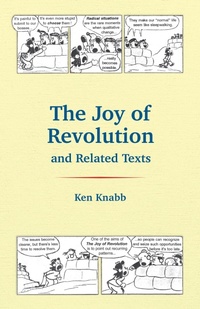
The Joy of Revolution and Related Texts
Description
It may seem absurd to talk about revolution. But all the alternatives assume the continuation of the present system, which is even more absurd.
Best known for his translations of works by Guy Debord and the Situationist International, Ken Knabb is himself the author of many incisive radical texts. The Joy of Revolution is widely considered his masterpiece. While there have been countless histories of past revolutions and countless examinations of the many flaws of the present society and the many methods proposed for reforming them, it would be difficult to name a single book that more clearly and concisely explores the problems and possibilities of a modern, situationist-type revolution.
Following a brief overview of the absurdities of the present social system and the failures of past efforts to change it, The Joy of Revolution examines the pros and cons of a wide range of radical tactics, first in the context of “normal” or “ordinary” conditions, then in the very different context of radical situations—those rare breakthroughs where masses of people start to call everything into question and real change becomes possible. The book then concludes with some speculations on how a postrevolutionary global network of culturally diverse liberated communities might work, and where we might go from there.
For this new edition, Ken has added some notes and updates to his original work and appended a number of his more recent texts—detourned comics; book reviews; a refutation of anarcho-primitivism; reports on two remarkable radical movements in France; a series of texts and talks on the Occupy movement (in which Ken was an enthusiastic participant); observations on the coronavirus shutdown; and analyses of the increasingly vicious and delirious Trump regime and the new forms of popular resistance it has inspired.
More details
Other editions
Additional editions
Person
Ken Knabb has lived in Berkeley, California, since 1965. He has translated numerous works by Guy Debord and the Situationist International, including The Society of the Spectacle. His own writings have been translated into more than a dozen languages.
Content
- Utopia or bust
- Stalinist “communism” and reformist “socialism” are merely variants of capitalism
- Representative democracy versus delegate democracy
- Irrationalities of capitalism
- Some exemplary modern revolts
- Some common objections
- Increasing dominance of the spectacle
- Personal breakthroughs
- Critical interventions
- Theory versus ideology
- Avoiding false choices and elucidating real ones
- The insurrectionary style
- Radical film
- Oppressionism versus playfulness
- The Strasbourg scandal
- The poverty of electoral politics
- Reforms and alternative institutions
- Political correctness, or equal opportunity alienation
- Drawbacks of moralism and simplistic extremism
- Advantages of boldness
- Advantages and limits of nonviolence
- Causes of social breakthroughs
- Postwar upheavals
- Effervescence of radical situations
- Popular self-organization
- The situationists in May 1968
- Workerism is obsolete, but workers’ position remains pivotal
- Wildcats and sitdowns
- Consumer strikes
- What could have happened in May 1968
- Methods of confusion and cooption
- Terrorism reinforces the state
- The ultimate showdown
- Internationalism
- Utopians fail to envision postrevolutionary diversity
- Decentralization and coordination
- Safeguards against abuses
- Consensus, majority rule, and unavoidable hierarchies
- Eliminating the roots of war and crime
- Abolishing money
- Absurdity of most present-day labor
- Transforming work into play
- Technophobic objections
- Ecological issues
- The blossoming of free communities
- More interesting problems
- Public Secrets (comic, 1998)
- The Poverty of Primitivism (2001)
- Reflections on the Uprising in France (2006)
- On the Occupy Movement (seven texts, 2011‒2012)
- Pregnant Pause: Remarks on the Corona Crisis (2020)
Index