

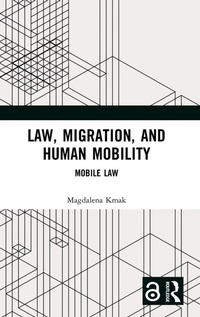
Law, Migration, and Human Mobility
Mobile Law
1st Edition
Published on 14. September 2023
Book
Hardback
194 pages
978-1-032-18524-8 (ISBN)
Description
This book analyses the multifaceted ways law operates in the context of human mobility, as well as the ways in which human mobility affects law.
Migration law is conventionally understood as a tool to regulate human movement across borders, and to define the rights and limits related to this movement. But drawing upon the emergence and development of the discipline of mobility studies, this book pushes the idea of migration law towards a more general concept of mobility that encompass the various processes, effects, and consequences of movement in a globalized world. In this respect, the book pursues a shift in perspective on how law is understood. Drawing on the concepts of 'kinology' and 'kinopolitics' developed by Thomas Nail as well as 'mobility justice' developed by Mimi Sheller, the book considers movement and motion as a constructive force behind political and social systems; and hence stability that needs to be explained and justified. Tracing the processes through which static forms, such as state, citizenship, or border, are constructed and how they partake in production of differential mobility, the book challenges the conventional understanding of migration law. More specifically, and in revealing its contingent and unstable nature, the book reveals how human mobility is itself constitutive of law.
This interdisciplinary book will appeal to those working in the areas of migration and refugee law, citizenship studies, mobility studies, legal theory, and sociolegal studies.
The Open Access version of this book, available at www.taylorfrancis.com, has been made available under a Creative Commons Attribution-Non Commercial-No Derivatives (CC-BY-NC-ND) 4.0 license. Funded by University of Helsinki and Abo Akademi University.
Migration law is conventionally understood as a tool to regulate human movement across borders, and to define the rights and limits related to this movement. But drawing upon the emergence and development of the discipline of mobility studies, this book pushes the idea of migration law towards a more general concept of mobility that encompass the various processes, effects, and consequences of movement in a globalized world. In this respect, the book pursues a shift in perspective on how law is understood. Drawing on the concepts of 'kinology' and 'kinopolitics' developed by Thomas Nail as well as 'mobility justice' developed by Mimi Sheller, the book considers movement and motion as a constructive force behind political and social systems; and hence stability that needs to be explained and justified. Tracing the processes through which static forms, such as state, citizenship, or border, are constructed and how they partake in production of differential mobility, the book challenges the conventional understanding of migration law. More specifically, and in revealing its contingent and unstable nature, the book reveals how human mobility is itself constitutive of law.
This interdisciplinary book will appeal to those working in the areas of migration and refugee law, citizenship studies, mobility studies, legal theory, and sociolegal studies.
The Open Access version of this book, available at www.taylorfrancis.com, has been made available under a Creative Commons Attribution-Non Commercial-No Derivatives (CC-BY-NC-ND) 4.0 license. Funded by University of Helsinki and Abo Akademi University.
More details
Language
English
Place of publication
London
United Kingdom
Publishing group
Taylor & Francis Ltd
Target group
College/higher education
Postgraduate and Undergraduate
Dimensions
Height: 240 mm
Width: 161 mm
Thickness: 16 mm
Weight
479 gr
ISBN-13
978-1-032-18524-8 (9781032185248)
Copyright in bibliographic data and cover images is held by Nielsen Book Services Limited or by the publishers or by their respective licensors: all rights reserved.
Schweitzer Classification
Other editions
Additional editions
Book
12/2024
1st Edition
Routledge
€63.00
Shipment within 10-20 days
E-Book
09/2023
1st Edition
Routledge
€0.00
Available for download
E-Book
09/2023
1st Edition
Routledge
€0.00
Available for download
Person
Magdalena Kmak is Professor of Public International Law, with a specialization in Migration and Minority Research, at Abo Akademi University, Finland.
Content
Introduction 1. Mobility as a quality of law 2. Mobility as a right 3. Mobility as a violation of law 4. Mobility as a resistance to law 5. Mobility as a method of legal knowledge production Conclusions