

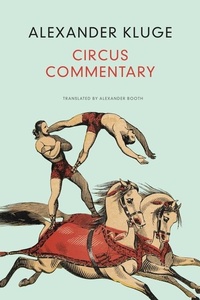
Circus Commentary
Published on 13. November 2024
Book
Hardback
208 pages
978-1-80309-324-6 (ISBN)
Description
Alexander Kluge explores the madcap, multifaceted world of the circus through a global geopolitical lens.
The circus has fascinated Alexander Kluge ever since he was a child, and his devotion to it has been preserved throughout his cinematic output and his most recent literary work. In the circus, he finds both the shadow image of work and the epitome of human excellence, from love to war to revolution. As surfaces onto which utopias are projected, these elaborate performances offer a tangible representation of developments within civilization, with its nearly infinite possibilities and sometimes inevitable crashes-from the excited roar of the crowd to death on the floor of the ring.
In Circus Commentary, Kluge's montage of modernities moves back and forth through time and space, expressing his unique mix of fictional and non-fictional reports, histories, and stories through semantic fields, images, and film sequences inserted in the book via QR codes. We encounter a broad panorama of perplexed artists and sophisticated surgeons cavorting alongside fighter pilots, sans-culottes drunk with dreams of omnipotence, and, most importantly, animals-to whose superhuman performances, this book creates a lasting memorial.
The circus has fascinated Alexander Kluge ever since he was a child, and his devotion to it has been preserved throughout his cinematic output and his most recent literary work. In the circus, he finds both the shadow image of work and the epitome of human excellence, from love to war to revolution. As surfaces onto which utopias are projected, these elaborate performances offer a tangible representation of developments within civilization, with its nearly infinite possibilities and sometimes inevitable crashes-from the excited roar of the crowd to death on the floor of the ring.
In Circus Commentary, Kluge's montage of modernities moves back and forth through time and space, expressing his unique mix of fictional and non-fictional reports, histories, and stories through semantic fields, images, and film sequences inserted in the book via QR codes. We encounter a broad panorama of perplexed artists and sophisticated surgeons cavorting alongside fighter pilots, sans-culottes drunk with dreams of omnipotence, and, most importantly, animals-to whose superhuman performances, this book creates a lasting memorial.
More details
Series
Language
English
Place of publication
Greenford
United Kingdom
Product notice
sewn/stitched
Cloth over boards
Illustrations
110 color plates
Dimensions
Height: 234 mm
Width: 155 mm
Thickness: 18 mm
Weight
386 gr
ISBN-13
978-1-80309-324-6 (9781803093246)
Copyright in bibliographic data and cover images is held by Nielsen Book Services Limited or by the publishers or by their respective licensors: all rights reserved.
Schweitzer Classification
Persons
Alexander Kluge is one of the major German fiction writers of the late twentieth century and an important social critic. As a filmmaker, he is credited with the launch of the New German Cinema movement. Alexander Booth is a writer and translator. He lives in Berlin.
Content
1. The Virus as Quick-Change Artist
2. At the Border the Animals Roared / In the Circus Tent the Lights Went Out
3. Work / Ability! Circus / Art
4. The Emergence of New York's High-Rises from Out of the Spirit of the Amusement Park
5. Curiosity for the 'Truly Wild'
6. Animals During a Bombing Campaign
7. He Saved the Dearest Thing He Possessed and at the Same Time a Rear Guard of Twelve Elephants
Notes and Sources
Image Credits
Acknowledgements
2. At the Border the Animals Roared / In the Circus Tent the Lights Went Out
3. Work / Ability! Circus / Art
4. The Emergence of New York's High-Rises from Out of the Spirit of the Amusement Park
5. Curiosity for the 'Truly Wild'
6. Animals During a Bombing Campaign
7. He Saved the Dearest Thing He Possessed and at the Same Time a Rear Guard of Twelve Elephants
Notes and Sources
Image Credits
Acknowledgements