

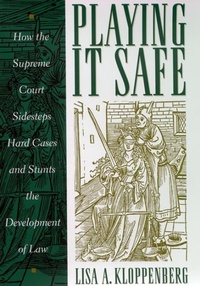
Playing It Safe
How the Supreme Court Sidesteps Hard Cases and Stunts the Development of Law
Published on 1. August 2001
Book
Hardback
320 pages
978-0-8147-4740-7 (ISBN)
Description
It is one of the unspoken truths of the American judicial system that courts go out of their way to avoid having to decide important and controversial issues. Even the Supreme Court from which the entire nation seeks guidance frequently engages in transparent tactics to avoid difficult, politically sensitive cases.
The Court's reliance on avoidance has been inconsistent and at times politically motivated. For example, liberal New Deal Justices, responding to the activism of a conservative Court, promoted deference to Congress and the presidency to protect the Court from political pressure. Likewise, as the Warren Court recognized new constitutional rights, conservative judges and critics praised avoidance as a foundational rule of judicial restraint. And as conservative Justices have constituted the majority on the Court in recent years, many liberals and moderates have urged avoidance, for fear of disagreeable verdicts.
By sharing the stories of litigants who struggled unsuccessfully to raise before the Supreme Court constitutional matters of the utmost importance from the 1970s-1990s, Playing it Safe argues that judges who fail to exercise their power in hard cases in effect abdicate their constitutional responsibility when it is needed most, and in so doing betray their commitment to neutrality. Lisa Kloppenberg demonstrates how the Court often avoids socially sensitive cases, such as those involving racial and ethnic discrimination, gender inequalities, abortion restrictions, sexual orientation discrimination, and environmental abuses. In the process, the Court ducks its responsibility to check the more politically responsive branches of government when "majority rule" pushes the boundaries of constitutional law. The Court has not used these malleable doctrines evenhandedly: it has actively shielded states from liability and national oversight, and aggressively expanded standing requirements to limit the role of federal courts.
The Court's reliance on avoidance has been inconsistent and at times politically motivated. For example, liberal New Deal Justices, responding to the activism of a conservative Court, promoted deference to Congress and the presidency to protect the Court from political pressure. Likewise, as the Warren Court recognized new constitutional rights, conservative judges and critics praised avoidance as a foundational rule of judicial restraint. And as conservative Justices have constituted the majority on the Court in recent years, many liberals and moderates have urged avoidance, for fear of disagreeable verdicts.
By sharing the stories of litigants who struggled unsuccessfully to raise before the Supreme Court constitutional matters of the utmost importance from the 1970s-1990s, Playing it Safe argues that judges who fail to exercise their power in hard cases in effect abdicate their constitutional responsibility when it is needed most, and in so doing betray their commitment to neutrality. Lisa Kloppenberg demonstrates how the Court often avoids socially sensitive cases, such as those involving racial and ethnic discrimination, gender inequalities, abortion restrictions, sexual orientation discrimination, and environmental abuses. In the process, the Court ducks its responsibility to check the more politically responsive branches of government when "majority rule" pushes the boundaries of constitutional law. The Court has not used these malleable doctrines evenhandedly: it has actively shielded states from liability and national oversight, and aggressively expanded standing requirements to limit the role of federal courts.
Reviews / Votes
A terrific examination of an unfortunately overlooked topic. What the Supreme Court doesn't decide is often as important as what it resolves. Professor Kloppenberg carefully reviews the way in which the Supreme Court has avoided crucial constitutional issues in areas ranging from environmental cases to race and gender discrimination. The book raises profound questions about proper role and procedures for the Supreme Court to follow. - Erwin Chemerinsky,USC Law Center Although there is a great deal of attention to the cases that the Supreme Court decides, there is unfortunately much less focus on what the Supreme Court does not decide, why it does not decide what it does not decide, and what the social and political implications are of the Court's frequent unwillingness to address hard and important issues. Lisa Kloppenberg has been one of our most perceptive analysts of Supreme Court avoidance of decision, and this book should be required reading for all who wish to understand the interplay between technical issues of Supreme Court jurisdiction and the substantive implications of the Court's practice of often avoiding hard cases. - Frederick Schauer,Harvard University By drawing our attention to what the Court does 'not' decideand whyLisa Kloppenberg enlarges our understanding of that institution. No student of the Supreme Court or of American constitutional law can afford to neglect the avoidance and techniques that Kloppenberg so ably describes or the dangers she sees in their overuse. - John Jeffries,Dean, University of Virginia School of Law Kloppenberg has provided the first sustained attack on the long-standing judicial practice of avoidance in at least a generation...her argument deserves careful attention. - Cass Sunstein,New Republic, 10/01 Supreme Court watchers have always known that the Court can be an artful dodger when it comes to hard cases. Lisa Kloppenberg has pulled together a startling array of such cases and demonstrates what a high price the country pays when the Court decides not to decide. Such dull legal concepts as 'abstention', 'standing', and 'federalism' take on flesh and blood dimensions when Kloppenberg shows how the Court uses those claims to thwart the claims of environmentalists, women and racial minorities. It is full of insights into the way the Court bobs and weaves its way around tough questions. And what's more, it is a good read. - Abner Mikva,Professor of Law, University of ChicagoMore details
Series
Language
English
Place of publication
New York
United States
Target group
Professional and scholarly
Product notice
Trade binding
Dimensions
Height: 236 mm
Width: 162 mm
Thickness: 25 mm
Weight
562 gr
ISBN-13
978-0-8147-4740-7 (9780814747407)
Copyright in bibliographic data and cover images is held by Nielsen Book Services Limited or by the publishers or by their respective licensors: all rights reserved.
Schweitzer Classification
Other editions
Additional editions
Lisa Kloppenberg
Playing It Safe
How the Supreme Court Sidesteps Hard Cases and Stunts the Development of Law
E-Book
08/2001
New York University Press
€38.99
Available for download
Person
Lisa A. Kloppenberg is Associate Professor of Law and Director of the Appropriate Dispute Resolution Program at the University of Oregon.