

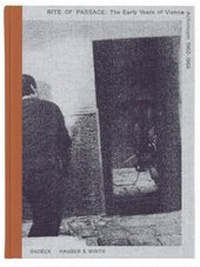
Rite of Passage
The Early Years of Vienna Acitionism 1960-1966
Published on 8. September 2014
Book
Hardback
116 pages
978-3-86442-097-9 (ISBN)
Description
A breaking point
Various developments of art in the second half of the last century have been influenced by the performative paradigm of a new concept of art that considers painting and sculpture as a directly experiential, event-like and procedural gesture. With radical actions, and emphasis on physical body-centred performance, Günter Brus, Hermann Nitsch, Otto Muehl and Rudolf Schwarzkogler played a crucial part in this paradigm shift of the 1960s. From 1960, these artists undertook a process in which the painted image was stretched to its »breaking point« - in the truest sense of the expression. Representation in the artworks of Vienna Actionists, especially in their actions, was replaced by a vehement devotion to sensual, and directly perceptible values: blood for Nitsch, junk and rubbish for Muehl, white paint sludge and meaning-laden objects for Brus, as well as the deconstruction of the compositionally controlled image for Schwarzkogler. The exhibition at Hauser & Wirth, New York, along with the publication here presented, deal with this fundamental development between 1960 and 1966 with high-quality works of painting and collage, as well as a selection of excellent vintage prints of »staged photography« by the artists.
Exhibition:
Hauser & Wirth, New York, 9/9-25/10/2014
Zerreißprobe
Das performative Paradigma eines neuen Kunstbegriffs, das Malerei und Skulptur als unmittelbar erfahrbare, ereignishafte und prozessuale Geste denkt, hat die Entwicklungen der Künste in der zweiten Hälfte des letzten Jahrhunderts geprägt. Mit ihren radikalen, den performativen Körper betonenden Aktionen haben Günter Brus, Hermann Nitsch, Otto Muehl und Rudolf Schwarzkogler in den entscheidenden 1960er Jahren großen Anteil an diesem Paradigmenwechsel. Ab 1960 durchlaufen diese Künstler einen Prozess, bei dem das gemalte Bild einer »Zerreißprobe« im wahrsten Sinne des Wortes ausgesetzt wird. An die Stelle der Repräsentation tritt bei den Kunstobjekten und vor allem bei den Aktionen eine vehemente Hinwendung zu sinnlich direkt wahrnehmbaren Werten. Blut bei Nitsch, Schrott und Abfall bei Muehl, weißer Farbschlamm und Objekte als Symbolträger bei Brus - auch bei Schwarzkogler wird das kompositorisch kontrollierte Bild dekonstruiert. Die Ausstellung bei Hauser & Wirth, New York, und die hier vorliegende Publikation thematisieren diese grundlegende Entwicklung in den Jahren 1960-1966 anhand hochwertiger Werke im Bereich der Malerei und Collage sowie mit einer Zusammenstellung erstklassiger Vintageprints aus dem aktionsfotografischen Werk der Künstler.
Various developments of art in the second half of the last century have been influenced by the performative paradigm of a new concept of art that considers painting and sculpture as a directly experiential, event-like and procedural gesture. With radical actions, and emphasis on physical body-centred performance, Günter Brus, Hermann Nitsch, Otto Muehl and Rudolf Schwarzkogler played a crucial part in this paradigm shift of the 1960s. From 1960, these artists undertook a process in which the painted image was stretched to its »breaking point« - in the truest sense of the expression. Representation in the artworks of Vienna Actionists, especially in their actions, was replaced by a vehement devotion to sensual, and directly perceptible values: blood for Nitsch, junk and rubbish for Muehl, white paint sludge and meaning-laden objects for Brus, as well as the deconstruction of the compositionally controlled image for Schwarzkogler. The exhibition at Hauser & Wirth, New York, along with the publication here presented, deal with this fundamental development between 1960 and 1966 with high-quality works of painting and collage, as well as a selection of excellent vintage prints of »staged photography« by the artists.
Exhibition:
Hauser & Wirth, New York, 9/9-25/10/2014
Zerreißprobe
Das performative Paradigma eines neuen Kunstbegriffs, das Malerei und Skulptur als unmittelbar erfahrbare, ereignishafte und prozessuale Geste denkt, hat die Entwicklungen der Künste in der zweiten Hälfte des letzten Jahrhunderts geprägt. Mit ihren radikalen, den performativen Körper betonenden Aktionen haben Günter Brus, Hermann Nitsch, Otto Muehl und Rudolf Schwarzkogler in den entscheidenden 1960er Jahren großen Anteil an diesem Paradigmenwechsel. Ab 1960 durchlaufen diese Künstler einen Prozess, bei dem das gemalte Bild einer »Zerreißprobe« im wahrsten Sinne des Wortes ausgesetzt wird. An die Stelle der Repräsentation tritt bei den Kunstobjekten und vor allem bei den Aktionen eine vehemente Hinwendung zu sinnlich direkt wahrnehmbaren Werten. Blut bei Nitsch, Schrott und Abfall bei Muehl, weißer Farbschlamm und Objekte als Symbolträger bei Brus - auch bei Schwarzkogler wird das kompositorisch kontrollierte Bild dekonstruiert. Die Ausstellung bei Hauser & Wirth, New York, und die hier vorliegende Publikation thematisieren diese grundlegende Entwicklung in den Jahren 1960-1966 anhand hochwertiger Werke im Bereich der Malerei und Collage sowie mit einer Zusammenstellung erstklassiger Vintageprints aus dem aktionsfotografischen Werk der Künstler.