

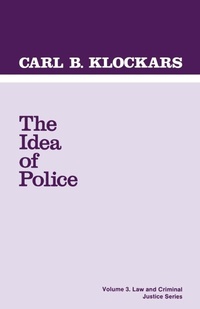
The Idea of Police
1st Edition
Published on 28. March 1985
Book
Paperback/Softback
160 pages
978-0-8039-2179-5 (ISBN)
Description
What is the best way to define the police? Why do we have police at all? In modern democracies like the United States and Great Britain, why is most policing done by employees of the state? What is the relationship between police and the law? What makes a good police officer? In addressing these questions, Klockars makes the reader look at the idea of police from a new perspective. First he explains how any definition of police must include the reality of coercive force--the fact that police officers everywhere have the right to "forcibly compel other people to do something." Next he describes the evolution of the police in the United States vis-a-vis the police in Great Britain. After exploring the role of the detective, he highlights the moral conflicts and issues of discretion that police officers face daily. Finally, Klockars examines what makes a good police officer. "An informative introductory resource. . . may prove valuable even to graduate students." --The Social Science Journal
More details
Series
Language
English
Place of publication
Thousand Oaks
United States
Target group
Professional and scholarly
Dimensions
Height: 216 mm
Width: 140 mm
Thickness: 9 mm
Weight
216 gr
ISBN-13
978-0-8039-2179-5 (9780803921795)
Copyright in bibliographic data and cover images is held by Nielsen Book Services Limited or by the publishers or by their respective licensors: all rights reserved.
Schweitzer Classification
Other editions
Additional editions

Carl B. Klockars
The Idea of Police
Book
04/1985
1st Edition
SAGE Publications Inc
€59.62
Article exhausted; check different version
Person
Carl B. Klockars is a Professor of Criminal Justice and Sociology at the University of Delaware. A criminologist of more than thirty years experience, Prof. Klockars is the author of five books, more than fifty scholarly articles, and numerous professional papers. He has served as nationally-elected vice-president of the Police Section of the Academy of Criminal Justice Sciences and was three times elected by the members of the American Society of Criminology to serve on its Executive Board. He has also served as a lobbyist for the Maryland Sheriffs Association and as an expert witness in cases alleging police misconduct. Prof. Klockars has been a pioneer in building collaborative research relationships between police and academics. He has written extensively on professional crime, criminological theory, the moral dilemmas of policing and police use of force. With colleagues he has recently completed a study with police agencies in Charleston, S.C., Charlotte-Mecklenburg, N.C., and St. Petersburg, FL that seeks to understand the mechanisms through which police agencies may create organizational environments that enhance and encourage integrity.
Content
The Idea of Police
Varieties of Avocational Policing
Shaping the Police Vocation: Patrol
Shaping the Police Vocation: The Detective
Selective Enforcement
Good Police and Good Policing
Varieties of Avocational Policing
Shaping the Police Vocation: Patrol
Shaping the Police Vocation: The Detective
Selective Enforcement
Good Police and Good Policing